AI Agents Are Forcing Cryptographic Proofs
Succinct Labs sees ZK-proofs as the answer to AI agents that browse, buy, and make transactions on their own. NIST is also working on standardizing this privacy tech.
Key Takeaways
- Brian Trunzo of Succinct Labs says not just AI content, but also autonomous machine actions, need to be verifiable.
- He says AI detection falls short and sees zero-knowledge proofs as the only way to bring cryptographic trust back online.
- According to Trunzo, ZK-proofs are becoming more important as AI agents can direct transactions, contracts, and data exchanges.
Autonomous AI agents are creating a new challenge, according to Brian Trunzo of Succinct Labs: it is not enough to verify content anymore, machine actions need proof too. In an opinion piece, he argues that today’s internet stack is not built for a world where AI systems can browse independently, make purchases, publish content, and even act on someone else’s behalf. Trunzo says the only real way to restore trust online is through cryptographic proof, not just detection or labels.
Why Detection Falls Short
Trunzo makes his argument against the backdrop of an internet that is becoming harder to distinguish from the real thing. He points to deepfakes and synthetic war footage that spread quickly before anyone could confirm whether they were authentic. To him, that is a sign the problem is no longer limited to misleading images or videos. It now includes systems that can take actions on their own.
That is why he says the usual answer, better AI detection, is not enough. He notes that these tools can often be bypassed with blur or distortion, while the attacker still keeps the advantage. The deeper issue, Trunzo says, is that an AI agent does not leave behind a clean, chronological record that can be easily audited later.
Zero-Knowledge as a Proof Layer
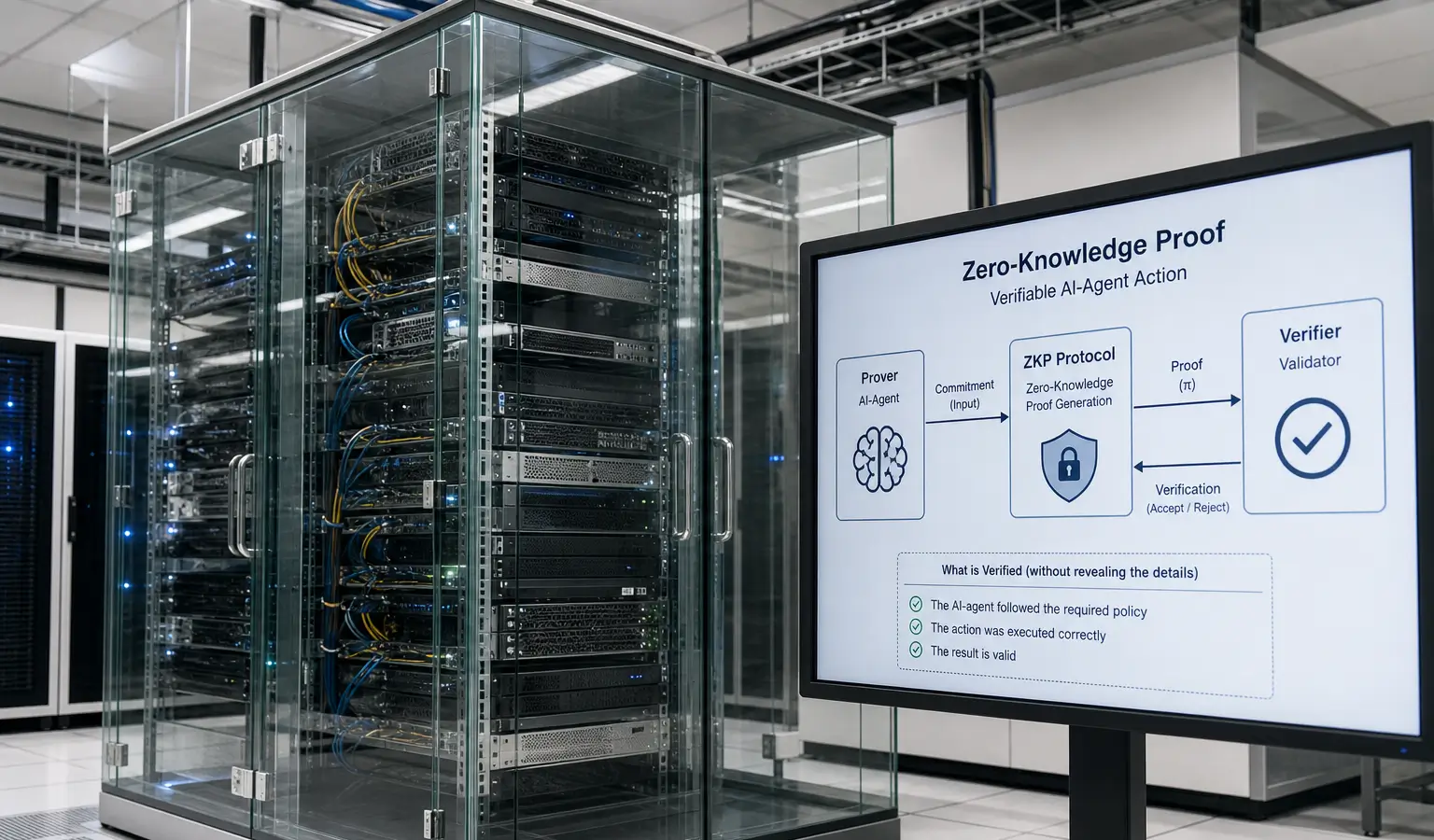
As an alternative, Trunzo points to zero-knowledge proofs, or ZK-proofs. They allow someone to prove a statement is true without exposing the underlying data. These tools have been part of crypto for years, but he says their role is now expanding into AI, where the goal is verifiable outcomes rather than just faster computation.
He outlines a few examples: a model can prove that a specific output came from a specific version, training data can be verified without revealing the data itself, and a result can be cryptographically linked to the process that produced it. He also points to the growing overlap between AI agents and blockchain technology, especially in systems that can execute transactions or run smart contracts without human input. In that setup, every autonomous action needs a way to be verified.
Why This Matters for Crypto
For European crypto and web3 readers, the main point is that Trunzo treats the AI debate as an infrastructure problem, not just a technology one. In his view, tokens are not the answer here. Proofs are. That fits a broader trend in crypto, where verifiability, privacy, and digital identity are becoming more important.
The same shift is already showing up in agentic payment products. For instance, Coinbase’s special accounts for AI bots show how quickly the market is moving toward systems where software does more than process information and can actually take action on its own.
Trunzo also says the U.S. government, through the National Institute of Standards and Technology, is working to standardize zero-knowledge within privacy-focused cryptography. That makes the discussion less theoretical and more policy-driven, especially as AI agents, in his view, become more capable of directing financial transactions, contracts, and data exchanges. For crypto, that suggests ZK technology is moving beyond a blockchain niche and into a broader building block for digital trust and control.