Bitcoin Debate Heats Up Around BIP-110 and Ordinals
BIP-110 aims to limit data storage on Bitcoin, but miners still show very little support. The fight also touches Ordinals, Bitcoin Knots, and the question of what the network should be.
Key Takeaways
- Ordinals developers say their tech will keep working if BIP-110 is introduced, despite limits on data storage in Bitcoin transactions.
- BIP-110 limits extra data to 256 bytes per part and would make inscriptions on the Bitcoin blockchain mostly unusable.
- Miner support for the soft fork is very low, which is pushing the debate over Bitcoin as money or as a data network even further.
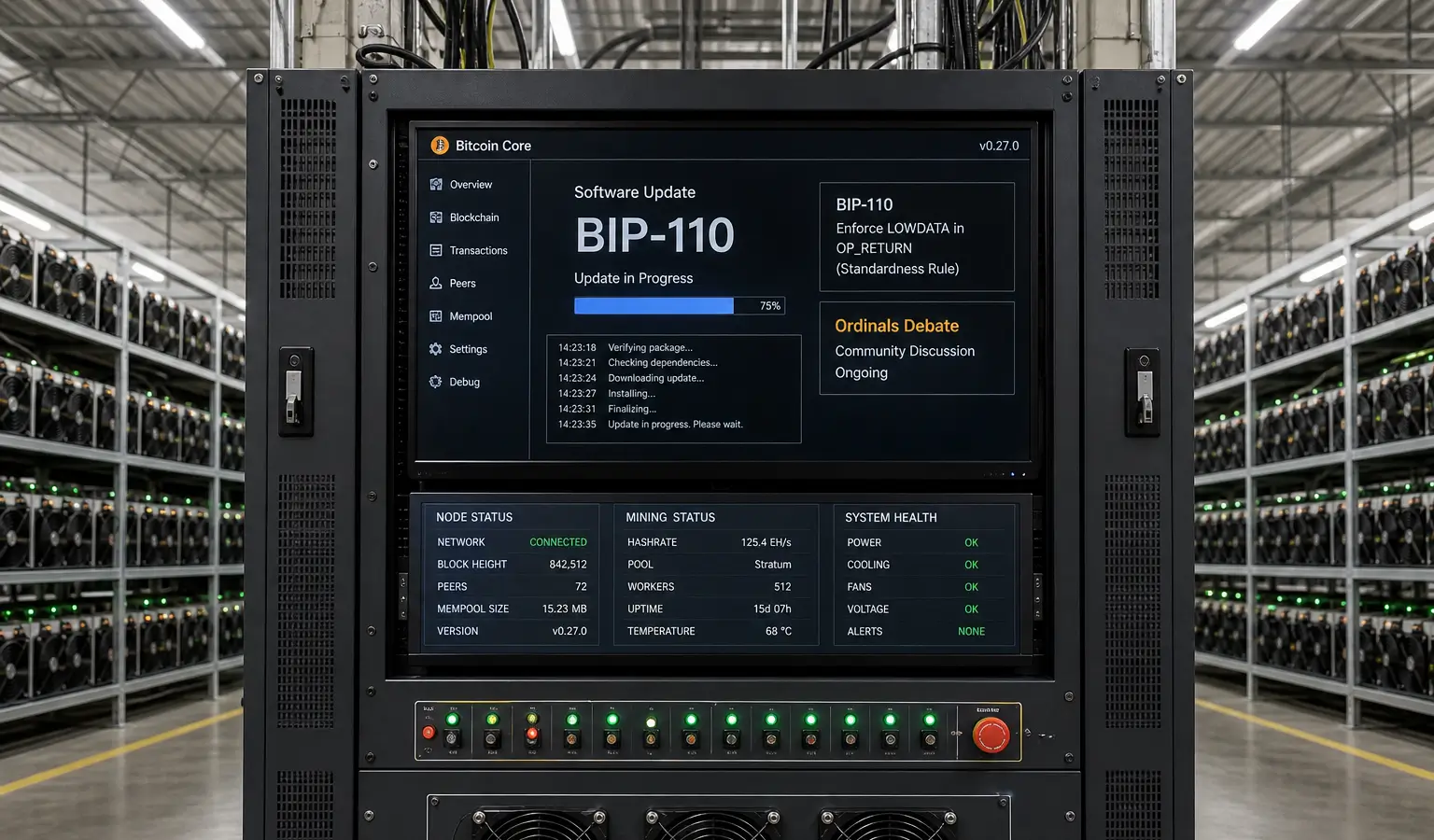
Ordinals developers say their system should still function if BIP-110 moves forward. The proposal is a soft fork designed to restrict file storage on Bitcoin. That has turned the discussion into more than a spam debate, raising a bigger question about Bitcoin’s purpose: is it mainly money, or also a place where people pay to store other kinds of data?
What BIP-110 Changes
Under BIP-110, the amount of extra data allowed in Bitcoin transactions would drop to 256 bytes per part, which is roughly the length of a short paragraph. In practice, that would make the current method used to store images and messages through inscriptions on the Bitcoin blockchain largely impractical. The change would only last for one year before shutting off automatically, and it would not affect older coins.
The proposal’s main author, who uses the pseudonym Dathon Ohm, says the goal is to temporarily steer Bitcoin back toward its monetary use case. The argument is not new. Ordinals, launched in January 2023 by Casey Rodarmor, made it possible to embed data directly into satoshis and create Bitcoin-native digital objects without sidechains or separate tokens.
Miner Support Remains Low
Miners decide the vote by adding a flag to the blocks they mine. To activate, the proposal needs 1,109 flagged blocks within a 2,016-block window, but the public monitor showed only three flagged blocks on June 30, or less than 1 percent. By the end of June, estimated support was still only about 0.31 percent of hashrate, underscoring how little broad backing the soft fork has so far.
That weak support makes the timing more delicate. Beginning in early August, nodes running the BIP-110 software will be able to reject blocks that do not include the flag, even if most miners do not go along. Blockstream CEO Adam Back has already warned about the risk of a fork, while MicroStrategy executive chairman Michael Saylor described the proposal as a self-created risk. In the wider debate over Bitcoin as a monetary network, there is also the question of how large treasury companies keep shifting their positions, as Strategy recently did with a new capital framework.
Why This Matters Beyond Bitcoin
For European crypto readers, this dispute is a reminder that even technical changes on Bitcoin can quickly become arguments about governance, usage, and network rules. If a soft fork focused on data storage can attract this little consensus, it shows how difficult it is to push Bitcoin in a new direction without friction. More broadly, the fight ties into a familiar crypto question: how much room should a network leave for non-monetary uses like NFTs and other data formats?
Ordinals developers are already adjusting. On July 2, developer lifofifoX posted a fix that breaks data into smaller, permitted pieces instead of using the approach BIP-110 is meant to block. Rodarmor approved the change that same day, while the other side has already put forward a counter-update for Bitcoin Knots. The next few weeks should make it clearer whether miners are quietly resisting or simply waiting to see how the debate plays out.