Bitcoin ETF Outflows Put BlackRock and Fidelity Under Pressure
Glassnode says trading in U.S. spot Bitcoin ETFs has fallen back to the lowest level of this cycle, with FBTC and IBIT as the biggest sources of outflows.

Key Takeaways
- U.S. spot Bitcoin ETFs saw about $430 million in net outflows on July 13, with Fidelity’s FBTC and BlackRock’s IBIT leading the selling.
- The 30-day average trading volume fell to about $1.25 billion, 78% below the peak and under 2024 levels.
- Bitcoin traded around $64,681; Glassnode points to $58,000 as support and $68,000 as a level for renewed institutional participation.
U.S. spot Bitcoin ETFs saw another round of heavy outflows on July 13, while trading activity in the products slipped to its lowest point in this cycle. According to Glassnode, net outflows came in at about $430 million, with Fidelity’s FBTC and BlackRock’s IBIT accounting for most of the selling.
Trading Slows Down
Glassnode says the 30-day moving average for daily trading volume in U.S. spot Bitcoin ETFs is now roughly $1.25 billion (€1.1 billion). That is 78% below the $5.8 billion (€5.1 billion) peak set in late 2025, and it is also running below 2024 levels. In the analysts’ view, this looks less like a brief pause and more like a market where investor attention has clearly moved on to other themes, including areas such as AI.
IBIT still represents the largest share of the remaining volume, but even there, activity has cooled over the past few months. The slowdown fits into a broader pattern. In June, Bitcoin logged its weakest month since the FTX collapse in 2022, helped lower by large ETF redemptions, softer institutional demand, and a macro backdrop shaped by sticky inflation and expectations for higher rates in the U.S. The brief pickup in inflows earlier this month also proved short-lived; on July 10, the market bounced after eight straight weeks of weak fund flows.
Outflows Hit Major Funds
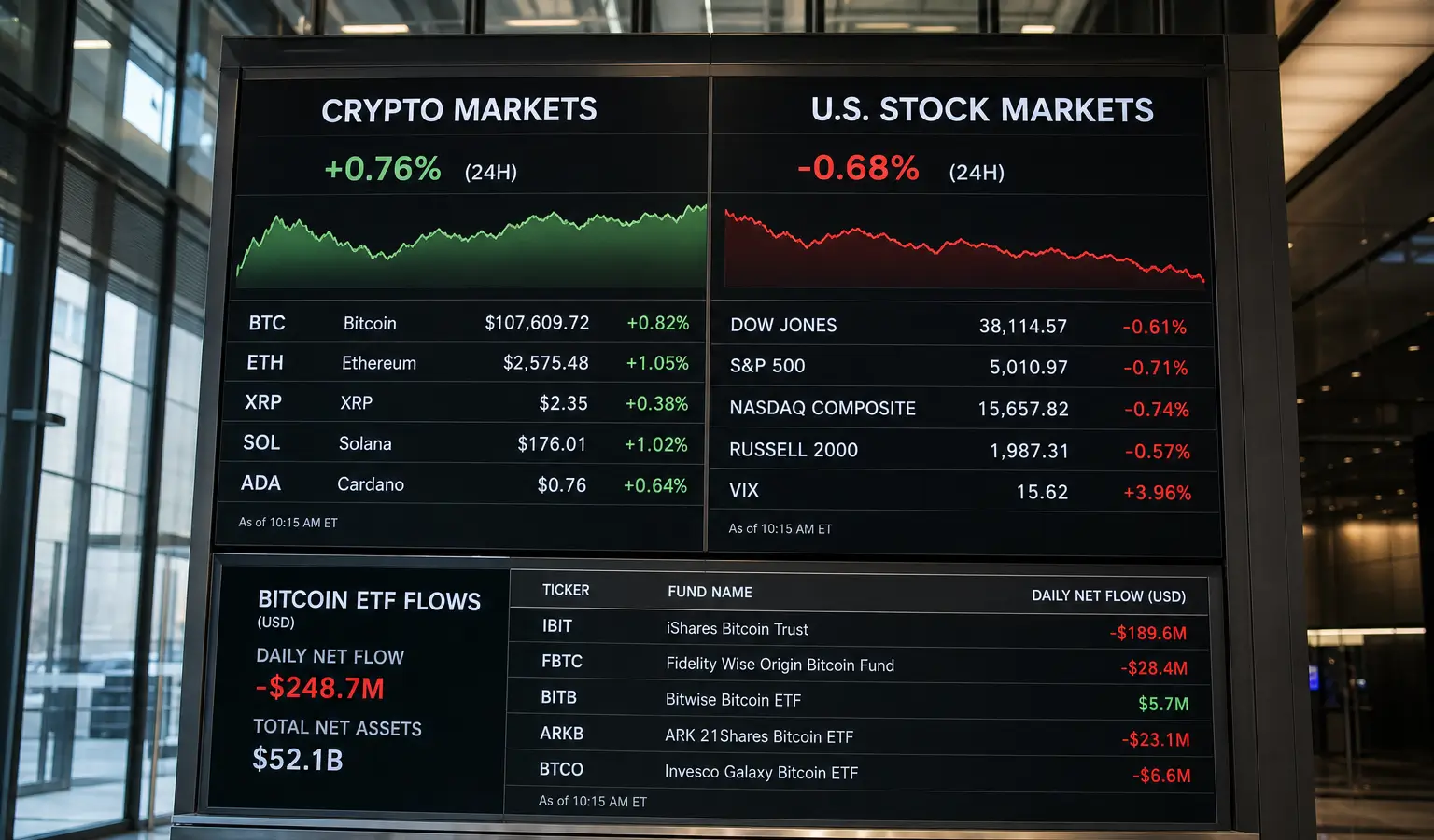
The daily breakdown painted a fairly one-sided picture. FBTC saw $246.3 million (€216 million) leave the fund, while IBIT recorded $186.1 million (€163 million) in outflows. VanEck’s HODL moved in the opposite direction with $3.5 million (€3.1 million) in inflows. Grayscale’s GBTC and Franklin Templeton’s EZBC posted smaller losses, bringing total outflows to about $430 million (€377 million).
The move stands out even more because Bitcoin funds had just brought in $197.4 million (€173 million) in net inflows in the week through July 10, ending an eight-week stretch of losses. Even so, spot Bitcoin ETFs were still down a net $5.4 billion (€4.7 billion) in the first half of 2026, marking their first negative half-year since launching in early 2024. At the same time, U.S. spot Bitcoin ETFs have still accumulated about $50.85 billion (€44.6 billion) in net inflows since launch, which shows the institutional base is still intact.
What This Means for BTC
BTC traded around $64,681 (€56,700) after gaining 4.4% over the past 24 hours. Glassnode ties the current weakness in flows to the slide from about $78,000 (€68,400) in mid-May to a low near $58,000 (€50,900) on June 30. That level remains the key support to watch, while a move back above $68,000 (€59,600) would suggest institutional participation is picking up again.
For European crypto readers, the main takeaway is that the U.S. spot Bitcoin ETF market is still one of the clearest signals for the broader crypto market. If inflows and trading volume stay weak, it suggests capital and attention may remain elsewhere for now, even though the overall ETF base is still substantial.