Bitcoin Volatility Nears a Zone That Often Precedes Price Pressure
BVIV is around 38%, a level that has often come before sharper BTC moves in the past. Spot ETF inflows and options data are keeping the market on edge for now.
Key Takeaways
- The 30-day implied volatility index BVIV is around 38%, a level that has often come before more movement and weaker Bitcoin price action.
- Bitcoin is trading just above $64,000 and has mostly been moving sideways in a tight range since last Wednesday.
- Recent inflows into spot ETFs are still limited compared with the billions that left the market over the previous eight weeks.
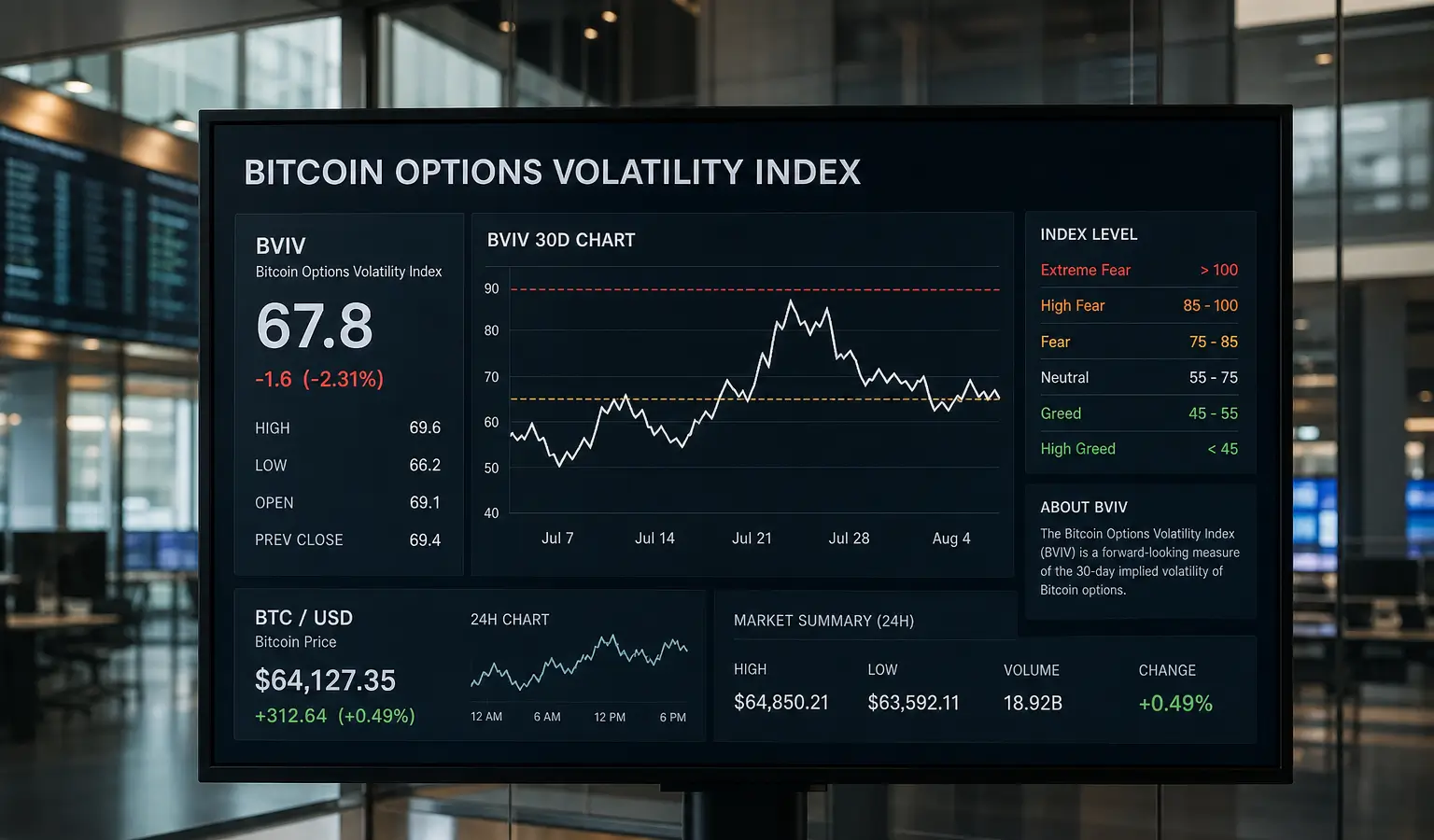
Traders are keeping a close eye on Bitcoin volatility over the next few days as a familiar pressure point comes back into view. The 30-day implied volatility index BVIV is hovering around 38%, a level that has often preceded bigger swings and softer BTC price action in past cycles.
BVIV Stays in a Sensitive Range
BVIV is often described as crypto's answer to Wall Street's VIX. It is derived from the options market and reflects how much movement traders are pricing into Bitcoin. When demand for options rises, implied volatility usually follows.
Right now, BVIV is sitting between 34% and 38%, which puts it squarely in a range that has repeatedly lined up with a pickup in volatility. At the end of May, a similar reading was followed by a sharp slide from $74,000 (€64,700) to below $60,000 (€52,500) in less than a week. A similar setup also came before a correction in early February and again after the record highs in October.
The index is also trading below both its 30-day and 200-day moving averages. In practical terms, that suggests volatility is still relatively cheap, even as the market sits near a historically important support area.
Bitcoin Remains in a Tight Range
Bitcoin is trading just above $64,000 (€56,000) and has mostly been stuck in a narrow range since last Wednesday. That makes the current stretch look calmer than the bigger swings that came before it, but traders often see this kind of quiet trading as a possible setup for a sharper move later.
Spot ETFs are another piece of the puzzle. The market has seen two straight weeks of net inflows, but those numbers are still small compared with the billions that exited over the previous eight weeks. For now, then, the recent pickup in demand is still modest relative to the earlier outflows.
Why This Matters for Europe
For European crypto investors, the setup matters because Bitcoin often leads the rest of the market. When BTC volatility picks up, it can quickly spill into altcoins, derivatives, and trading activity on European exchanges. The combination of ETF flows and options data also shows how closely the market is now tied to institutional positioning, something Dutch and other European traders are dealing with more and more. The recent shift in Bitcoin options also suggests that traders are already adjusting to higher or lower price ranges as soon as the market gets trapped in a tight band.