

Bundesbank and MAS Test CBDC Payments Without Settlement Risk
MAS and the Bundesbank tested a CBDC solution for the euro and Singapore dollar with DBS, Deutsche Bank, and Partior. The trial is meant to reduce settlement risk in cross-border FX payments.
Key Takeaways
- MAS and the Bundesbank successfully tested a cross-border payment method using wholesale CBDCs to reduce settlement risk.
- In Project Simbolon, euros and Singapore dollars changed hands through separate test environments, with DBS, Deutsche Bank, and Partior.
- The trial shows how central banks are testing blockchain-like techniques for settling real payments outside shared opening hours.
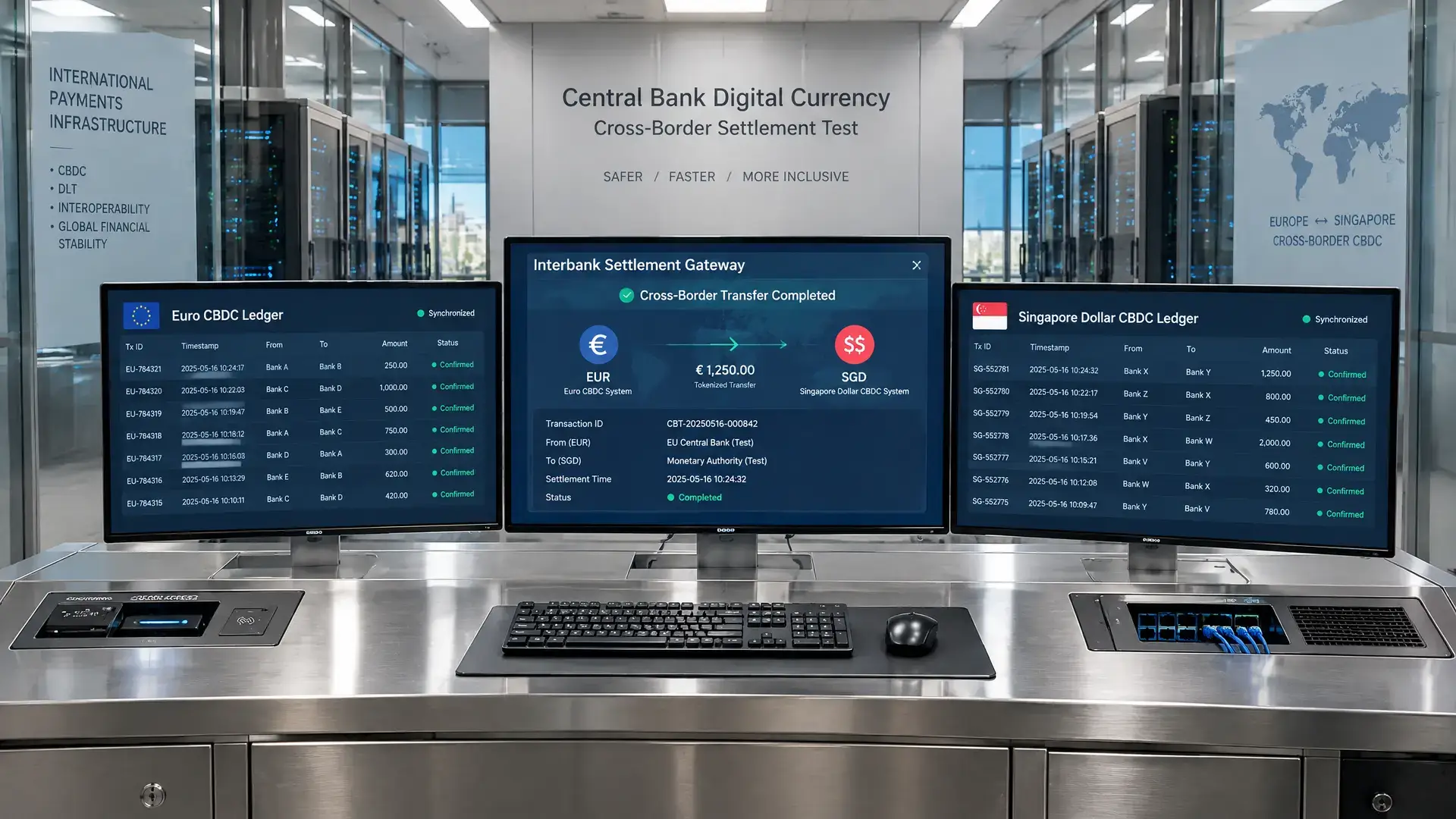
The Monetary Authority of Singapore and the Bundesbank successfully tested a cross-border payment method that reduces the risk that only one side of a transaction gets settled. In Project Simbolon, they used wholesale central bank digital currencies to exchange euros and Singapore dollars, together with DBS, Deutsche Bank, and technology company Partior.
How the Test Worked
The trial centered on two separate test environments from the central banks, without a shared platform or intermediary. With zero-knowledge proofs, each side could verify that the other payment had been locked in, without seeing the underlying data.
That matters because about 10% of daily foreign exchange trading, worth around $1.4 trillion (€1.3 trillion), still runs through processes where banks face settlement risk. That risk comes up when a bank pays out one currency but does not receive the other.
Why This Matters
For the euro and Singapore dollar, there is already a bank-owned system that settles both sides of a trade at the same time, but it only works during the limited hours when both central bank systems are open. Simbolon tested whether the central banks' own tokenized ledgers can do the same thing outside that shared window, without both systems having to run on one shared network.
Singapore is the third-largest FX hub in the world, with $1.49 trillion (€1.3 trillion) in daily trading in April 2025. About $203 billion (€184 billion) of that involved trades with the euro. The test also builds on earlier MAS experiments, including ones with the Bank of England and the Bank of Thailand, and on BIS Project Agorá, which settled about $1 million (€0.9 million) in tokenized cross-border payments in July.
Broader European Importance
For European crypto and fintech readers, this shows how central banks are testing blockchain-like techniques for real payment flows. The focus is not on speculative tokens, but on settlement infrastructure, which could matter for how future cross-border payments and tokenized assets are set up.
The ECB is also working on similar infrastructure: with Pontes, the central bank is linking tokenization systems to Eurosystem payments so institutions can settle tokenized assets in central bank money.