

Bybit Keeps $1.46 Billion Hack Report Internal
Bybit says its investigation into the attack through the Safe interface is finished, but it is withholding details to prevent new attacks. The hack was previously linked to the North Korean group TraderTraitor.
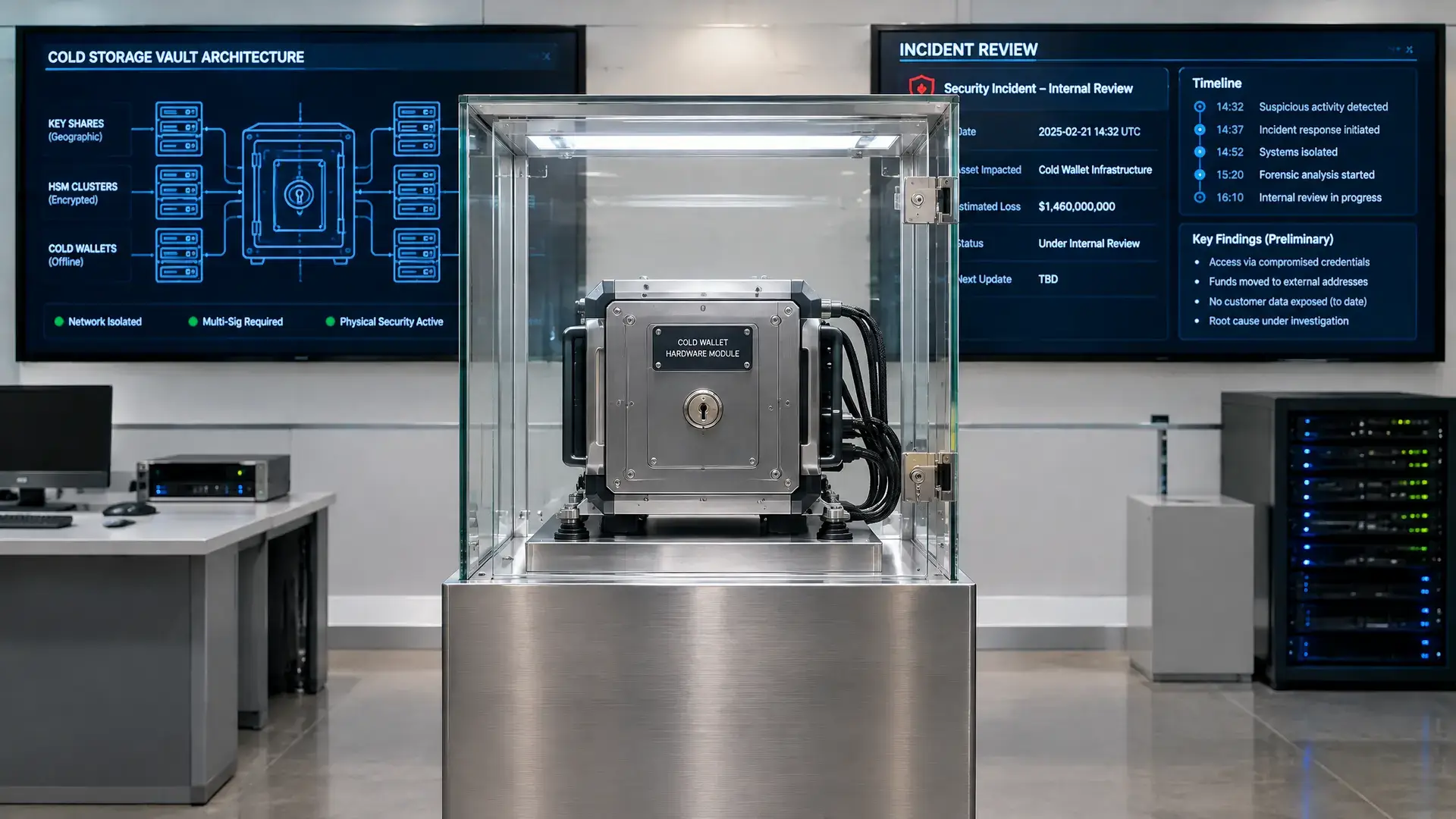
Key Takeaways
- Bybit is not making its full report on the $1.46 billion (€1.3 billion) hack public and is keeping it internal so attackers do not get extra information.
- The February 2025 attack hit Bybit's cold wallet; earlier reports pointed to malicious code in the Safe interface, not a weakness in Bybit's infrastructure.
- Bybit has rebuilt its cold and hot wallets and says the industry is working more closely together to freeze and recover stolen funds faster.
Bybit is not making its full report public on the $1.46 billion (€1.3 billion) hack, even though the crypto company has already finished the document internally. According to CTO Rockman Zhang, the crypto exchange wants to prevent attackers from learning too much about its internal systems and processes. The February 2025 attack hit Bybit's cold wallet and led to one of the biggest thefts in the crypto market over the past year.
Report Stays Behind Closed Doors
Zhang said in an interview that the team worked through the attack step by step, from the compromised signing interface to the script the hackers inserted and the way they eventually took over the cold wallet. Still, that full reconstruction remains internal for now. Bybit had said in March 2025 that a full report would come “soon,” but the public picture still rests on preliminary reports from Sygnia Labs and Verichains.
Those earlier reports pointed to malicious code in the Safe interface used for the cold wallet. They found no weakness in Bybit's own infrastructure. Zhang is sticking to that line and says the attack came through a third party, not because of a mistake by Bybit itself.
Lessons After Binance Attack
The timing of Zhang's comments stands out, because U.S. prosecutors are now seeking to forfeit more than $1.1 billion in frozen stablecoins from the Binance hack. The FBI linked both the attack on Bybit and the one on Binance to TraderTraitor, the North Korean group the agency tracks. According to the FBI, that group often uses social engineering, like fake job applications and compromised vendors, to gain access to crypto exchanges.
Bybit says it has fully rebuilt its cold and hot wallets after the attack. The new design assumes that any part can be compromised and therefore limits what each part can do. Zhang also said an outside security firm reviewed the case. According to him, the broader industry is now helping each other more with freezing and recovering stolen funds, because attackers are getting faster and smarter.
Why This Matters
For European crypto users, this case shows how vulnerable wallet processes still are, even at large and well-known crypto exchanges. At the same time, it makes clear why companies sometimes share less detail than investors might want: too much technical information can also be useful for new attacks. That tension between transparency and security is playing a bigger role in the industry more and more.