

Canaan Uses Bitcoin for Share Buyback After Revenue Drop
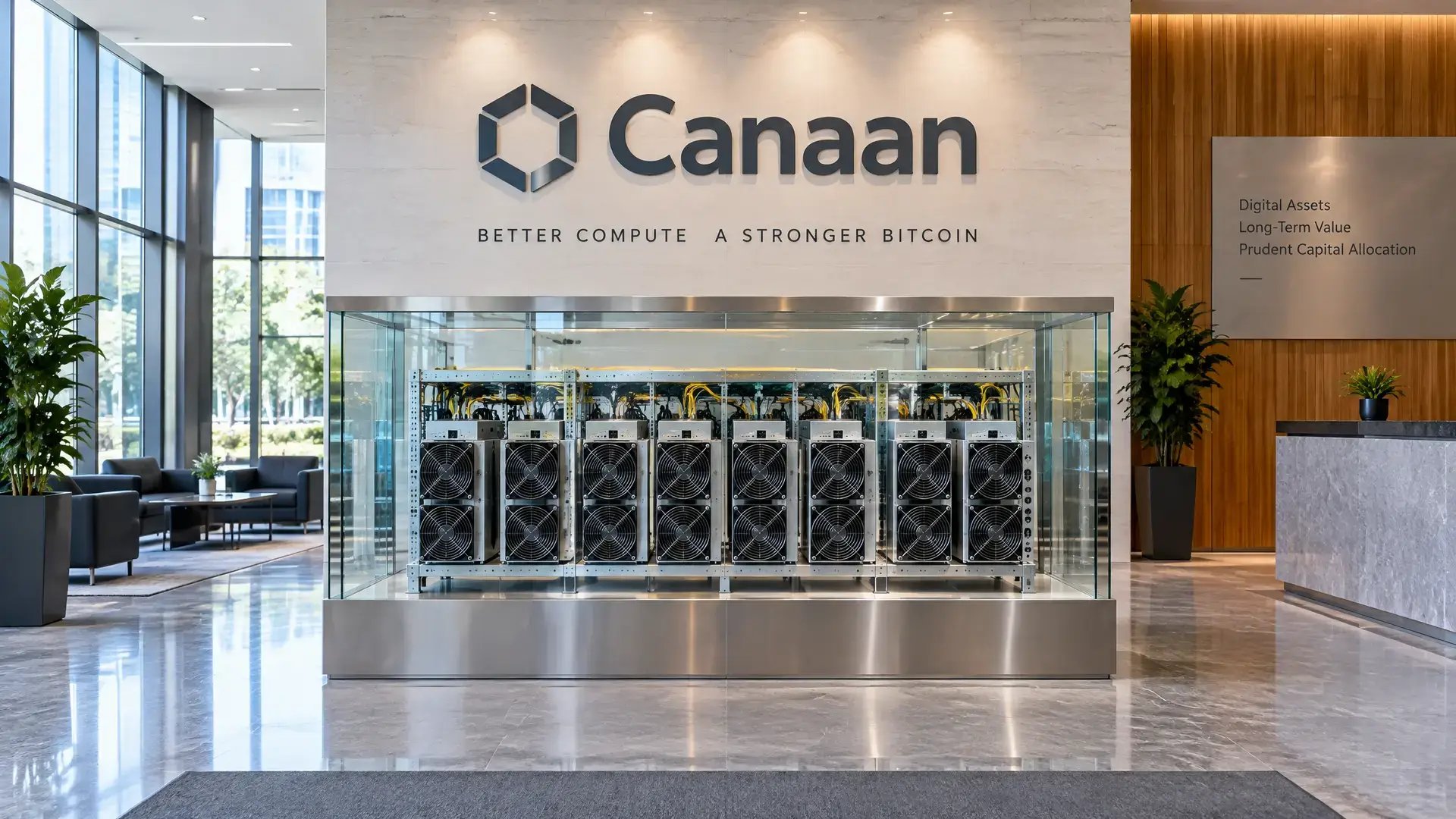
The miner is using part of its Bitcoin stash to fund a $20 million buyback program, while hardware revenue fell sharply in the third quarter.
Key Takeaways
- Canaan launched a $20 million share buyback program under a broader $100 million authorization.
- Hardware revenue fell to $4.8 million in the third quarter, down 96% year over year.
- The company sold 3,952 ETH and 54.5 BTC in October to partly fund the repurchase of its own shares.
Bitcoin miner Canaan is using its crypto reserves to buy back its own shares as sales of mining equipment have slumped sharply. The crypto company launched a $20 million buyback program on Tuesday under a broader $100 million (€89.9 million) authorization. At the same time, hardware revenue in the third quarter fell to $4.8 million (€4.3 million), down 96% from a year earlier.
Revenue From Rigs Collapses
Canaan said weak demand and lower selling prices weighed on hardware revenue. Its own mining operations brought in $9.5 million (€8.5 million) in the same quarter, nearly twice as much as equipment sales. That shows how much the company’s revenue mix has shifted.
Canaan shares are down about 75% so far this year through Wednesday. According to CEO Nangeng Zhang, the company wants to hold a long-term stockpile of digital assets while selectively selling crypto to help fund share buybacks.
Bitcoin Stash Partly Locked Up
Earlier reports show that Canaan sold 3,952 ETH and 54.5 BTC in October for about $13.9 million (€12.5 million). Of that, $5.4 million (€4.9 million) was used to buy back 13.6 million American depositary shares, the securities that represent the company’s Nasdaq listing.
At the end of September, Canaan held 1,875.5 BTC. Of that, 1,258 BTC was pledged as collateral for loans and 100 BTC was placed in a fixed product. The remaining 517.5 BTC sat directly on the balance sheet as crypto assets, worth $43.7 million (€39.3 million) at the end of the quarter.
Pressure on Miners Remains High
Canaan’s situation fits into a broader trend among Bitcoin miners. More and more players are looking beyond mining for income from AI and high-performance computing, because margins are under pressure. In the first half of 2026, publicly traded miners together pulled about 56 EH/s of capacity out of the market, while some companies are repurposing their data centers for other computing work.
That shift is also visible at MARA, which is selling Bitcoin to fund AI infrastructure and debt reduction. For European crypto followers, that matters because it shows how miners are trying to use their existing infrastructure in different ways. For Canaan, the focus is now mainly on freeing up capital from Bitcoin and other assets while its core business stays under pressure.