Cathie Wood: AI Agents Could Drive Crypto Payments
Wood points to a new use case for crypto: AI agents that make payments on their own. BlackRock and Ethereum also come into view as infrastructure for machine-to-machine transactions.
Key Takeaways
- Cathie Wood says investors should not only follow AI models, but also pay attention to where AI agents will spend money next.
- According to Wood and other market players, AI agents could create new demand for payment networks for machine-to-machine transactions.
- Open blockchains and stablecoins are mentioned as possible infrastructure for agents that make payments on their own.
Cathie Wood says investors should not only look at AI models and developers, but also at where AI agents will spend money next. According to the ARK Invest CEO, that is becoming more important now that software not only answers questions, but also carries out tasks on its own and can make payments.
Agents as New Users
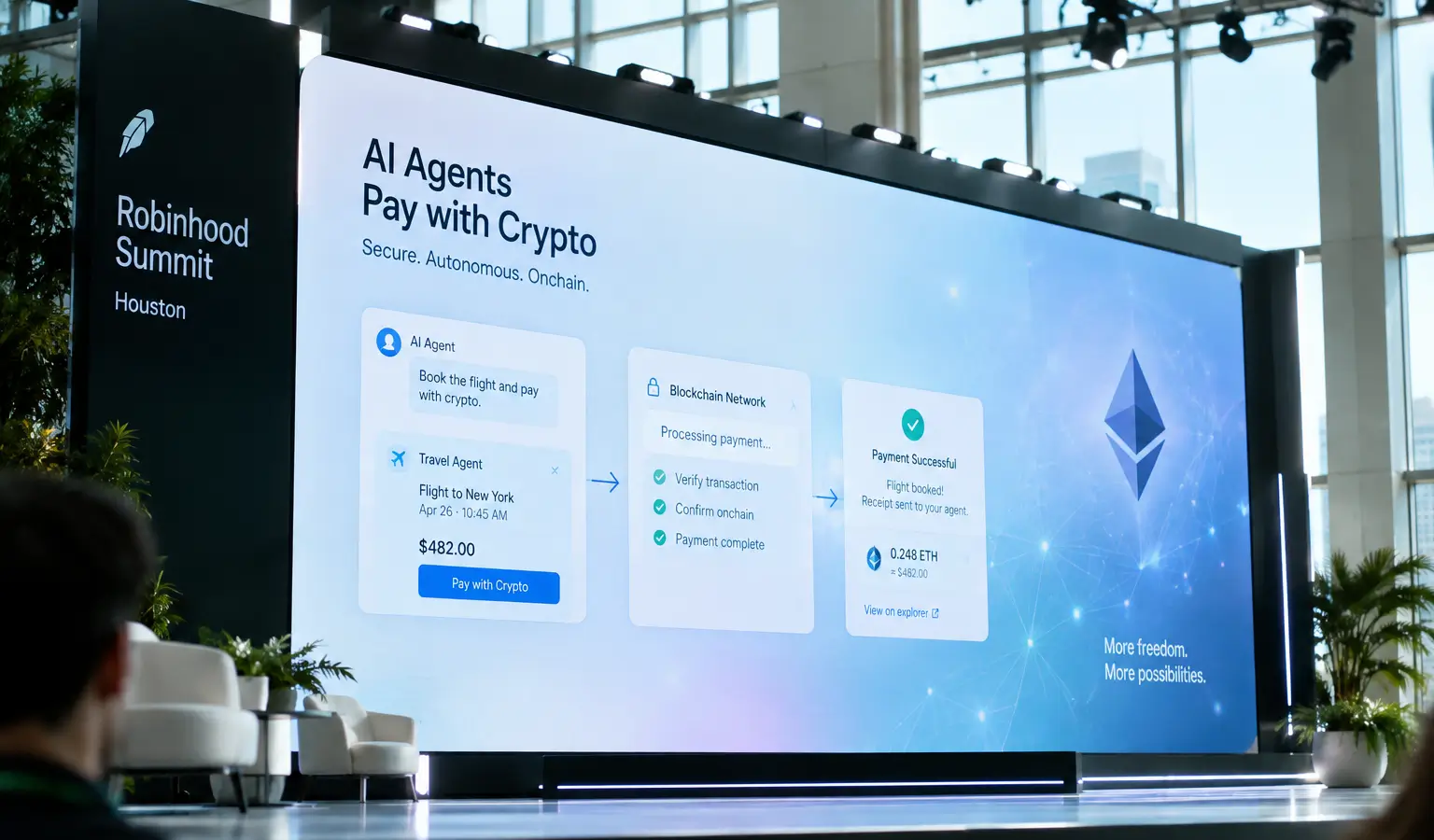
Wood made her comments during a panel at Robinhood’s Summit in Houston. She referred to AI agents, software that can act on behalf of a user instead of just generating text.
The core of her point is simple: if millions of agents start choosing software, services, and networks on their own, their behavior could show where real demand is forming. According to Wood, that makes it worth tracking not just which tools developers use, but also which agents become active and where they carry out transactions.
That shift directly raises the question of who controls the payment infrastructure for these agents. If an agent books a hotel or buys data, for example, it needs to be clear how much freedom that software gets, how that authority is limited, and how the user can take it back.
Why Crypto Comes Into View
That is exactly where Joseph Chalom, co-CEO of SharpLink and former head of digital assets at BlackRock, sees a role for crypto. In a recent post, he said that a world full of intelligent agents is not worth much if a handful of companies decide where money can go.
Chalom is pushing for an open financial network where agents can carry their identity, data, and permissions over to another provider. According to him, open blockchains like Ethereum can serve as a shared layer for that, so every company does not have to build its own closed payment system.
BlackRock drew a similar line in a paper in September. The asset manager said AI agents could create new demand for payment networks built for machines. An agent could then pay for an API call, buy data, or rent computing power without waiting for human approval every time. Stablecoins and blockchain-based payment protocols were mentioned as possible solutions.
BlackRock’s own analysis also points out that machine-native money becomes more important once agents start making payments on their own.
Why This Matters for Crypto Investors
For crypto investors, this matters mainly because it offers a new way to track stablecoin and blockchain usage. If AI agents start paying on their own more often, it could show which networks are actually being used for machine-to-machine transactions and which ones are mostly staying on the sidelines.
There are already early signs that agents are showing up in crypto. Coinbase CEO Brian Armstrong said on X that Grok is currently the main client for agentic traders on Coinbase, although he did not give any numbers. At the same time, Stripe, Visa, Google, and OpenAI are also working on ways for agents to make purchases, which shows that crypto is not the only player chasing this market.