

CFTC Nominee Raises Questions About Prediction Markets
Rowland stressed that the CFTC has to weigh the public interest when it comes to event contracts. Meanwhile, the legal fight over Kalshi, Polymarket, and state gambling laws remains unresolved.
Key Takeaways
- CFTC nominee Matthew Rowland raised questions about whether prediction markets serve the public interest.
- Rowland stressed that the regulator has to weigh the balance between the public interest and the economic usefulness of event contracts.
- The legal fight over prediction markets remains open, while states and federal regulators are locked in a direct clash.
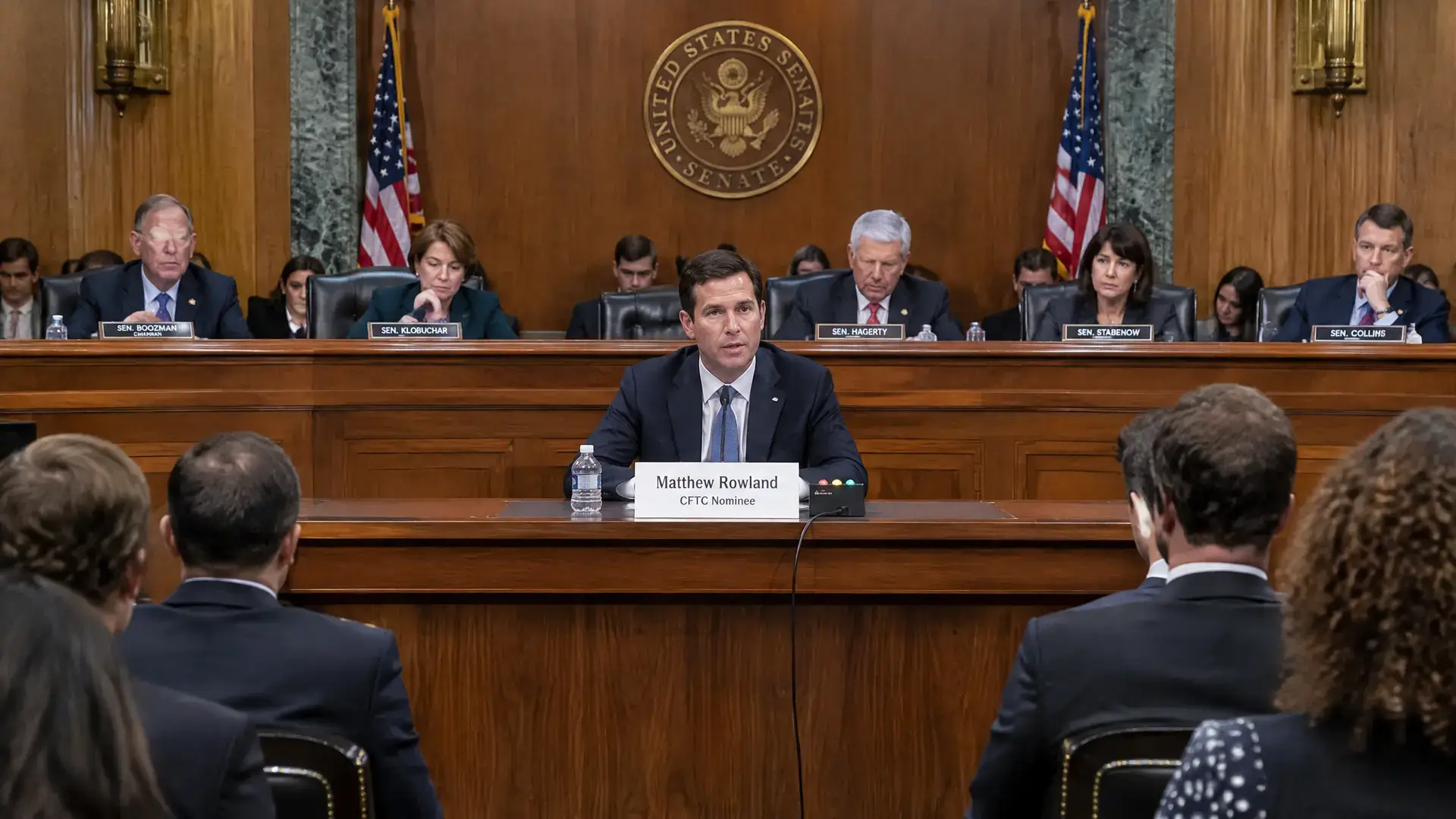
President Donald Trump’s two nominees for the Commodity Futures Trading Commission did not come out strongly against prediction markets during their hearing in the U.S. Senate. Democratic nominee Matthew Rowland did raise questions about whether this market serves the public interest, while the legal fight around the sector continues to escalate.
Public Interest Takes Center Stage
Rowland told the Senate Agriculture Committee on Tuesday that federal law tells the regulator to weigh the public interest when trading certain event contracts. In his view, the CFTC should “carefully think about the balance between the public interest and the economic usefulness of these contracts.” That put the focus on a core question that has long hovered over the sector: are prediction markets mainly a useful financial product, or mostly gambling in a new wrapper?
The sector includes platforms from Kalshi, Polymarket, Coinbase, and other exchanges regulated by the CFTC. Several states have sued those companies or imposed bans because they believe the platforms violate state gambling laws. The companies and the CFTC, on the other hand, say these are federal derivatives exchanges and therefore not an activity covered by state law. A federal judge has already sided with that view in one case, but the outcome still differs by jurisdiction.
Legal Fight Remains Open
The CFTC is also active in lawsuits to defend its authority over prediction markets. The regulator has also proposed rules specifically tailored to this emerging market. Rowland said he hopes to help with that if he is confirmed.
The other nominee, Nathan Anonick, called the legal uncertainty one reason why regulation of prediction markets remains complicated. He said he would follow any ruling from the U.S. Supreme Court if it settles the issue. Senator Tina Smith of Minnesota responded that, in her view, this is not an emotional issue but a legal one, and pointed to states’ rights to regulate sports betting.
Why This Matters
For European crypto readers, this matters because prediction markets are increasingly being grouped alongside crypto exchanges and other on-chain products in the debate over oversight and market boundaries. The outcome in the U.S. could show how far regulators can go when it comes to new trading products that sit somewhere between finance and gambling. Political ties, such as Donald Trump Jr.’s involvement in the sector, also make it clear how sensitive this issue is when it comes to regulation and conflicts of interest.
The tensions around Kalshi and similar platforms are not new: the CFTC has previously stepped in on contracts that came too close to political or personal statements. That makes the current hearing mostly another step in a longer-running fight over the limits of prediction markets.