

Cryptographers Warn of AI Risks Around Bitcoin
The new CIRG from top researchers is meant to test AI claims about code-breaking. For Bitcoin, a quantum computer remains a more realistic long-term risk than current AI models.
Key Takeaways
- A group of 21 cryptographers has formed the Cryptography Incident Review Group to assess AI claims about code-breaking.
- The group wants to advise on reporting weaknesses, informing affected parties, and cryptographic resilience.
- For Bitcoin, there is no evidence of a direct AI break-in; researchers mainly see a future threat from quantum computers.
A group of 21 leading cryptographers has set up a new organization to assess claims about code-breaking by AI and to advise on reporting weaknesses. The move comes at a time when online speculation is growing about possible breakthroughs that could undermine widely used encryption, but there is still no hard evidence for that.
New Group to Put Risks in Context
The Cryptography Incident Review Group, or CIRG, includes Stanford researcher Dan Boneh, Johns Hopkins professor Matthew Green, and MIT researchers Yael Tauman Kalai and Vinod Vaikuntanathan. The group says it wants to advise on disclosing a breach, informing affected parties, and planning for cryptographic resilience.
Vaikuntanathan warned on X on Sunday that people should not be too quick to believe unverified claims about AI. According to him, there has been a lot of speculation on social media lately about AI labs supposedly breaking cryptography, but some of those posts are wrong or heavily exaggerated. He also urged researchers to test existing systems with advanced AI models while also investing in new methods and backup systems.
Bitcoin Stays Out of the Crosshairs
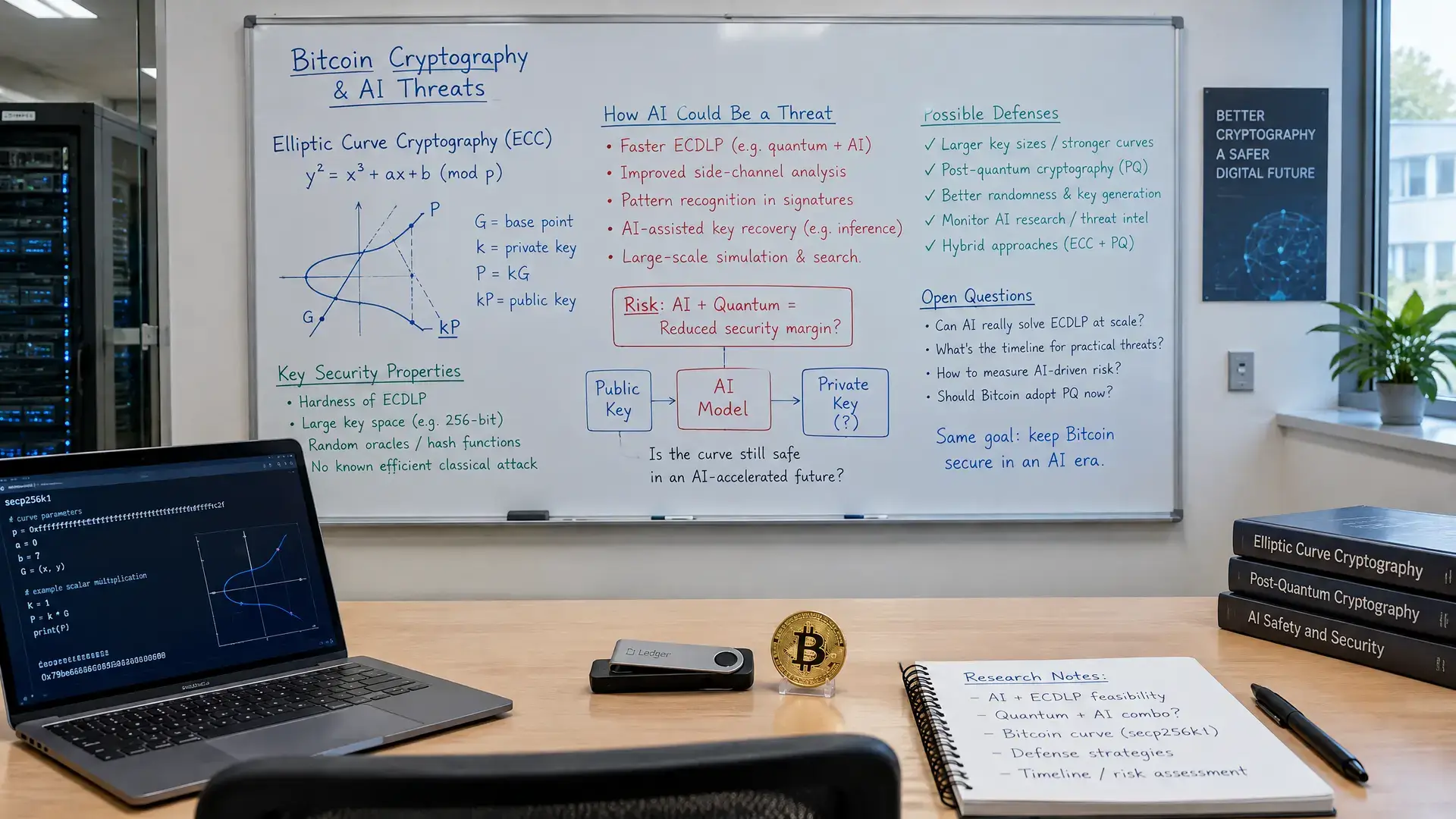
The debate partly centers on whether AI researchers have found more efficient ways to solve the math behind widely used encryption, including RSA. For Bitcoin, that is not the same as a direct break, because the network uses elliptic-curve digital signatures, and since the Taproot upgrade it also uses Schnorr signatures. Mining also relies on SHA-256.
Security researchers point out that a much more realistic risk is a powerful quantum computer. That kind of machine does not exist yet, but in theory it could derive private keys from visible public keys. In particular, wallets whose public key is already visible on the blockchain would be vulnerable. Coinbase said in a blog post on November 28 that it sees no evidence of a direct and practical threat to the cryptography that modern systems use today.
IOSCO's warning also fits into that broader discussion: the regulator said that very powerful quantum computers could affect today's financial encryption within a few years and urged firms to migrate to quantum-safe systems in time.
Why This Matters for Europe
For European crypto investors, this matters because debates about cryptography are not just about Bitcoin, but about the foundation of many wallets, exchanges, and blockchain networks. The European Commission itself already faced a cyberattack this year, showing how broadly digital security can come under pressure. At the same time, companies in the sector are already working on post-quantum solutions, because switching to new signature methods will likely require coordination among network participants over time.