Ethereum Shows Healthy Network Activity Despite Ongoing ETF Outflows
Even though Ethereum ETFs have been losing money for seven weeks, network activity remains strong. Staking demand and on-chain signals suggest investors may be rotating elsewhere.

Key Takeaways
- Ethereum fell to around $1,711, while spot Ethereum ETFs posted net outflows for the seventh week in a row.
- The Ethereum network is showing strong staking demand, with 2.68 million ETH in the entry queue versus 223,000 ETH in the exit queue.
- Smaller funds like XRP, Solana, and Hyperliquid are attracting inflows instead, pointing to rotation within the crypto market.
Ethereum (ETH) is in the middle of a pretty interesting setup: while the price dropped to around $1,711 (€1,490) and outflows from spot Ethereum ETFs keep going for a seventh straight week, the network data itself tells a different story. That contrast points to a broader rotation in the crypto market, with investors moving from the biggest funds into newer products.
Ongoing Outflows From Bitcoin and Ethereum ETFs
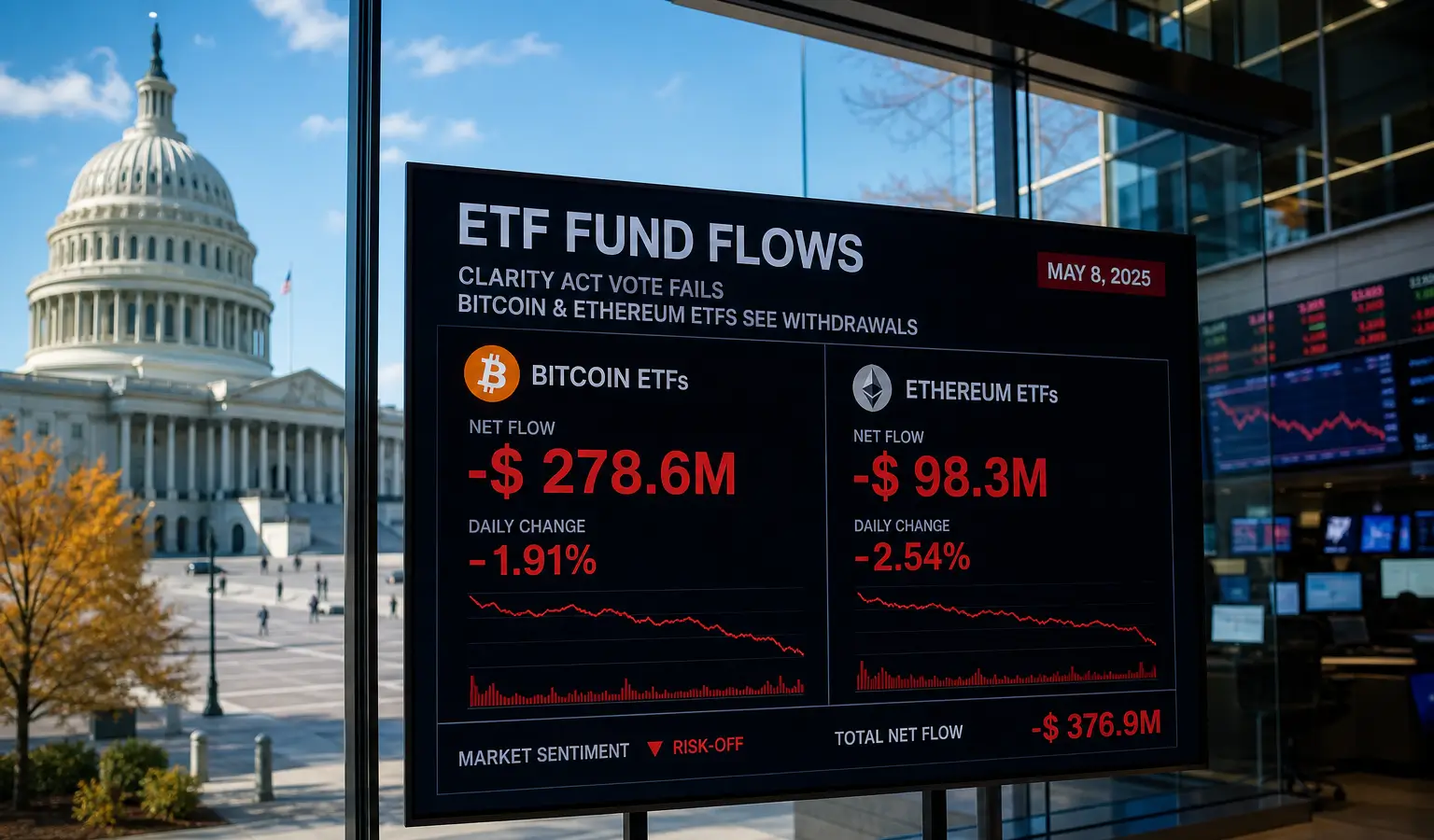
Spot ETFs for Bitcoin (BTC) and Ethereum have each logged a seventh week of net outflows. Even though Ethereum's outflows were much smaller at $66 million (€57.6 million) in the latest week than the $255 million (€223 million) seen in May, it is still a persistent trend. Bitcoin ETFs saw their outflows ease from $1.72 billion (€1.5 billion) in early June to $68 million (€59.4 million) by late June. These numbers show that while the majors are losing money, the pace of outflows is slowing.
At the same time, smaller funds tied to XRP and Solana are attracting money instead. XRP ETFs posted an eighth week of inflows, even after price drops earlier in June. Solana funds have stayed mostly positive since mid-May, with about $836 million (€730 million) in assets under management. The newly launched Hyperliquid (HYPE) funds have also seen nothing but inflows since May, which points to an early rotation of capital within the crypto market.
Staking and On-Chain Signals Point to Confidence in Ethereum
Despite the ETF outflows, the Ethereum network is showing strong demand for staking. The queue for validators looking to enter is about 2.68 million ETH, more than twelve times larger than the exit queue, which is around 223,000 ETH. That ratio points to growing interest in locking up Ethereum, with relatively little pressure to leave.
Daily net validator deposits have also turned positive over the past ten days, after a stretch with more exit days. The amount of unstaked ETH ending up on exchanges remains limited, which suggests that staking outflows are not immediately turning into market selling. On top of that, the stETH peg stayed stable around 1.0 during June's roughly 20% price drop, which points to a lack of panic selling among holders.
Early Signs of Rotation in Crypto Investment Products
An analysis of the five-day net flows between Bitcoin and Ethereum shows a slight shift toward Ethereum. ETH's share of this combined flow rose to 21%, which is a standard deviation above the normal 12% to 15% range. That points to an accelerated rotation into Ethereum, despite the negative ETF numbers.
This gap between ETF outflows and on-chain activity suggests that the money leaving Ethereum ETFs is not necessarily leaving the Ethereum ecosystem. Instead, it may be getting moved into other products, or other investors, like large holders, may simply be continuing to accumulate.
For a confirmed rotation, it will be important for inflows into alternative funds like XRP, Solana, and Hyperliquid to keep growing while outflows from Bitcoin and Ethereum continue. Positive weekly numbers for the majors could break that thesis.
Why This Matters for European Crypto Investors
These developments could matter for European investors who are watching crypto market trends. The mix of ongoing ETF outflows and strong Ethereum network activity highlights why it is important to separate different investment flows and strategies. It also points to a possible shift in preferences across crypto investment products, which could shape the landscape for both institutional and retail investors in Europe.