Ethereum Wants to Cut Finality to Four Minutes
The proposal is meant to make stablecoin and cross-chain payments cheaper, while keeping validators and Ethereum’s security front and center.
Key Takeaways
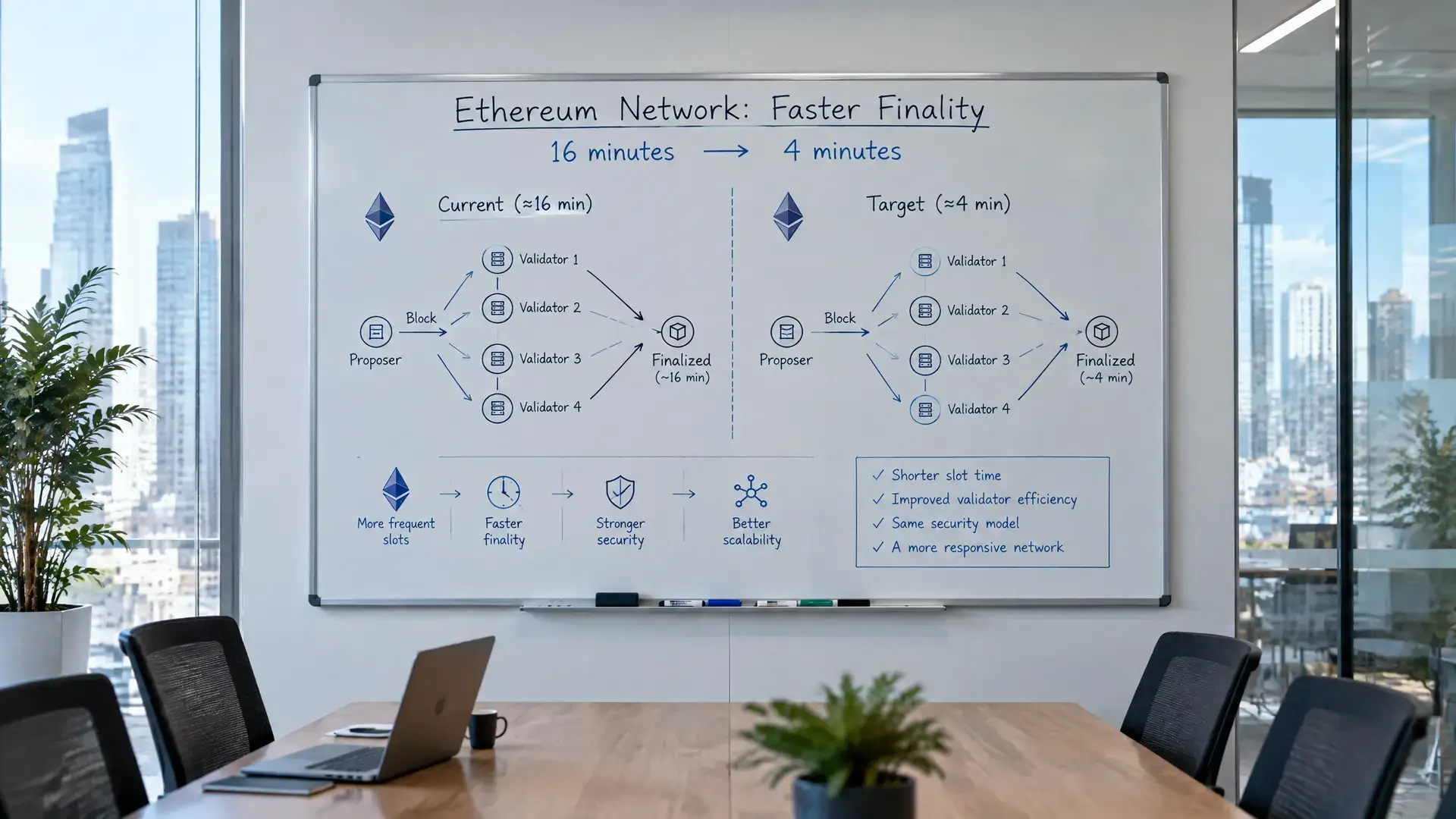
- Ethereum researchers want to cut transaction finality from about 16 minutes to around four minutes.
- Faster finality could make money movement between blockchains cheaper because parties would need to front less capital.
- The proposal is not finished yet, has no activation date, and still has to go through Ethereum’s formal upgrade process.
Ethereum researchers are working on a proposal to bring transaction finality down from about 16 minutes to around four minutes. That could make money movement between blockchains cheaper, because parties would have to front capital for less time while a payment is still not final.
What the Proposal Changes
Ben Edgington, who coordinates Ethereum’s fast-finality research, submitted the draft on Wednesday with Francesco D’Amato, Roberto Saltini, Yann Vonlanthen, and Mikhail Kalinin. The plan is first aiming for a fourfold speedup, but it is still not finished and does not yet have an activation date.
Right now, a transaction can already be in an Ethereum block before the network sees it as final. That is the point when validators, the computers that secure the network, agree that the transaction can no longer be reversed. So if someone sends money from Ethereum to another chain, they have to wait for finality before the other side safely releases the amount.
Why This Matters for Users
According to the researchers, that waiting time really costs businesses money. A transfer service that fronts $10,000 (€8,900) right away, for example, has that amount tied up until Ethereum finishes settling. With a continuous flow of $1 million (€0.9 million) per hour, such a service would have about $267,000 (€237,700) tied up with a 16-minute wait. At four minutes, that drops to about $67,000 (€59,600).
That is especially relevant for services around stablecoins, where speed already comes with a price tag. Circle, the issuer of USDC, charges 0.01% for its fast route from Ethereum, or $1 (€0.89) per $10,000 (€8,900), not including network and application fees. The standard route has no Circle transfer fee. Circle also caps the total value of fast transfers that are still waiting for final settlement; each completed settlement frees up room again.
Splitting the Vote
The current wait time comes from the way validators vote. One vote now does two things at once: helping choose a new block and locking in older blocks. Validators take turns doing that, and a block only becomes final after two full rounds in which everyone has voted.
The proposal splits those two tasks apart, so locking in blocks can run on a faster schedule. The researchers also say this could later help with the move to quantum-resistant signatures, although that is still a long way off. At the same time, a lot is still open. The voting times, penalties, and parts of the security analysis have not been worked out yet, and Edgington wrote that many pieces are still unresolved.
For European crypto readers, the main takeaway is that this shows how much Ethereum’s infrastructure is still changing. Faster finality could lower the practical barrier for payments and stablecoin transfers, but changes like this also directly affect security and validator incentives. The proposal still has to go through Ethereum’s formal upgrade process first.
Even then, four minutes is still much slower than Solana, which activated its Alpenglow upgrade on Wednesday with a finality target of about 150 milliseconds. Institutional payment flows are also continuing to move on Ethereum: JPMorgan is bringing JPM Coin to Ethereum to support blockchain payments and settlement for a broader group of business users.