

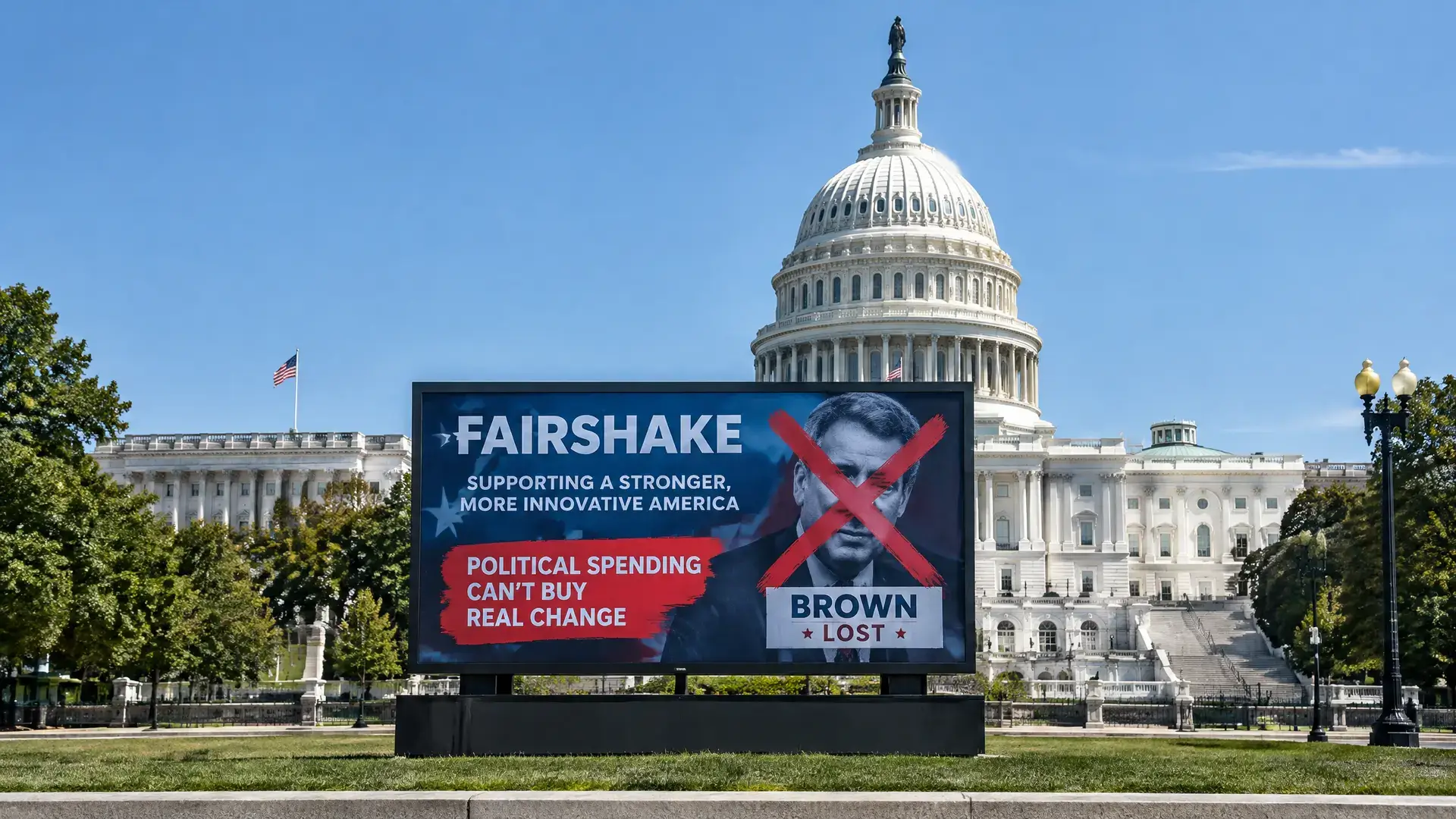
Fairshake Loses Its Grip After Costly Sherrod Brown Misfire
The super PAC lost millions on Sherrod Brown, while several crypto-friendly candidates also lost in Congress. That is putting pressure on the sector’s influence over stablecoin and crypto legislation.
Key Takeaways
- Fairshake spent $56 million trying to defeat Sherrod Brown, but Brown won by nearly 5 percentage points.
- The super PAC spent about $154 million on campaign ads this year, with a heavy focus on Ohio and other key races.
- Several crypto-friendly candidates lost, while Fairshake says it still has $56 million set aside for the next election cycle.
Fairshake, the crypto sector’s main political money machine, took an expensive hit after the U.S. elections. The super PAC put $56 million (€49.7 million) into trying to defeat Democrat Sherrod Brown, but Brown won on Tuesday by nearly 5 percentage points. That raises the question of how effective the sector’s aggressive election strategy really is.
Big Bet on Brown
Fairshake and its related funds grew into a dominant force in U.S. congressional elections in 2024. This year, the group said it spent about $154 million (€137 million) on campaign ads to get more allies onto Capitol Hill. A big chunk of that went to Ohio, where the bet on Brown ended up backfiring.
The super PAC had also previously spent $10 million (€8.9 million) against Juliana Stratton during the Democratic primary in Illinois. Stratton still won that race and also took the general election this week. Brown and Stratton will enter the Senate in January with a strong Democratic majority, which will likely make their stance on crypto more skeptical.
According to Mark Hays of Americans for Financial Reform, this was a clear rebuke of the crypto sector’s broader political strategy. Ron Hammond of Wintermute, meanwhile, pointed out that Brown had long opposed a stablecoin bill and other crypto initiatives, and that Fairshake was therefore justified in targeting him.
Majority Shifts
Election night brought more setbacks for crypto-friendly candidates. Fairshake and other crypto PACs tried to rally extra Republican support in the final stretch, but that mostly backfired. The only clear win for the group came in Nebraska, where an $11 million (€9.8 million) push helped Pete Ricketts win reelection.
At the same time, two Republicans known as crypto supporters, Bryan Steil and Bill Huizenga, lost their seats. House Financial Services Committee Chair French Hill also found himself in a tight race. That matters for the sector because this committee plays a key role in legislation on crypto and stablecoins.
The result fits into a broader shift in Washington, where the political winds seem less favorable for the sector. That makes the next legislative round especially important for how much influence crypto can still have in Congress.
What This Means for Crypto
For European readers, this result shows how dependent U.S. crypto lobbies still are on a few big races and a small number of key politicians. The sector still has influence in Washington, but the election results make it clear that money alone is no guarantee of political wins. That could matter for issues that also spill beyond the U.S., such as stablecoin rules and broader market legislation.
Fairshake says it still has $56 million (€49.7 million) set aside for the next election cycle. But after this cycle, its aura of being unstoppable has taken a hit, just as the debate over crypto in Congress is likely to get even tougher.