

HKMA Uses AI to Fight Crypto Crime at Banks
The regulator wants banks to connect wallet data with customer identities faster, as stablecoins make money laundering investigations more complex. Project SAGE is also meant to define the role and responsibility of AI agents.
Key Takeaways
- The Hong Kong Monetary Authority wants banks to use AI faster to better detect crypto-related financial crime and money laundering.
- The regulator sees strong potential for AI agents that link blockchain transactions to customer data and spot suspicious patterns faster.
- Banks are still testing AI cautiously; the HKMA has also launched Project SAGE to study the identity, authority, and liability of financial AI agents.
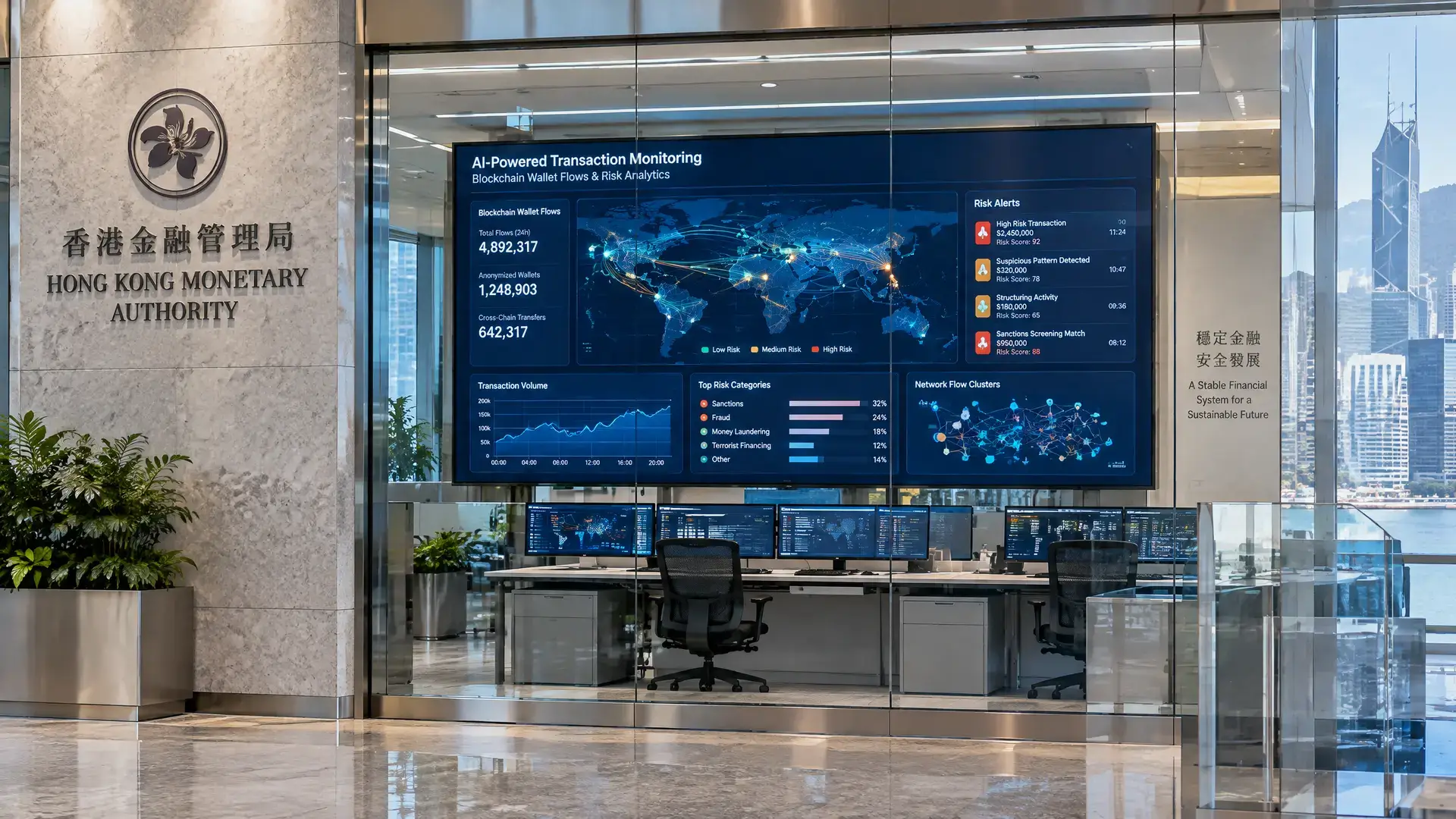
The Hong Kong Monetary Authority wants banks to move faster on artificial intelligence to detect financial crime, as stablecoins and other digital assets make suspicious money flows harder to track. The regulator is also looking at AI agents that can connect blockchain transactions to customer data, so banks can more quickly see who is behind a wallet.
Faster Data Linking
Raymond Chan, who oversees enforcement and anti-money laundering at the HKMA, said Tuesday that the regulator wants to speed up AI adoption at banks. In his view, the biggest challenge is linking wallet activity to real identities fast enough before the money can be moved further.
Chan pointed to Chainalysis research showing that illegal crypto addresses received at least $154 billion (€140 billion) in 2025, 162% more than a year earlier. Stablecoins accounted for 84% of that total. At the same time, the company said illegal activity made up less than 1% of total crypto transaction volume in its analysis.
The HKMA sees especially strong potential for AI agents that recognize patterns, such as rapid swaps between crypto and traditional money. Banks can track transactions on a blockchain, but figuring out who owns a wallet is still much harder. That ties into the broader debate over how autonomous AI agents should be limited and verified in financial systems.
Banks Are Still Testing Cautiously
Abdul Rafay Gadit, co-founder of ZIG Finance, said banks should first test AI agents on past fraud cases and run them alongside existing control systems. In his view, it is important to compare what a system catches, what it misses, and how long investigations take.
The Hong Kong Institute for Monetary and Financial Research said in a report that the HKMA has already given banks technical support and workshops on using AI. The report also describes a bank that uses generative AI to investigate possible money laundering cases based on transaction records, images, and customers' digital activity. The bank said investigations became faster and more accurate, but did not share further details.
The same survey found that 90% of the financial institutions surveyed had already adopted generative AI or planned to do so. For AI agents, that share was 13%, with another 56% planning to use them.
Why This Matters
The debate in Hong Kong shows how regulators and banks are trying to keep up in a market where crypto, stablecoins, and traditional payment flows are increasingly overlapping. For European crypto readers, that matters because similar questions are also coming up around regulation, wallet identification, and the role of AI in compliance. Concerns about explainability and security make it clear that using AI in banks is not just a tech issue, but an operational one too.
The concerns go beyond detection alone. Gadit and other experts stressed that decisions about freezing accounts, rejecting payments, or reporting suspicious transactions should still stay with bank staff. Dominik Clemente of World Foundation also pointed out that banks need to verify whether someone approving a transaction remotely is really who they say they are.
The HKMA also launched Project SAGE on November 2, a separate study into how financial AI agents should prove their identity and authority, and who is responsible if something goes wrong.