

Hyundai Tests AI Agents on JPMorgan's Kinexys Blockchain
Hyundai Card tested whether AI agents on JPMorgan's Kinexys can handle FX, cash management, and internal transfers automatically. The trial shows how permissioned blockchain and strict authorization come together in treasury processes.
Key Takeaways
- Hyundai Card tested AI agents on JPMorgan's Kinexys blockchain for cash management, currency exchanges, and money transfers.
- The trial used simulated transactions between hypothetical foreign subsidiaries and showed automatic processing within limits.
- Orders outside the allowed boundaries were sent for human approval or rejected, with extra security through identity and authorization.
Hyundai Card ran a trial with AI agents on Kinexys, JPMorgan Chase's blockchain platform. The company looked at whether financial tasks like cash management, currency exchanges, and money transfers could run automatically through communication between AI systems.
Test With FX and Transfers
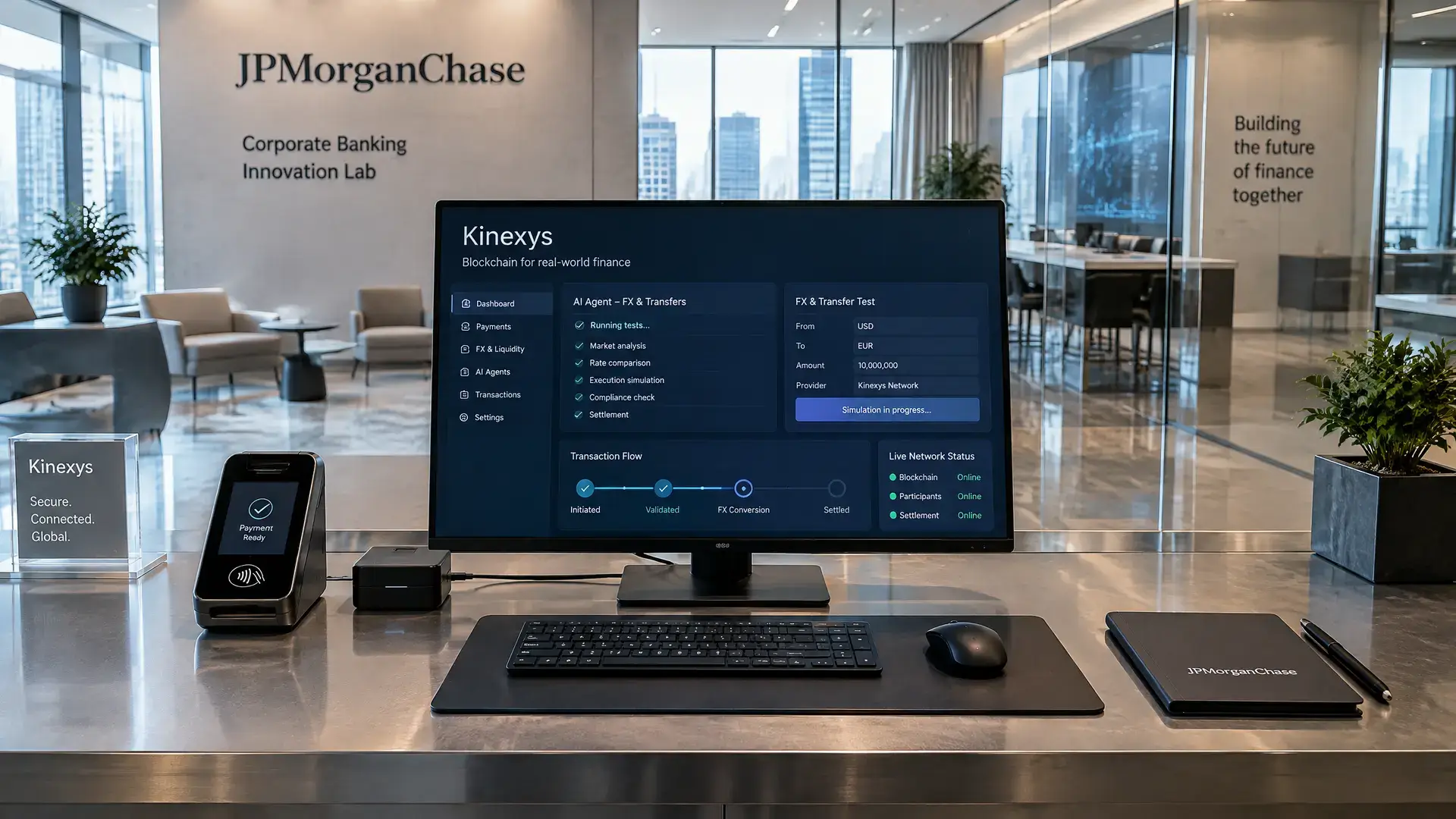
According to Hyundai, this was a proof of concept with simulated transactions between hypothetical foreign subsidiaries. The setup was meant to show whether an AI agent could keep a subsidiary's account above a preset threshold by exchanging and sending funds when a shortfall was about to happen.
Hyundai Card designed the transaction scenario, while JPMorgan built the AI agents for both sides. Identity, authorization, control, and validation mechanisms were also built in to secure transactions between the agents.
During the test, the Hyundai Card AI Agent monitored subsidiary balances, compared FX rates from multiple banks, and instructed the Kinexys AI Agent to carry out the needed currency exchange and transfer. Transactions within the allowed limits were processed automatically. Orders outside those limits were sent for human approval or rejected.
Why This Matters
The test fits into a broader shift where major financial firms are looking at how AI and blockchain can be used together for payments and treasury work. For European crypto followers, what's especially relevant is that experiments like this show how permissioned blockchains and smart contracts are being used more and more outside pure crypto trading.
Hyundai is building on an earlier pilot with stablecoins for cross-border internal transfers, which had already been brought to production-ready status on Avalanche. That makes it clear the company sees blockchain not as a standalone experiment, but as part of its payment infrastructure.
Attention is also growing in the banking sector around the risks of autonomous systems: Fed Governor Barr warned earlier that AI agents that can move money without human approval could create new risks and require stricter identity checks.
Kinexys Keeps Growing
Kinexys, formerly Onyx, has been running since 2020 and, based on the available information, is now one of JPMorgan's most important blockchain initiatives. The bank has long shown interest in digital assets and blockchain technology, and uses the platform for business applications around payments and settlement.
The broader context is that banks see both opportunities and risks in AI agents. Recent reports from the U.S. banking sector show that institutions are becoming cautious about AI systems that get access to customer accounts, because those tools can also initiate unwanted transactions. That underscores why verification and authorization are central in tests like this.