

Matt Corallo Sees 80% Chance of Bitcoin Soft Fork BIP-54
BIP-54 is meant to fix known weak spots in Bitcoin’s consensus code and, according to Corallo, also serves as a test for smoother soft fork activation. The timing is still uncertain, with developers only expecting it from 2027 or later.
Key Takeaways
- Matt Corallo estimates the odds of Bitcoin soft fork BIP-54, the Great Consensus Cleanup, at 80%.
- BIP-54 is meant to clean up known weak spots in Bitcoin’s consensus code and serves as practice for future soft forks.
- There is still no formal timeline; an informal poll named 2027 or later as a possible activation date.
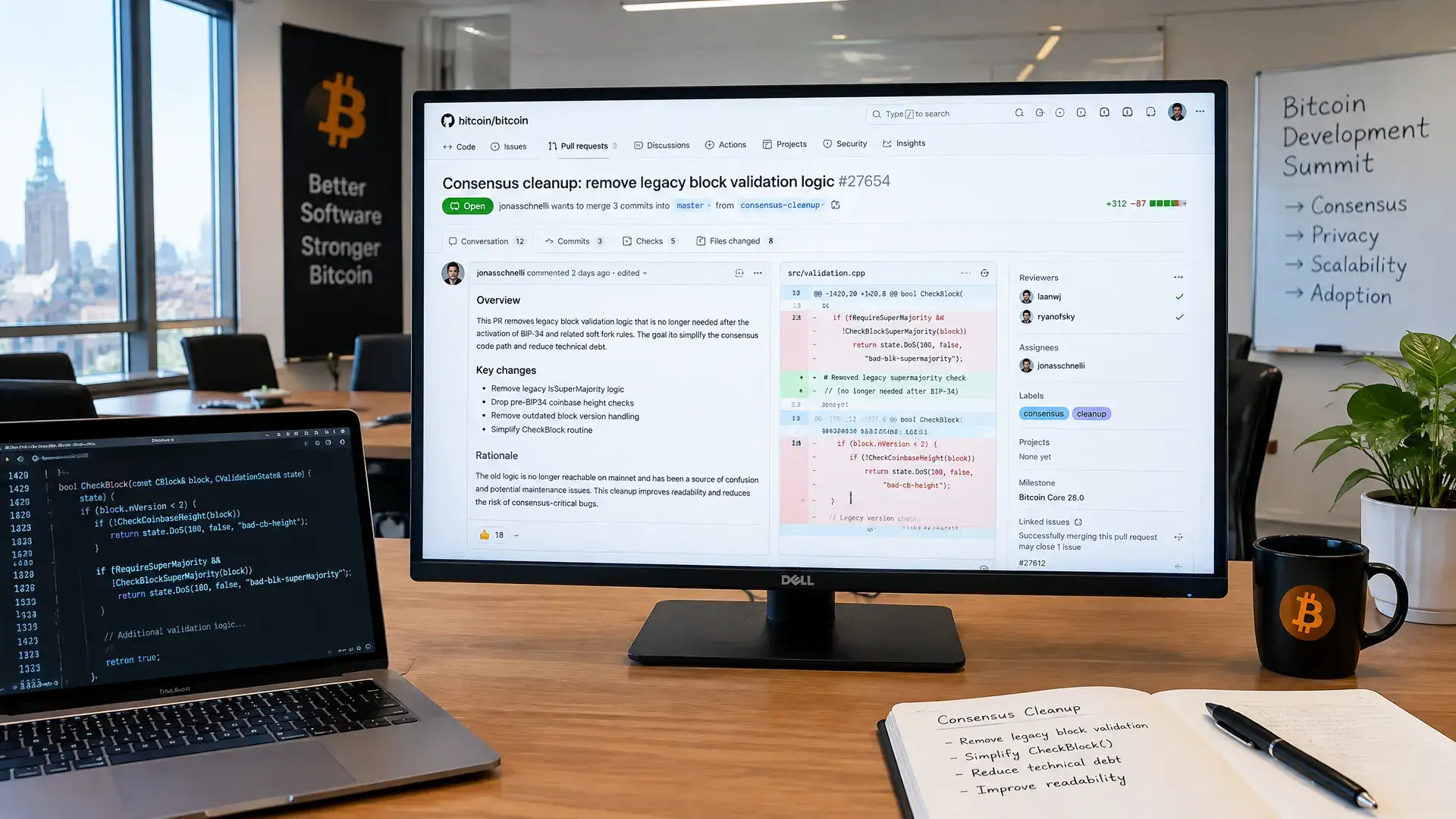
The chance that Bitcoin’s next soft fork will be the Great Consensus Cleanup is estimated at 80% by co-author Matt Corallo. The longtime Bitcoin developer said that in an interview, even though there is still no formal timeline. The proposal is called BIP-54 and is mainly about cleaning up known weak spots in the consensus code.
BIP-54 as Practice
Corallo mainly sees the proposal as practice. According to him, every recent soft fork has involved debate over the activation mechanism. That is exactly why he sees BIP-54 as a chance to walk through that process calmly once. After that, the same approach could be used again for future soft forks, so there would be less hassle around activation.
The proposal itself is not very controversial in substance. BIP-54 is supposed to close a handful of long-known weak spots in Bitcoin’s consensus code. According to Corallo, that makes it suitable as a dress rehearsal for a future protocol change.
Earlier Soft Forks Were Difficult
Bitcoin’s history shows that soft forks often come together with difficulty. SegWit in 2017 led to heated debates within the community, while Taproot in 2021 was the first soft fork to be activated afterward. That last change went relatively smoothly, with broad support from miners.
That background makes it clear why an apparently small cleanup fork can still matter. If an activation method works without major conflict once, it can later help with heavier proposals that face more resistance. Think of plans like OP_CAT and OP_CHECKTEMPLATEVERIFY, which still do not have ecosystem-wide consensus.
Timing Remains Uncertain
Nothing is certain yet when it comes to timing. At TABconf in Atlanta, Paul Sztorc, co-founder and CEO of LayerTwo Labs, held an informal poll among developers in October about the activation date of the next soft fork. The earliest estimate was September 1, 2027, while most answers were in 2028 or later.
So for Dutch Bitcoin holders and miners, nothing changes in the short term. Corallo’s 80% is a personal estimate, not a network decision. As long as there is no formal timeline or activation date, BIP-54 remains mainly a proposal that shows how Bitcoin developers want to prepare for the next big step.