Metaplanet and Strategy Book Nearly $10 Billion in Paper Losses on Bitcoin
Metaplanet and Strategy are holding billions in unrealized BTC losses together, while their debt-fueled treasury model increases balance sheet risk.
Key Takeaways
- Metaplanet and Strategy together have nearly $10 billion in unrealized paper losses on their Bitcoin positions.
- Metaplanet reported a $1.5 billion loss on 43,000 BTC; Strategy reported an $8.2 billion loss last month.
- Bitcoin has been trading between $62,000 and $66,000 for weeks, while traders watch Jackson Hole and new macro data.
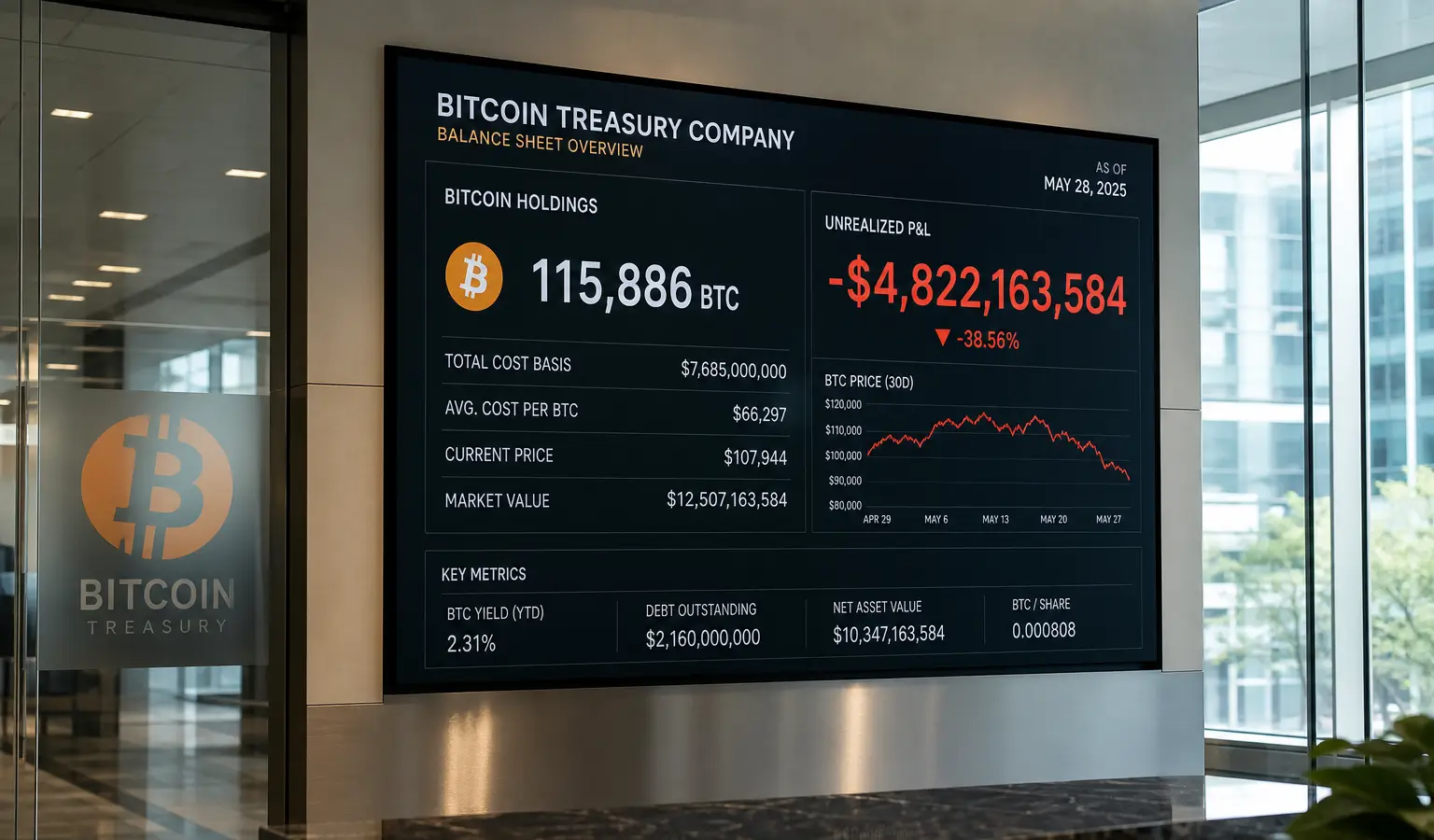
The world’s two biggest publicly traded Bitcoin treasury companies are sitting on nearly $10 billion (€8.7 billion) in combined paper losses, a figure that sharply shows the scale of their exposure to a single token. Metaplanet said early Thursday in Tokyo that it had an unrealized loss of $1.5 billion on its 43,000 BTC as of the end of June, while Strategy last month reported a similar paper loss of $8.2 billion (€7.1 billion).
Big Positions, Big Risk
The numbers show how far Bitcoin’s financialization has gone. If those losses were tokenized, a hypothetical Loss Token would even be the 11th-largest digital asset based on the market comparison, just behind Dogecoin and well above tokenized Treasury coins like ONDO, privacy tokens like ZEC, and DeFi player AAVE.
That also brings the concentration of risk in one asset back into focus. Many of these DAT companies have funded their BTC purchases with debt, which makes their balance sheets vulnerable if the price stays weak for a long time. That matters even more because Bitcoin itself does not generate any built-in return, cash flow, or yield.
BTC Stays in a Tight Range
Interestingly, the market does not seem to care much about those balance sheet risks for now. BTC has been moving between $62,000 (€53,700) and $66,000 (€57,200) for weeks, and today it has mostly traded below $64,000 (€55,400). That keeps the crypto market in a wait-and-see phase, while analysts try to figure out whether the bear market has already found its bottom.
According to Alex Kuptsikevich, chief analyst at FxPro, current levels are close to the peaks of the bull market in 2021. He pointed out that three years ago Bitcoin only slowed its decline around $20,000 (€17,300), close to the top of the previous cycle from 2017, and that this could point to fading bearish momentum toward the 200-week moving average.
Why This Matters for Europe
For European crypto investors, this is especially relevant because publicly traded treasury companies have become a more visible link between traditional capital markets and Bitcoin. If these companies keep expanding their positions with borrowed money, that could draw more attention to balance sheet risk, financing costs, and the way large BTC positions are priced in the market.
Later today, traders are also watching the Jackson Hole central bank symposium and new macro data for more direction. In a market where Bitcoin has been trading in a narrow range for weeks, that could temporarily shift attention from corporate balance sheets to rate expectations and broader risk sentiment. The recent pressure on the price also fits the broader picture of weak demand and ongoing selling pressure in the market, as Bitcoin Falls Further as Miners Sold $1.78 Billion showed earlier.