Morgan Stanley Launches Ethereum and Solana ETFs With a 0.14% Fee
With spot funds on NYSE Arca, the bank is starting with a low fee while staking through Figment, Galaxy, and Coinbase Canada shapes the yield setup.
Key Takeaways
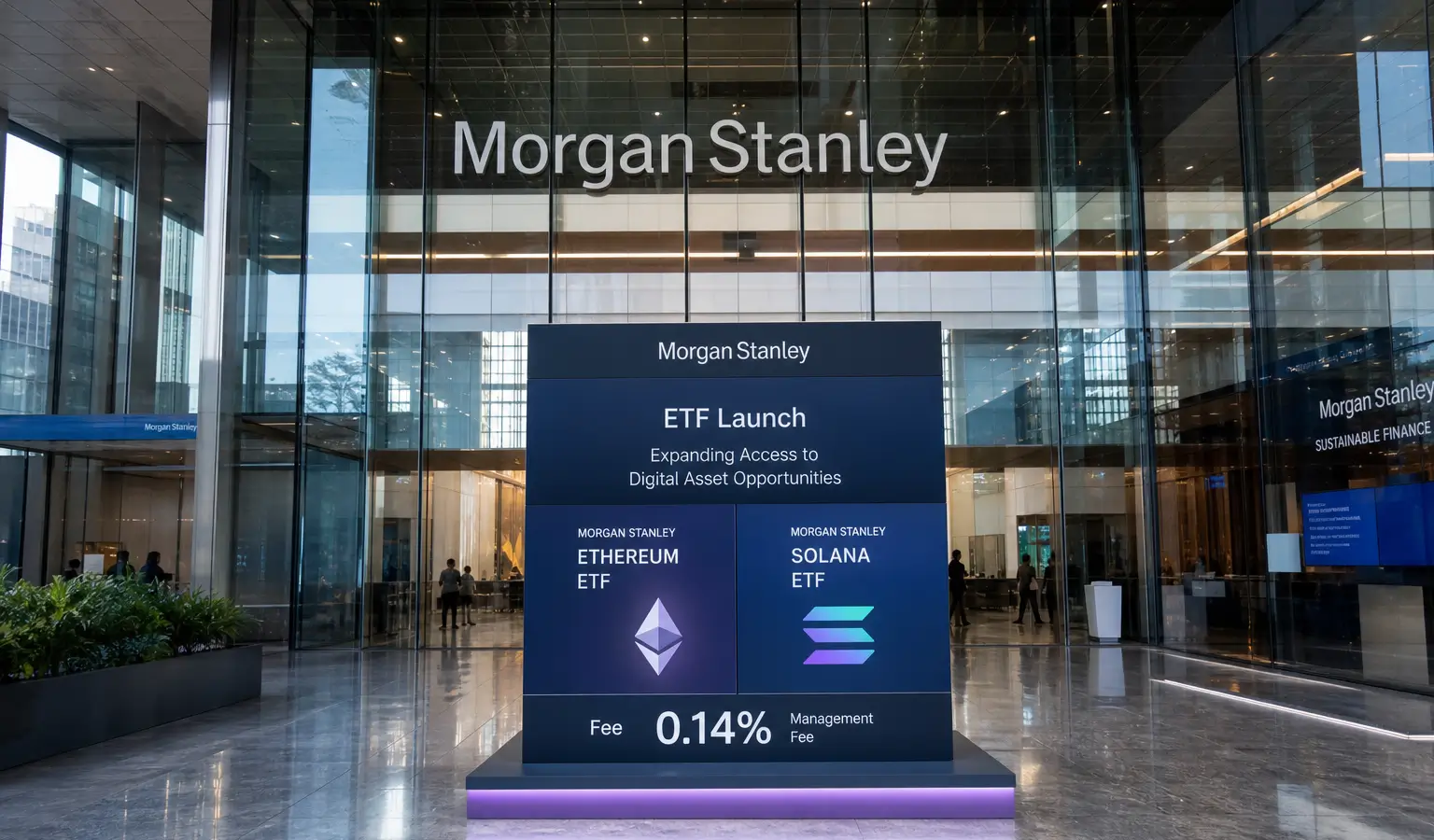
- Morgan Stanley launched spot Ethereum and Solana ETFs on NYSE Arca with a 0.14% management fee.
- The funds stake through Figment, Galaxy Blockchain Infrastructure, and Coinbase Canada, with monthly cash distributions from staking rewards.
- The bank is pushing the products through 16,000 advisers and E*TRADE in a competitive market with similar staking ETFs.
Morgan Stanley has rolled out spot Ethereum and Solana ETFs with a 0.14% fee, immediately putting pressure on pricing in two markets where costs, staking, and adviser distribution matter more and more. The bigger question is whether that low fee can actually attract assets, especially with Ethereum and Solana still trading far below their recent highs.
Low Fee in a Crowded Market
The Morgan Stanley Ethereum Trust (MSSE) and Morgan Stanley Solana Trust (MSOL) began trading Tuesday on NYSE Arca. Both funds charge 0.14% daily on net asset value, which undercuts the earlier 0.15% floor for ether products. According to Bloomberg ETF analyst Eric Balchunas, that makes both products the cheapest in their categories from day one.
Morgan Stanley has already shown that a low-cost launch can help a fund gather assets over time. The Morgan Stanley Bitcoin Trust took in $34 million (€29.9 million) in April at its low-cost Bitcoin ETF debut and, based on the cited figures, had grown to $381 million (€335 million) by July 16. That is still only a small part of the bank's $14 billion (€12.3 billion) exchange-traded lineup, but it gives the new funds a useful precedent.
Staking and Payouts
The prospectuses show that the staking setup differs between the two funds. Both trusts stake through Figment, Galaxy Blockchain Infrastructure, and Coinbase Canada, and those providers, along with the custodians, receive 5% of gross rewards. Morgan Stanley does not take any of that share, although the separate 0.14% management fee still applies.
MSOL can stake up to 100% of SOL, while MSSE is targeting a 50% to 80% ether allocation and has an 80% staking cap. Timing matters for Ethereum here: the validator activation queue was about 2.71 million ether on July 6, which translated to an estimated 47-day wait before new validators could start earning rewards. According to the prospectus, Solana has a bonding period of two to three days.
The rewards will be paid out as monthly cash distributions, with quarterly as the minimum cadence. So these products are not just about fees. They are also about how staking income gets packaged and passed through to investors.
Why This Matters
For European crypto readers, the launch stands out because major U.S. asset managers are pushing spot crypto deeper into their adviser networks. Morgan Stanley has about 16,000 advisers overseeing roughly $9.3 trillion (€8.2 trillion) combined, and the bank also turned on spot trading through E*TRADE this month. That could shape how institutional demand for Ethereum and Solana develops, even if the launch itself does not tell us much about the pace of inflows.
Competition is already building as well. In the same corner of the market, products such as Grayscale's Ethereum Staking Mini ETF and Bitwise's Solana Staking ETF already offer similar exposure and staking features. For investors, that means the decision is not just about the tokens themselves, but also about fees, staking mechanics, and access through large distribution platforms.