MUFG Tests Real-Time Blockchain Settlement for Japanese Government Bonds
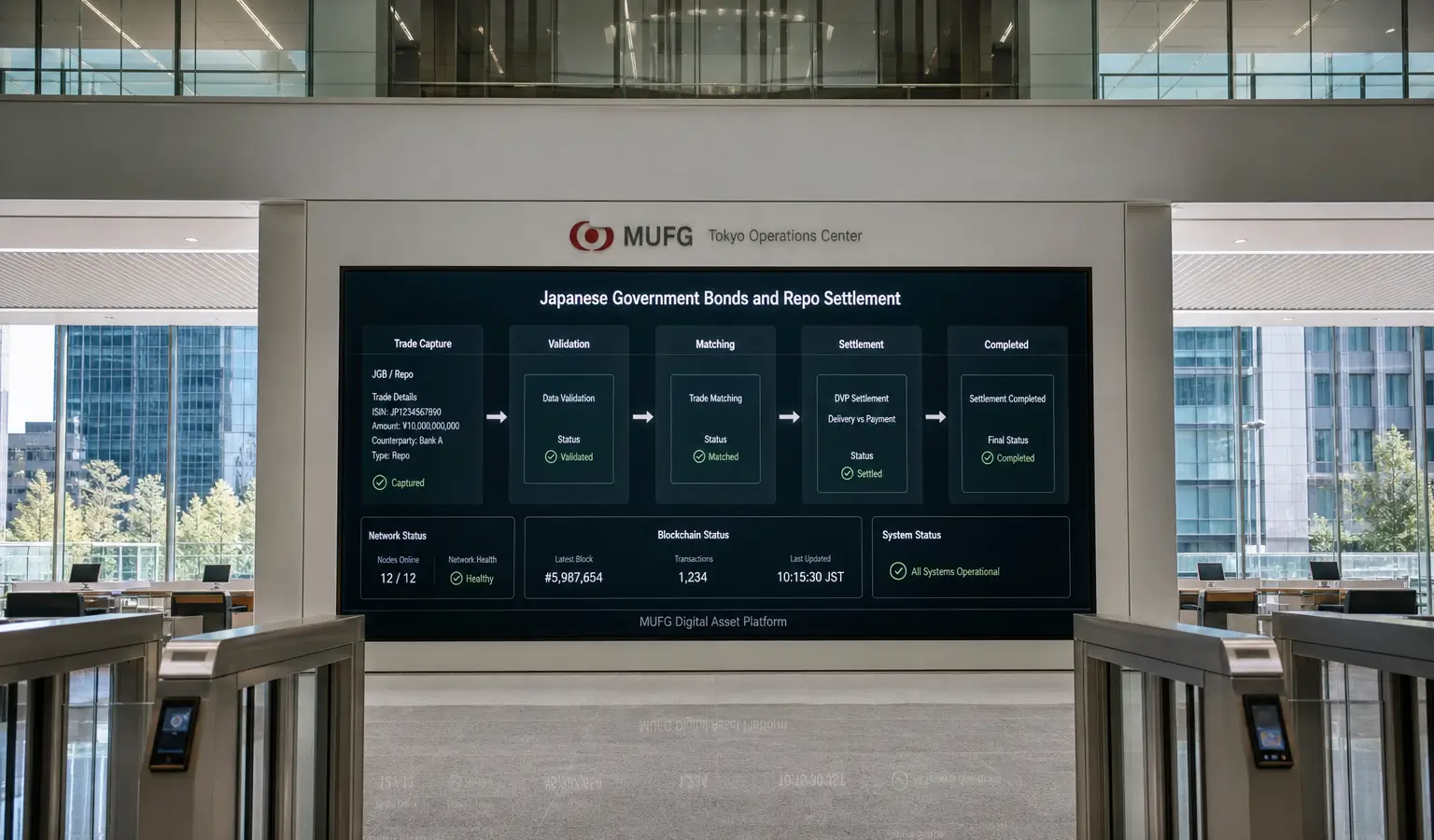
MUFG is exploring onchain settlement through the Canton network to make repo trades with JGBs faster and more efficient. The project fits into broader tokenization and settlement tests at major banks.
Key Takeaways
- MUFG is testing blockchain for faster settlement of Japanese government bonds through a proof of concept on the Canton network.
- The bank wants to improve the operational and capital efficiency of repo transactions with real-time 24/7 onchain settlement.
- MUFG sees blockchain as part of a broader program for regulated financial services, including stablecoin and tokenization research.
Mitsubishi UFJ Financial Group (MUFG) wants to use blockchain to speed up the settlement of Japanese government bonds. The bank is preparing a proof of concept for onchain JGB transactions through the Canton network, in a move that shows how traditional banks are trying to further automate settlement processes.
Faster Settlement
According to MUFG, settlement for JGB transactions through traditional systems usually takes 1 to 3 days. With real-time 24/7 onchain settlement, the bank mainly wants to improve the operational and capital efficiency of repo transactions. In repo trades, securities are used as collateral for short-term funding, making speed and availability directly relevant for market participants.
MUFG said on Wednesday that JGBs are widely used as collateral for repo transactions because of their high credit quality and liquidity, both in Japan and abroad. The bank therefore sees growing interest in bringing this market on chain. The project fits into a broader trend in which financial institutions are testing blockchain for functions that normally run through existing market infrastructure.
Canton in Regulated Finance
The Canton network was launched in 2023 by a consortium that includes Goldman Sachs, BNP Paribas, Deutsche Börse, and Microsoft. The network is built for regulated financial institutions and uses a privacy model where transaction data is only visible to the parties involved. That makes it suitable for transactions where confidentiality and compliance matter.
MUFG also points out that banks in Europe and the United States have been running proof-of-concept projects for the same goal for some time. A well-known example is JPMorgan's Kinexys network, which went live in 2020 and has supported intraday repo trades with U.S. government bonds for years. In December 2025, the Depository Trust & Clearing Corporation also received a No-Action Letter from the SEC to tokenize U.S. Treasury securities on Canton, which has further increased attention on onchain settlement of government bonds.
Broader Blockchain Program
The JGB trial is not happening on its own. MUFG is also working more broadly on blockchain use cases within traditional financial services. For example, the bank recently announced that it is working with Sumitomo Mitsui Financial Group and Mizuho Financial Group to explore whether a jointly issued stablecoin could be listed by March 2027.
For European crypto readers, the main takeaway is that projects like this show how blockchain is being tested more and more inside regulated market infrastructure, separate from speculative token trading. If major banks keep integrating settlement, collateral, and tokenization, that could narrow the gap between traditional finance and crypto infrastructure even further. That lines up with the broader institutional shift toward tokenized settlement, such as tokenized deposits, where banks are trying to combine 24/7 settlement with existing deposit structures.