

OpenUSD Charges a Fee and Offers Partners an Equity Earn-In
OpenUSD pairs a low transaction fee with an equity earn-in for partners, while Visa works out the stablecoin integration on the technical side.
Key Takeaways
- OpenUSD charges a management fee on payment volume of 0.1 basis point, with a maximum of $0.01 per payment.
- Partners can earn equity through an earn-in pool, depending on how much OpenUSD they hold and move.
- Visa published more than 100 pages of technical explanations and guidelines for connecting OpenUSD through the Visa Stablecoin Platform.
OpenUSD, the new consortium stablecoin from Stripe, Visa, Mastercard, Coinbase, and Shopify, will charge a management fee on payment volume while also giving partners a chance to earn equity in the project. According to internal documents, the fee is 0.1 basis point, with a maximum of $0.01 (€0.0089) per payment.
Fee on Payment Volume
The setup means smaller payments cost 0.1 basis point of the amount, while payments of $1,000 (€895) or more immediately hit the maximum of $0.01 (€0.0089). For a payment of $1 million (€0.9 million), 0.1 basis point would normally come out to $10 (€8.95), but the documents say the cap of $0.01 (€0.0089) still applies there too.
Open Standard, the company behind OpenUSD, says the stablecoin is meant to make cross-border settlement easier and bring currency exchange costs almost down to zero. Unlike Tether’s USDT and Circle’s USDC, where the issuer keeps the interest on reserves, that yield is distributed among partners at OpenUSD after the fee is deducted.
Partners Can Earn Equity
Open Standard also offers partners an earn-in pool for equity. The split depends on how much OpenUSD partners hold and move. Each month, the company measures how much of the stablecoin they hold and move, and based on that, it determines the annual pool.
To take part, partners must hold at least $50 million (€44.7 million). For any one party, the maximum ownership is 5 percent if all warrants are earned. With that, OpenUSD is trying to align participants’ interests more closely while the stablecoin is rolled out more broadly.
Visa Publishes Integration Guide
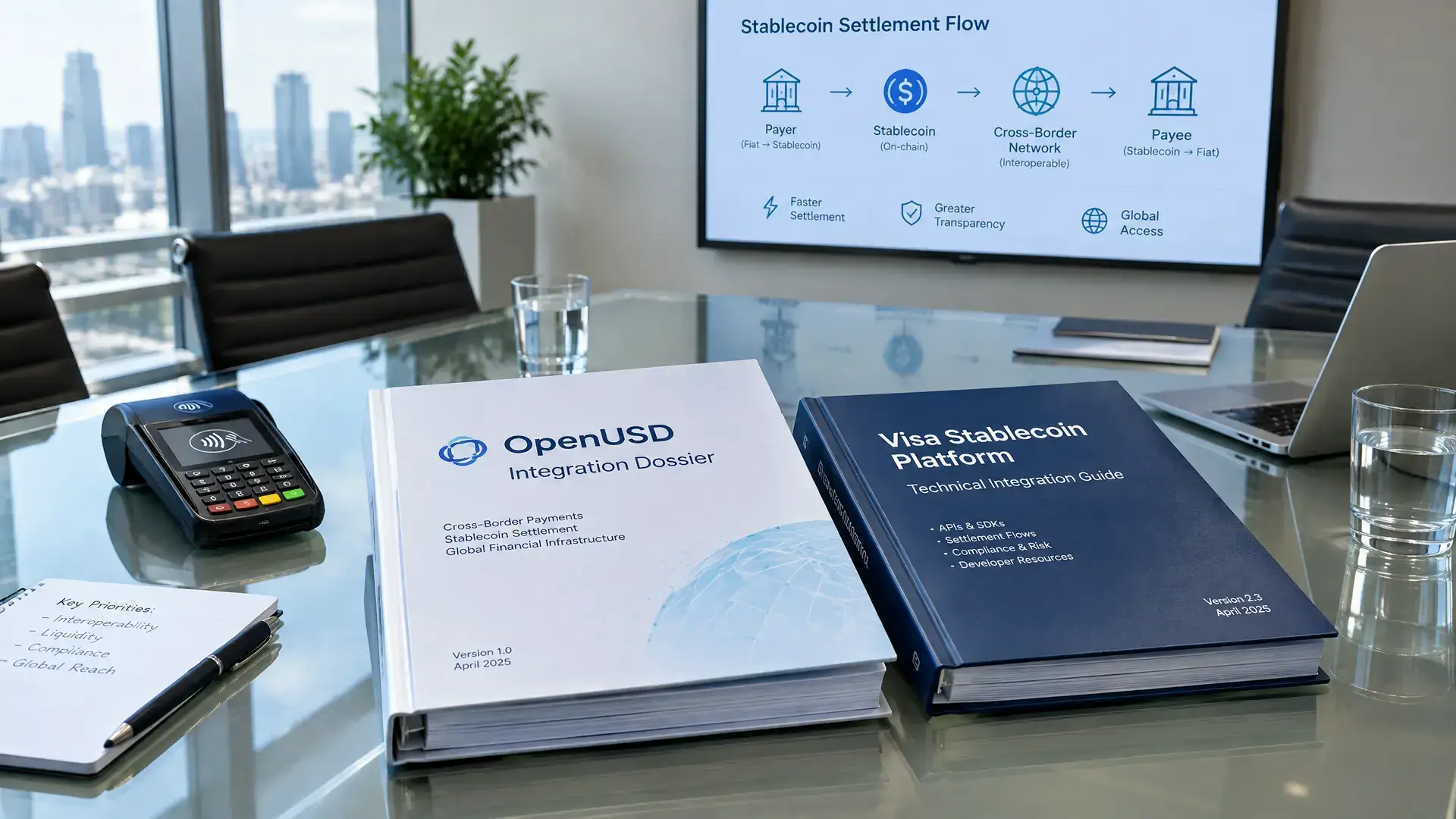
Alongside the fee and equity documents, Visa has also released more than 100 pages of technical explanations and user guidelines for partner companies that want to connect OpenUSD through the Visa Stablecoin Platform. For European crypto readers, that matters because it shows how quickly major payment companies are trying to fit stablecoins into existing payment flows and settlement processes. That fits into a broader shift in which major payment networks are increasingly treating stablecoins as settlement infrastructure, as Visa’s growing stablecoin volume already showed.