Solana Escapes Network Freeze After Routing Error
An error at data center provider Teraswitch affected validators in Europe and Asia, while Solana stayed just below the finality threshold, according to Marinade.
Key Takeaways
- Solana narrowly escaped a network freeze Wednesday morning because of a routing error at data center provider Teraswitch.
- About 29% of staked tokens briefly went offline; finality came dangerously close to the safety threshold.
- The outage hit validators in Europe and Asia, while North America stayed online and the issue was fixed after about 10 minutes.
Solana came dangerously close to a network freeze Wednesday morning after a routing error at a major data center provider nearly took 29% of staked tokens offline, staking platform Marinade Finance said. According to the platform, the blockchain was about 20 million tokens below the level where finality comes under threat, the point at which transactions become final.
What Went Wrong
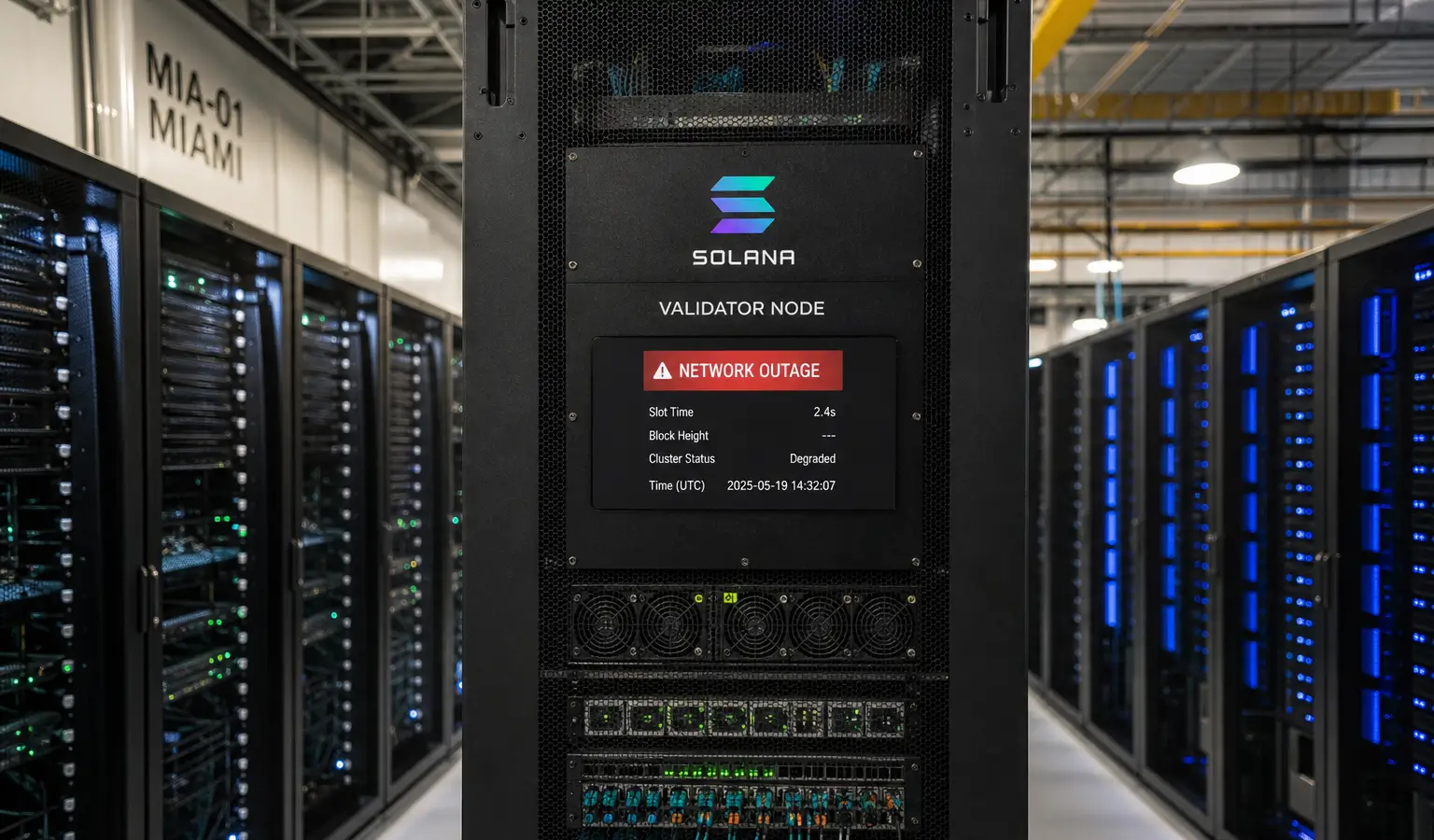
The outage started with a bad internet route from Teraswitch in Miami and then spread to data centers in Europe and Asia. That affected validators in London, Amsterdam, Frankfurt, Singapore, and Tokyo, while North America stayed online. The provider fixed the issue in about 10 minutes, and traffic returned to normal around 4:16 a.m. UTC.
Marinade said about 90 validators were affected and together missed out on 333 SOL in rewards. That amount is relatively small and is covered through so-called validator bonds. One network operator, AS2032, also controlled more than a quarter of all tokens that had been locked up to secure the network, above Solana’s safety threshold. When that position went offline at the same time, the network came close to the threshold where finality can disappear for all SOL holders.
Solana Remains Vulnerable
Solana is considered one of the main smart contract blockchains and, according to Marinade, has $4.3 billion (€3.7 billion) in assets locked in DeFi protocols on the network. The chain is known for being faster and cheaper than Ethereum, but it has had several outages in the past. The mix of high throughput and low transaction costs makes the network attractive, but it can also make it more sensitive to congestion and downtime.
The latest near-outage fits that pattern. Solana has had major incidents before in September 2021, January 2022, and February 2024. The February 2024 outage lasted about five hours and was resolved after validators restarted the network. In a note, Marinade warned that if more than a third of staked tokens goes offline at the same time, no one on SOL will get finality anymore, and there is no quick fix for the broader damage that can follow. That makes upgrades meant to speed up finality especially relevant, such as Alpenglow, which is supposed to cut the time to finality sharply.
Why This Matters for Investors
For European crypto investors, this is especially relevant because Solana is one of the most widely used networks for DeFi and other onchain applications. Incidents like this do not just affect the technical layer, they can also put pressure on confidence in how reliable a chain is. History shows that even short disruptions on Solana get watched closely, precisely because the network plays such a big role in the crypto market.