South Korea Puts $518 Billion Into AI Chips, Keeping Pressure on Bitcoin
Samsung and SK Hynix are speeding up the buildout of AI chip factories, while capital keeps flowing out of crypto. Bitcoin is still around $60,000, and miners are looking for extra revenue through AI hosting.
Key Takeaways
- South Korea is investing about $518 billion in new chip factories for artificial intelligence.
- Samsung and SK Hynix want to double DRAM production over five years and benefit from demand for HBM chips.
- The flow of capital into AI and chips is putting pressure on Bitcoin, while the price is trading around $60,000.
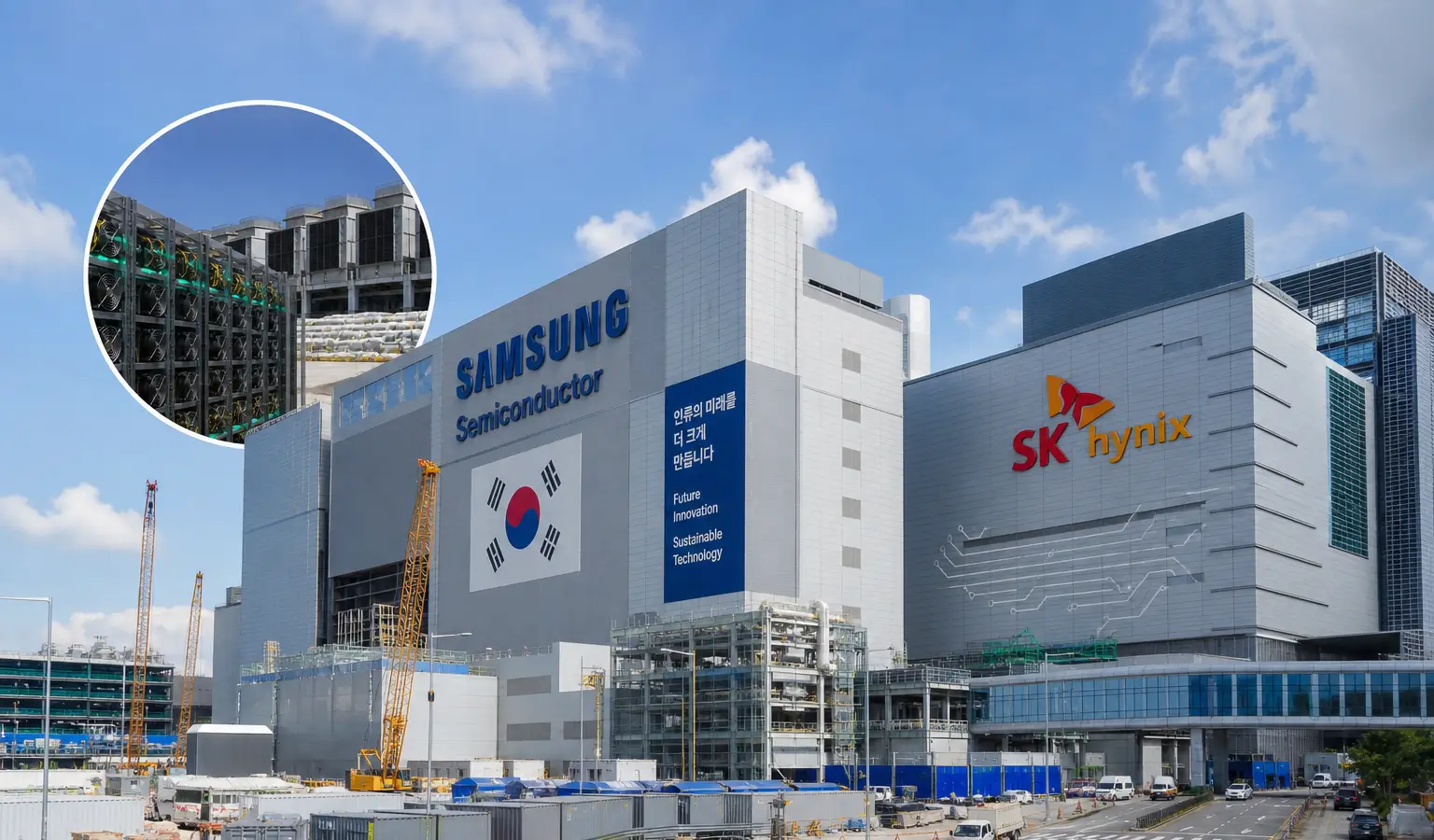
South Korea is rolling out a roughly $518 billion push to build new chip factories centered on artificial intelligence (AI). Samsung Electronics and SK Hynix plan to use that spending to double DRAM memory output over the next five years, a key part of the memory used in phones and computers. The move fits into a wider national effort to strengthen South Korea’s role in the global chip market.
Faster Chip Production Driven by AI Demand
The main force behind the spending is demand for advanced AI chips, especially high-bandwidth memory (HBM). These chips are a core part of training AI models such as ChatGPT and Claude. SK Hynix has leaned into that demand to become a market leader and recently passed Samsung to become South Korea’s most valuable publicly traded company for the first time in 25 years. Together, the two companies supply most of the world’s HBM and have deals with major AI names including Nvidia and OpenAI.
A South Korean presidential adviser said the factories could be finished as soon as 2034 or 2035, more than a decade ahead of the original schedule. That timeline underscores just how quickly AI has moved to the center of the region’s industrial plans.
Impact on the Crypto Market and Bitcoin
The scale of this AI spending is also rippling through the crypto market. It reflects a broader capital rotation that has drawn investor money toward AI while leaving less support for digital assets like Bitcoin. Over the past year, investors have increasingly favored AI-linked stocks, while crypto has struggled to regain momentum.
Bitcoin is still trading near $60,000 and is approaching its 200-week moving average, a long-term level that has often lined up with weaker market phases. Even Bitcoin miners are adapting, with some redirecting part of their computing power to AI hosting because those contracts can provide steadier revenue than mining.
Taken together, these shifts show how capital that once flowed into crypto is now being redirected toward AI and chip manufacturing. Whether that is a short-term trend or a more lasting change in market behavior is still an open question.
Why This Matters for European Crypto Investors
For European crypto investors, this trend may signal a changing risk backdrop across both tech and crypto markets. The heavy focus on AI infrastructure in Asia, especially South Korea, could influence where capital goes and how innovation develops in crypto. That may end up shaping how European investors and companies position themselves in the broader global crypto market.