Vitalik Buterin Unveils Lean Ethereum, But the Timeline Draws Criticism
The roadmap centers on recursive STARKs, quantum security, and lower fees, but some in the Ethereum community are questioning whether the rollout is moving too slowly.
Key Takeaways
- Vitalik Buterin introduced Lean Ethereum, a roadmap meant to overhaul Ethereum over the next three to four years.
- The plan brings in recursive STARKs, quantum-safe cryptography, lower fees, and a new scalable data architecture.
- Ethereum researcher Dankrad Feist criticized the timeline as too slow, while the Foundation is also cutting staff and budget.
Vitalik Buterin has put forward a broad redesign of the Ethereum network through Lean Ethereum, but the schedule is already getting pushback. The roadmap is meant to steer Ethereum through the next three to four years and would affect nearly every major part of the protocol. Even so, some in the Ethereum community are arguing that the plan moves too slowly for something this ambitious.
What Lean Ethereum Changes
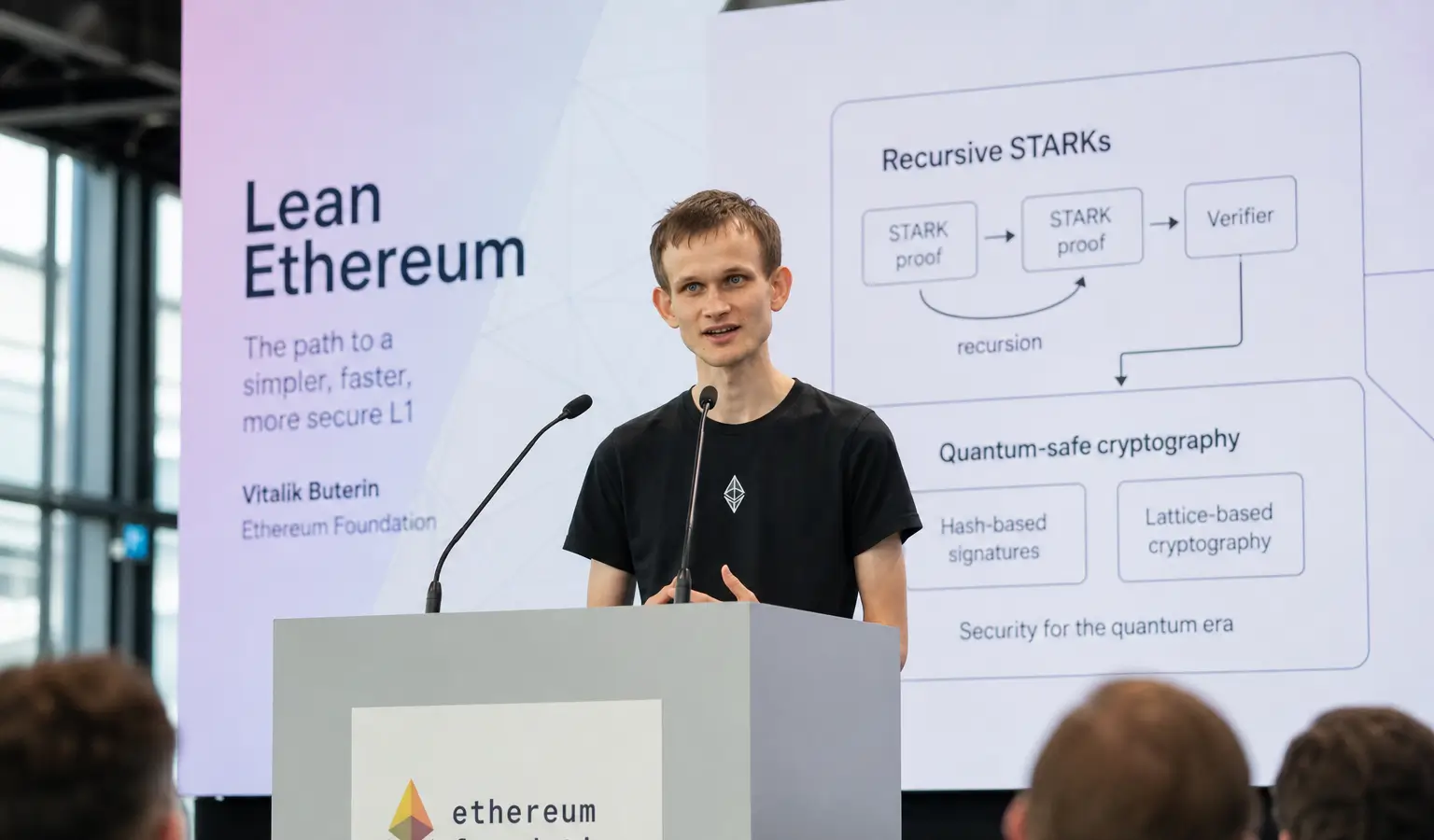
At the heart of the proposal are recursive STARKs, a cryptographic proof system that allows the chain to be verified without every node reprocessing every transaction. Buterin wants those proofs built into the protocol itself, which would move Ethereum toward a more efficient verification model and reduce the technical load on the network.
Quantum safety is also a bigger part of the picture. The roadmap would swap out quantum-vulnerable cryptography for hash-based schemes that are expected to be more resilient against future quantum computers. That lines up with a wider industry shift, as post-quantum security standards become harder to ignore.
More Scale and Lower Fees
The biggest shift is in Ethereum’s data storage model. Buterin wants to keep the core architecture largely intact while adding a strict new state type that is designed to scale toward 100 TB by 2030. According to the roadmap, moving an ERC-20 token or NFT into that format could reduce fees by more than 10x, while more complex applications such as decentralized exchanges would remain unchanged.
Privacy is also being treated as a core objective rather than a side feature. In the near term, the upcoming Glamsterdam upgrade is expected to increase the gas limit as well. Buterin also points to the Merge in 2022, which shifted Ethereum to proof of stake and cut energy use by more than 99% without major disruption for users or apps.
Criticism of the Timeline
Not everyone is convinced the proposed timeline is realistic. Ethereum Foundation researcher Dankrad Feist supported the direction of the plan, but said three to four years is far too long. He argued that, with help from AI-assisted research, it could be done in roughly a year. The strawmap is based on human-led development, although the document does note that AI could speed things up.
The timing matters even more because the Ethereum Foundation recently cut about 20% of its staff, or 54 roles. That move fits into a tighter budget plan, with annual spending set to decline from 15% to 5% of the treasury by 2030. For European crypto readers, that is a sign that Ethereum is entering a new phase not just on the technical side, but organizationally too. The real question is no longer just what gets built, but how quickly the organization can support it.
Buterin says the strawmap is only a draft, not a final blueprint. Still, he said the upcoming Hegotá fork will likely be the last one before the Lean era starts. Ether is also under pressure in the market, with the price down about 41% in 2026 to around $1,760 (€1,540), underscoring the gap between the roadmap and investor expectations.