Zcash Launches Zakura for Visa-Scale Privacy
The new full node is designed to prepare Zcash for tens of thousands of transactions per second while preserving zero-knowledge privacy and verifiability.
Key Takeaways
- Zcash has launched Zakura, a new full node built to get its infrastructure ready for payment traffic at Visa and Mastercard scale.
- Zakura is a fork of Zebra, uses pruning to reduce storage demands, and is expected to keep wallets and exchanges working through a compatibility mode.
- The next major test arrives at the end of July with Ironwood on mainnet, following an earlier Orchard bug that briefly triggered remediation steps.
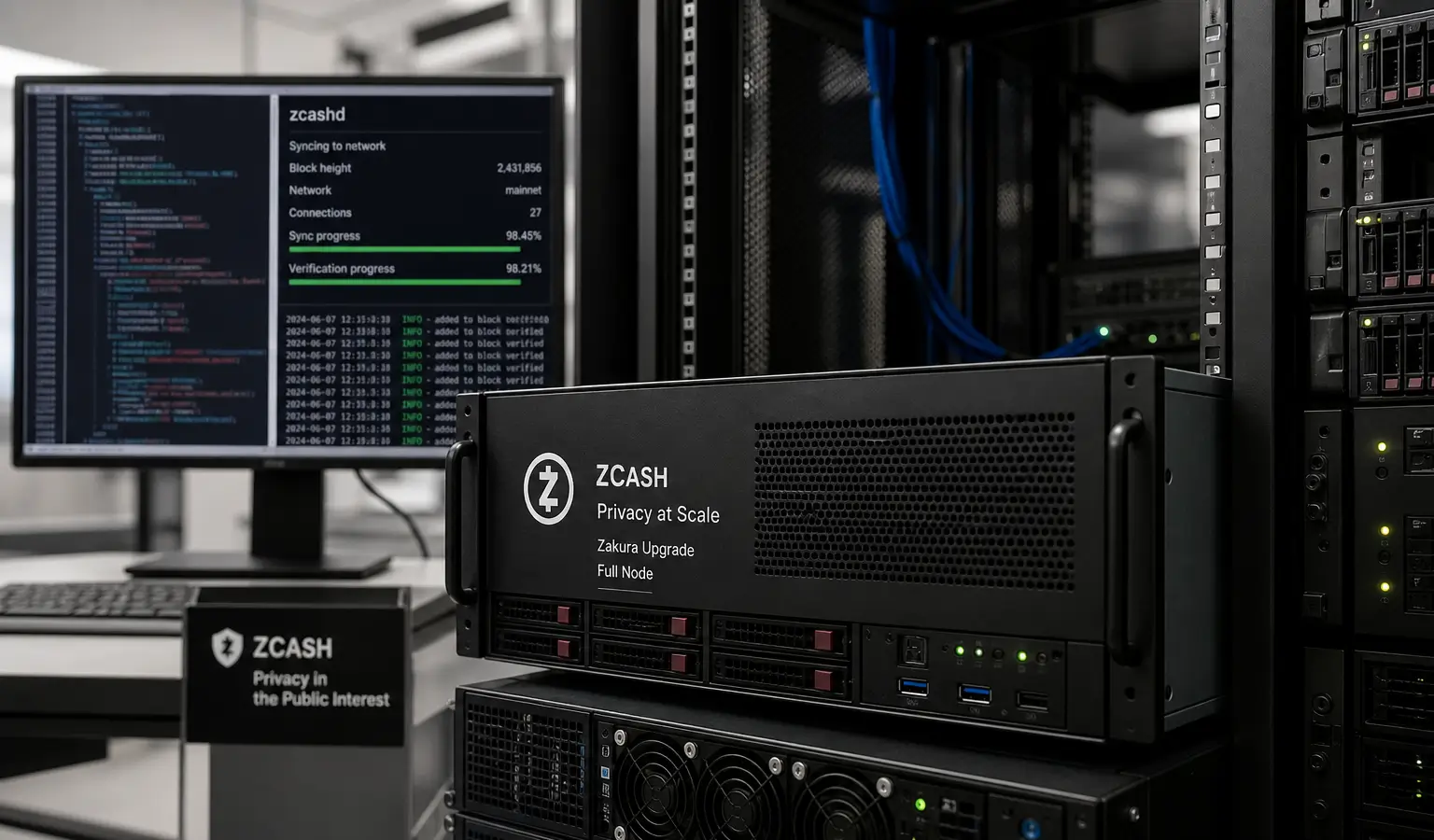
Zcash has rolled out Zakura, a new full node aimed at preparing the network for payment traffic at Visa and Mastercard scale without sacrificing privacy or verifiability. It is the first live piece of a broader infrastructure overhaul designed to make tens of thousands of transactions per second possible.
New Node for Higher Capacity
Zakura went live on Wednesday in version 1.0.0 and is being maintained by Sean Bowe, one of the founders of Zcash’s zero-knowledge cryptography, and Dev Ojha, cofounder of Osmosis and now leader of Valar Group. Both efforts are funded by private ZEC donations rather than by a company or foundation.
A full node keeps a complete copy of the blockchain and independently verifies that transactions follow the rules. Zakura is a fork of Zebra, the Zcash Foundation’s node software, so it is built on the foundation’s official codebase.
The new client can prune older data, which significantly lowers storage requirements. According to the team, a fresh node can now get up and running in under two minutes, while wallets and exchange integrations that still depend on the old zcashd interface should continue working through a compatibility mode.
Crunching Privacy at Scale
The main challenge Zakura is meant to address is technical. The team says Visa and Mastercard together handle more than 50,000 transactions per second, and for Zcash that is the baseline, not the ceiling. At the current cryptographic setup, a node would need to process more than 500 MB per second to keep pace.
That is also why Bowe is working on Project Tachyon, which centers on recursive proofs. In that model, one proof can verify the validity of thousands of others, cutting the amount of data a node has to inspect at the consensus layer. Valar Group is also developing private information retrieval, allowing wallets to pull their own data without revealing to the server which records they want.
That matters for users because Zcash has long tried to frame privacy as a core network feature, not just a niche add-on. The launch of the Zashi wallet, where shielded transactions are now the default, follows the same direction and could make the network even easier to use.
Ironwood Tests the Upgrade
The first real stress test arrives at the end of July, when Ironwood, formally NU6.3, activates on mainnet at block 3.428.143. That is around 8:00 a.m. Eastern on July 28, and Zakura supports the upgrade from release.
The timing matters after the Orchard proof circuit bug that surfaced in June. In theory, the bug could have allowed counterfeit ZEC to be created without an onchain trace, prompting developers to temporarily disable Orchard before fixing it through NU6.2. Ironwood is intended to reduce that kind of risk with a turnstile at the edge of the shielded pools, so unwanted extra supply cannot move freely through the system.
Zcash is also drawing more attention in the market. The privacy coin’s market value has now moved above Monero’s, putting Zcash back in the spotlight as one of the leading privacy-focused cryptos. For European crypto readers, the bigger takeaway is that the upgrade shows how far privacy coins have come in trying to solve scalability, wallet experience, and security at the same time.