Armstrong Says Bitcoin Became Digital Gold as Stablecoins Take Over Payments
Armstrong says Bitcoin has mostly become a store of value, while stablecoins like USDT and USDC are increasingly handling everyday payments on blockchains.
Key Takeaways
- Brian Armstrong says Bitcoin has mostly become digital gold and is no longer everyday digital money.
- According to Armstrong, stablecoins now fill the role of a payment method on blockchains.
- He calls Bitcoin a successful store of value, while it never really broke through as a payment tool.
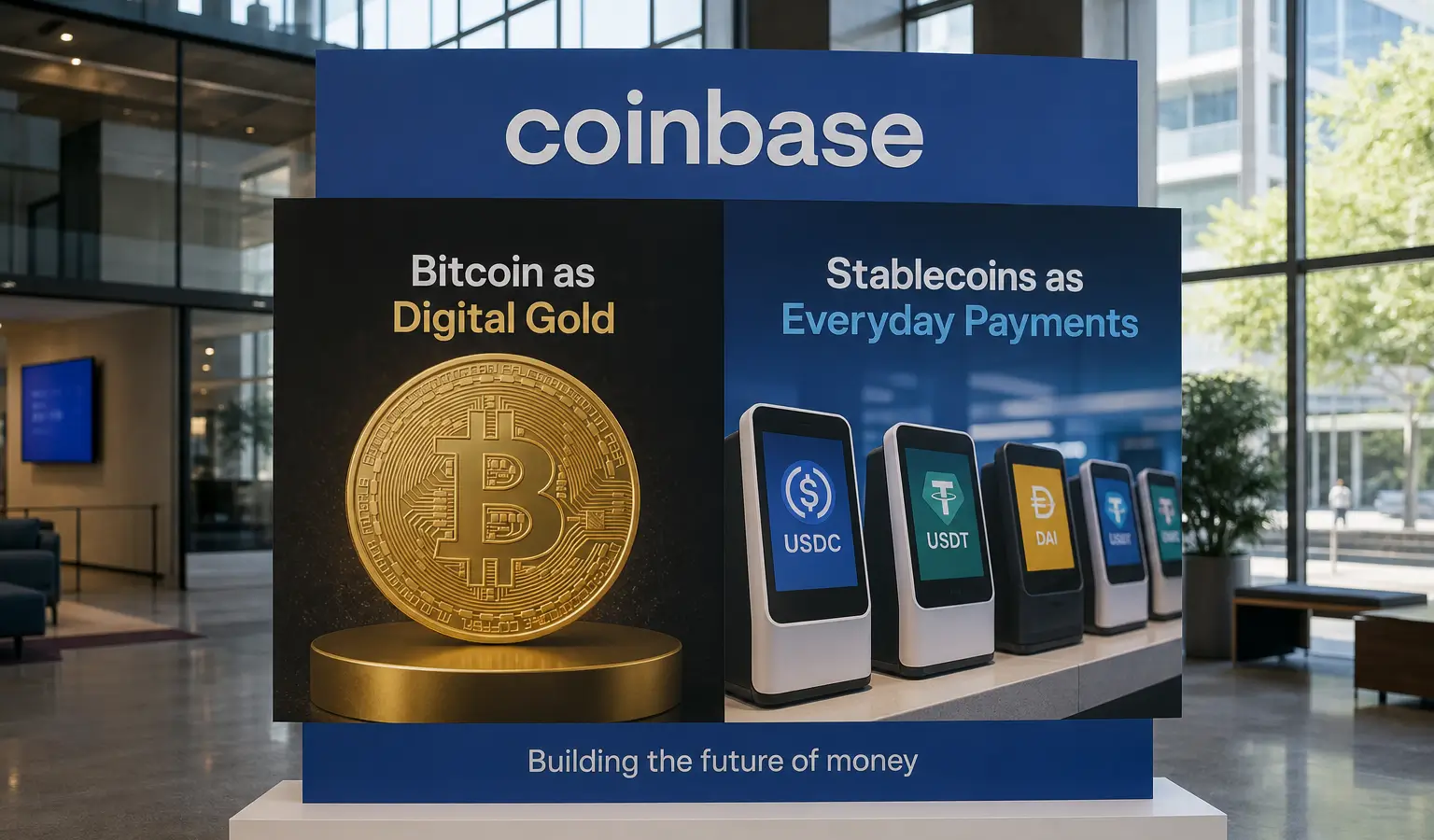
Coinbase CEO Brian Armstrong says Bitcoin never fully became the everyday digital money Satoshi Nakamoto originally envisioned. In his view, Bitcoin has settled into the role of digital gold, while stablecoins have stepped in as the main payment option. That brings one of crypto’s oldest debates back into focus: what is Bitcoin actually for in a market that has grown far beyond its early days?
Bitcoin as a Store of Value, Not a Payment Method
Armstrong shared that view during an interview with Zerodha founder Nikhil Kamath on the People by WTF podcast. Asked whether Bitcoin still serves the purpose it was built for, he said it now functions mostly as a store of value rather than a medium of exchange.
The price action reflects that shift. Bitcoin is trading around $64,523 (€56,400), which leaves it about 45 percent below its October 2025 peak of $126,080 (€110,300). In other words, it has increasingly become something investors hold onto, not something they use to pay for goods and services.
Armstrong also pointed to the Lightning Network as an effort to make Bitcoin more useful for payments. The layer is designed to speed up transactions and lower costs, but he said it never really reached broad adoption. That fits the larger picture: Bitcoin has improved technically, but it still has not reclaimed a major role as a payment network.
Stablecoins Fill the Gap
If Bitcoin became more of a savings asset, Armstrong argued, stablecoins took over the payments side. These dollar-pegged tokens have grown quickly and are now widely used as a practical way to move money on blockchains. In Armstrong’s view, fiat-backed stablecoins now handle the medium of exchange role, while Bitcoin remains digital gold.
The market size supports that argument. According to DefiLlama, the stablecoin supply is close to $310 billion (€271 billion), with Tether’s USDT at $184 billion (€161 billion) and Circle’s USDC at $73 billion (€63.8 billion). Armstrong also pointed to the GENIUS Act, signed in July 2025, as a key step toward clearer rules in the US.
Why This Matters for Europe
For European crypto readers, the takeaway is that the market is increasingly splitting into two clear use cases: Bitcoin as a reserve-style asset and stablecoins as payment infrastructure. That divide also feeds into bigger questions around regulation, adoption, and the role of blockchains like Base and Solana, where much of this activity is now taking place.
The shift also changes the broader conversation around Bitcoin itself. In practice, the network is becoming more about storing value and governance, as shown in the debate around BIP-110 and Ordinals, while payment activity moves elsewhere.
Armstrong does not see that as a setback. In his view, Bitcoin works well as digital gold and was never really built for high-volume payments. So from his perspective, Bitcoin did not fail. It simply ended up with a different job than Satoshi Nakamoto originally imagined.