Balance Stablecoin Crashes 99% After Oracle Exploit
The attack hit Balance Protocol through a manipulated bitcoin oracle, causing unfair vault liquidations and an estimated $912,000 haul, according to SlowMist.
Key Takeaways
- Balance Coin dropped more than 99% on Wednesday after an exploit hit the Balance Protocol oracle.
- The attacker manipulated a bitcoin price feed, triggering unfair liquidations and stealing about $912,000.
- The incident is another reminder that DeFi systems remain exposed when price feeds and liquidation logic depend too much on a single data point.
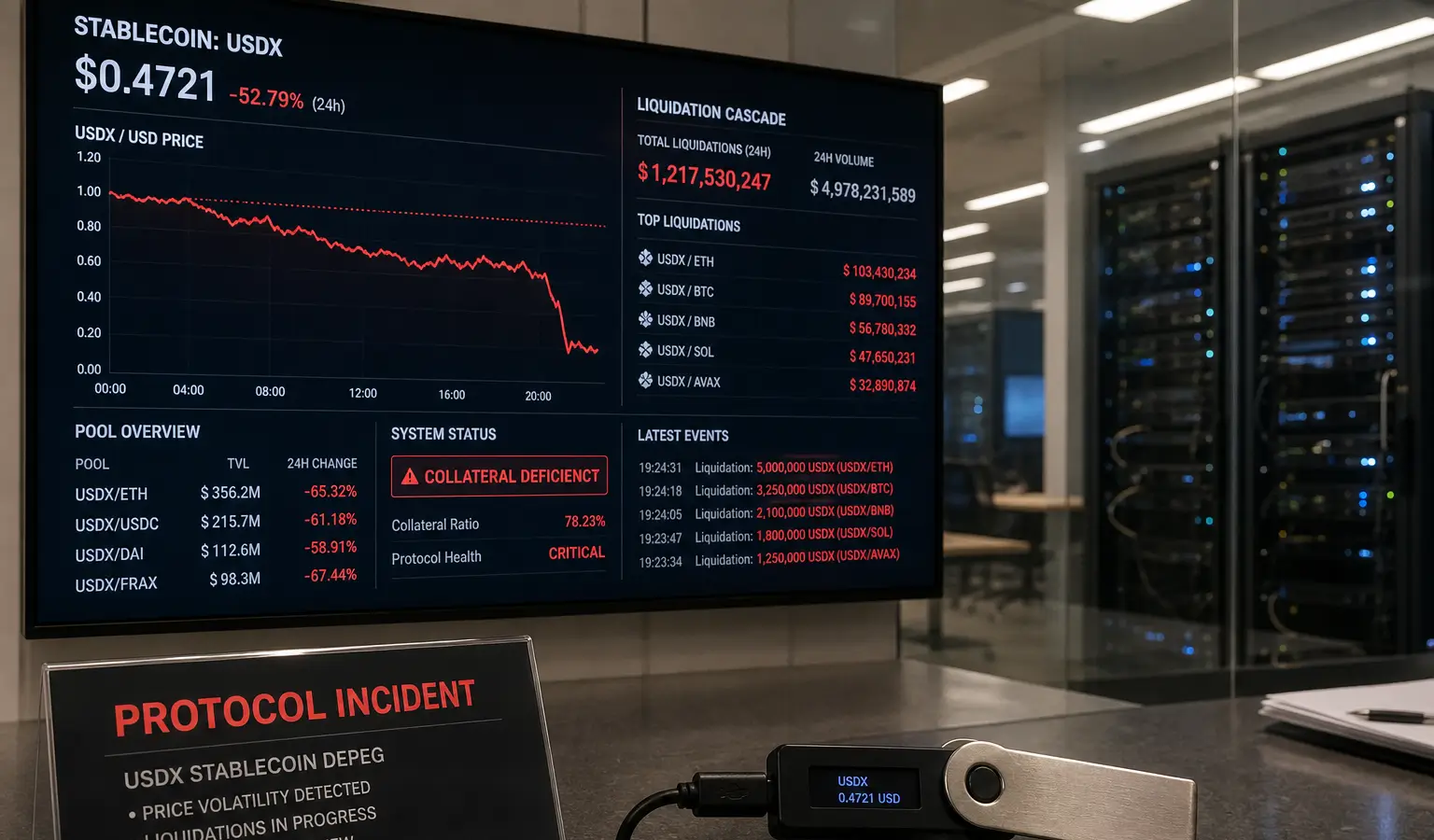
Balance Coin lost more than 99% on Wednesday after an attacker took advantage of a pricing flaw in the protocol behind the stablecoin. The token had still been trading near $1 (€0.88) a day earlier, but it fell to around $0,0014 (€0,0012), erasing nearly all of its roughly $3.5 million (€3.1 million) nominal value.
How the Attack Worked
Blockchain data and security firm SlowMist show that the attacker manipulated the Balance Protocol oracle, the external price feed the system depends on. That allowed an unrealistically low bitcoin price to be recorded in the protocol, without the lending contract first verifying whether the number fell within a reasonable range.
Once that happened, multiple vaults were liquidated immediately, even though they should not have met the normal liquidation threshold. In the same transaction, the attacker converted the released collateral into profit and ultimately walked away with about $912,000 (€798,700) from the treasury of 42DAO, the governance structure behind the protocol.
Why This Matters More Broadly
The exploit is a reminder that DeFi systems are still vulnerable when price feeds and liquidation rules rely too heavily on a single input. Back in 2020, DeFi networks lost more than $33 million (€28.9 million) to oracle manipulation, and protocols have since tried to limit that risk with tools such as TWAPs, multiple oracles, and circuit breakers.
For European crypto readers, the issue matters because stablecoins and lending protocols are increasingly being marketed as core infrastructure for wider crypto adoption. But that only works if the underlying security holds up, especially at a time when flash loans and other fast-capital attack methods are still very much part of DeFi. That also makes the recent debate over collateral acceptance even more relevant: if collateral and price feeds are not solid, a protocol can unravel fast.
DeFi Under Extra Pressure
The exploit lands as DeFi security is getting even more attention. The sector is not just dealing with familiar smart contract risks, but also with a broader question of how easily automated systems can be manipulated when safeguards are missing or too weak.