Binance.US Aims to Win Back 20% of the U.S. Market
The U.S. arm wants to win customers back with near-zero trading fees and deeper liquidity. Its growth plans are also tied to tighter oversight after the $4.3 billion settlement in 2023.
Key Takeaways
- Binance.US wants to move back toward about 20% market share in the U.S. crypto market.
- CEO Stephen Gregory says the last two years were basically a period of hibernation because of legal and regulatory pressure.
- The crypto exchange is cutting trading fees and leaning into more liquidity and product growth.
Binance.US says it is back in growth mode and wants to reclaim roughly 20% of the U.S. crypto market. CEO Stephen Gregory said the last two years were effectively a period of "hibernation" as the broader Binance brand dealt with legal and regulatory problems, but he said the U.S. business is now rebuilding.
Lower Fees as the Hook
Gregory said Binance.US is a separate U.S. company with its own governance, even though it shares the Binance name and the same ultimate owner as Binance.com. He added that the exchange is now licensed only to serve U.S. customers. That separation matters because the global Binance exchange is not open to U.S. users, and Binance.US itself offers a narrower set of products.
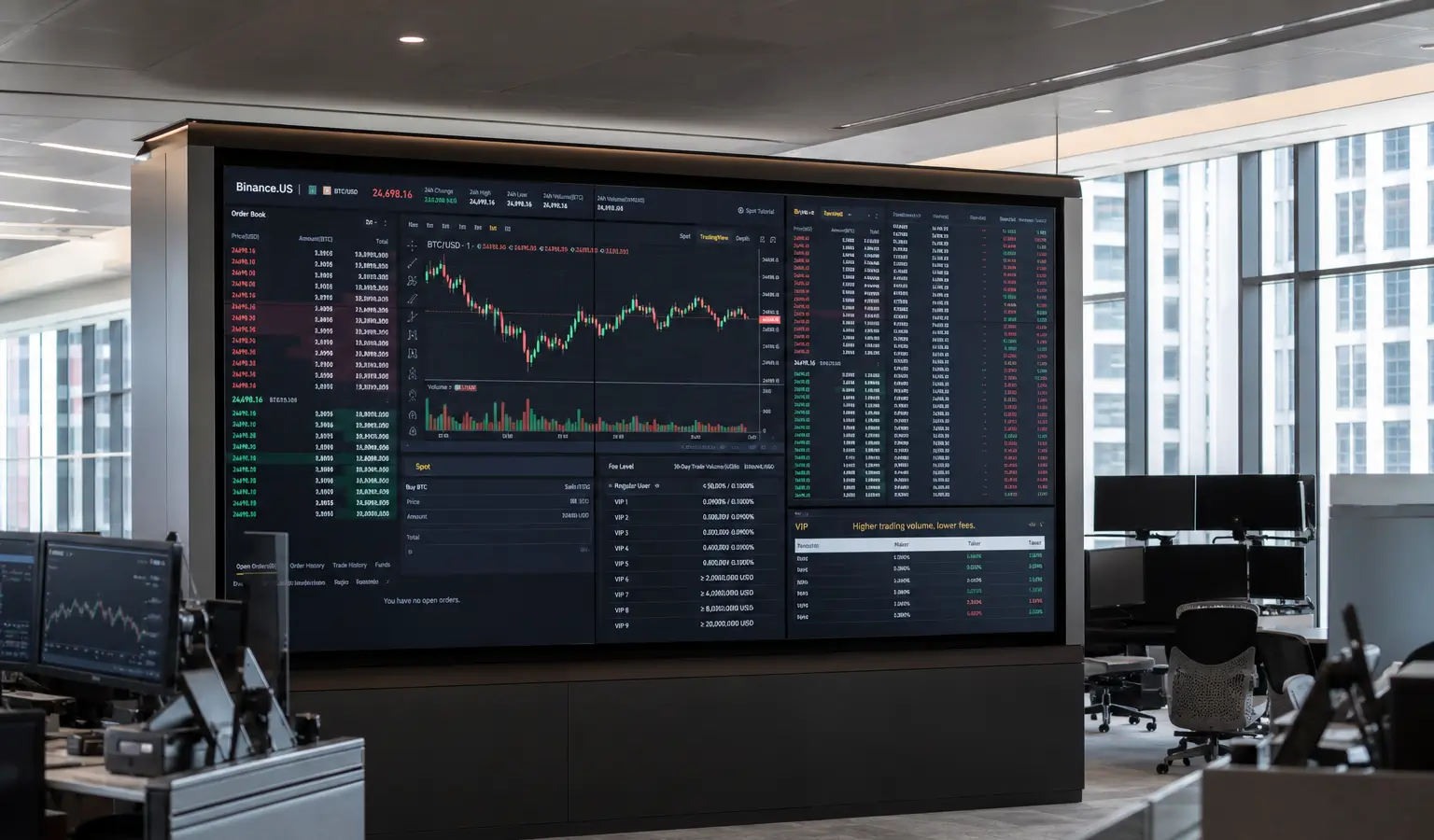
To stand out from competitors like Coinbase and Kraken, the exchange is leaning hard into low trading fees. Gregory said Binance.US has reduced fees to "essentially almost a no-fee exchange," with 0% maker fees and 2 basis points taker fees. The company keeps its operating model lean and also plans to generate revenue from services such as custody.
Liquidity and Product Expansion
Binance.US is also trying to rebuild liquidity through incentives and direct outreach to retail users. Gregory said he personally contacted some of the platform's largest users to hear their feedback. The goal is to deepen the order book, tighten spreads, and make the exchange more appealing to active traders.
The push comes after Binance agreed to a $4.3 billion (€3.8 billion) settlement with U.S. regulators in November 2023, including the Department of Justice, FinCEN, OFAC, and the CFTC, over violations tied to the Bank Secrecy Act, sanctions rules, and the Commodity Exchange Act. Binance.US operates as a separate entity, is registered with FinCEN as a money services business, and is geo-restricted with a more limited product lineup and exclusions from states including New York, Texas, and Florida.
What This Means for European Readers
For European crypto readers, the story is a reminder of how much regulation still shapes the strategy of major exchanges. Gregory said a more favorable U.S. regulatory backdrop could allow Binance.US to expand into derivatives, perpetual futures, and prediction markets, while regulators like the CFTC and SEC are expected to remain active in the market in the years ahead. That makes Binance.US's repositioning in the U.S. relevant for anyone following the growth of regulated crypto platforms.
Other major exchanges are also looking for ways to earn more beyond spot trading. Coinbase Expands Into Derivatives and AI to Cut Its Dependence on Trading Fees is another example of how widespread that shift has become across the industry.