Bitcoin and Ethereum Exchange Balances Hit Record Lows
Santiment sees the lowest exchange reserves since 2017 and 2015, but spot ETFs, staking, and institutional custody make the old bull signal less clear-cut.
Key Takeaways
- The amount of Bitcoin and Ethereum on exchanges has dropped to its lowest level in years.
- Santiment says Bitcoin is at 6.6 percent and Ethereum at 4.3 percent of circulating supply on exchanges.
- Low exchange reserves are less clear-cut because of institutional custody, spot ETFs, staking, and DeFi.
The amount of Bitcoin and Ethereum sitting on crypto exchanges has slipped to its lowest level in years, but that does not mean a fresh rally is around the corner. In the past, shrinking exchange reserves were often treated as a straightforward bullish sign. Today, though, traders say that signal is harder to read because of institutional custody, spot ETFs, and the broader financial plumbing now built around crypto.
Old Signal, New Market
For a long time, the logic was simple: when fewer coins were held on exchanges, there was less immediate selling pressure and prices had room to rise. Santiment says that idea still gets repeated often on social media, but the market has changed a lot since Bitcoin’s early years.
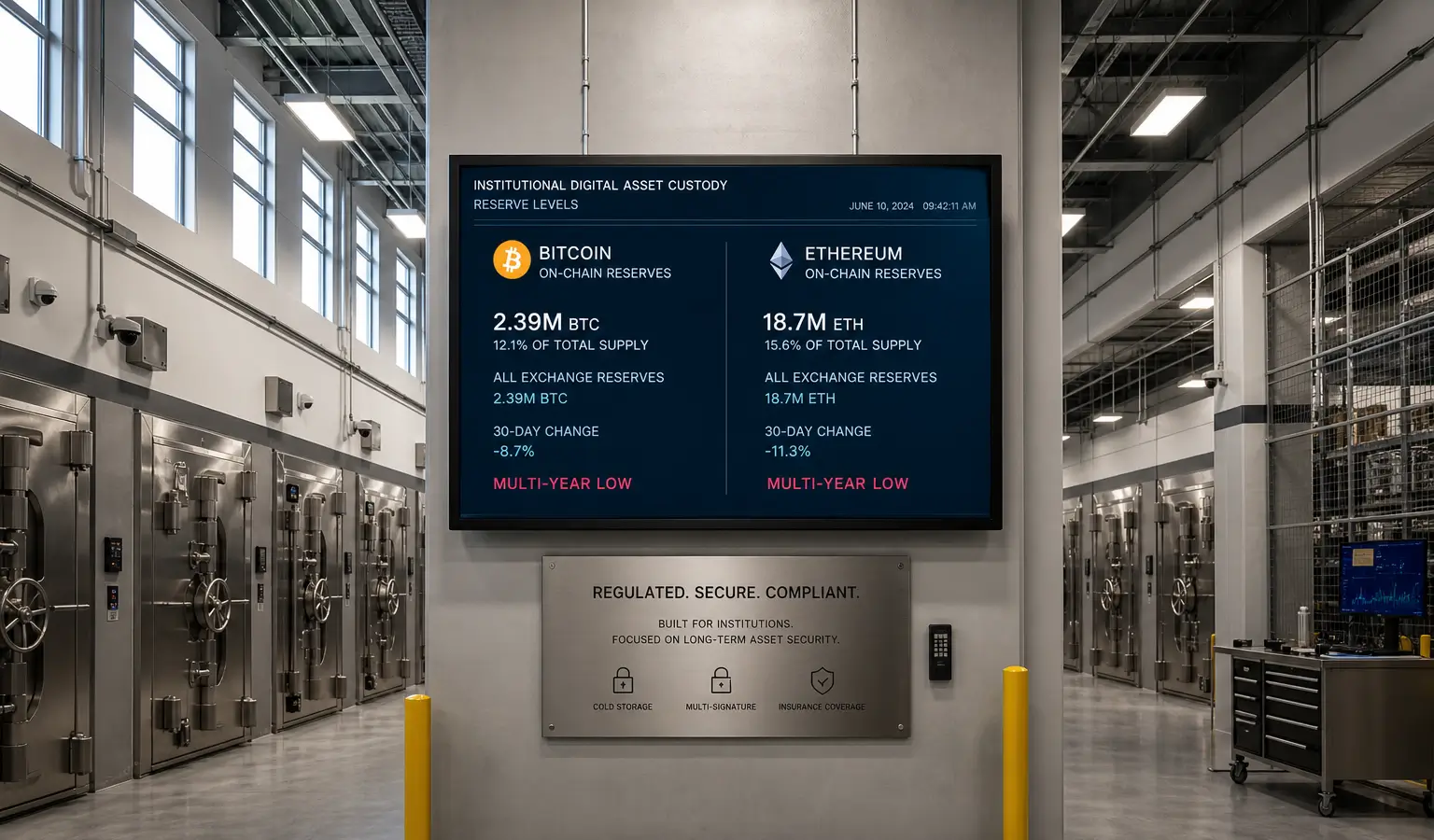
According to Santiment data, Bitcoin exchange supply now stands at 6.6 percent of circulating supply, while Ethereum is at 4.3 percent. Those are the lowest readings since 2017 and 2015, respectively. Even so, Bitcoin was trading at roughly half of its peak during that same stretch, which is a reminder that low exchange balances alone no longer guarantee a quick reversal.
Where the Coins Are Going Now
Visible exchange balances matter less than they used to, because a lot of crypto is not simply vanishing into cold storage. Some of it is moving into staking, DeFi protocols, or institutional vaults, where the assets are still in play but no longer sitting on a centralized exchange.
Spot Bitcoin ETFs have also reshaped the picture. When demand for those funds picks up, issuers buy Bitcoin to create new shares, and the coins are moved from exchanges or OTC desks into institutional custodians such as Coinbase Custody, Fidelity Digital Assets, and BitGo. Coinglass says U.S. spot Bitcoin ETFs now hold about $73 billion (€64 billion) in net assets, equal to more than 641,400 BTC. Ether ETFs account for about $13.7 billion (€12 billion) and roughly 7.7 million ETH.
That is why market watchers say the drop in exchange supply mostly reflects how much Bitcoin and Ethereum have shifted into regulated storage and onchain use. For European crypto readers, that matters because liquidity is increasingly spreading beyond the old exchange model. In that same institutional setup, BlackRock recently argued for a small Bitcoin allocation as part of a broader portfolio strategy.
Less Supply, More Nuance
Not everyone thinks the current numbers should be read as a clean signal for the next bull run. Mark Zalan, CEO of GoMining, says falling exchange supply has often come before several quarters of higher prices, but he also notes that no one can identify the exact turning point in advance.
That caution makes sense in a market where more players are holding coins off exchanges. According to Bitcoin Treasuries, public companies, private companies, governments, DeFi protocols, and ETFs together control a large share of supply that is no longer actively trading. In total, nearly 11.2 million Bitcoin is now outside active circulation, or about 56.5 percent of the current supply.
So while the old exchange reserve signal is not meaningless, it is definitely less straightforward than it used to be. For Bitcoin and Ethereum, the bigger question now is not just whether coins are leaving exchanges, but where they are going and how liquid those new holding structures really are in practice.