Bitcoin and Stocks Head Into a Volatile Second Half
AI is dividing the stock market, while Bitcoin hovers around $58,300. Spot Bitcoin ETFs and derivatives are making the coin more sensitive to macro and liquidity shifts.
Key Takeaways
- The first half of the year was mostly driven by the AI trade, but market watchers expect the second half to separate the winners from the losers.
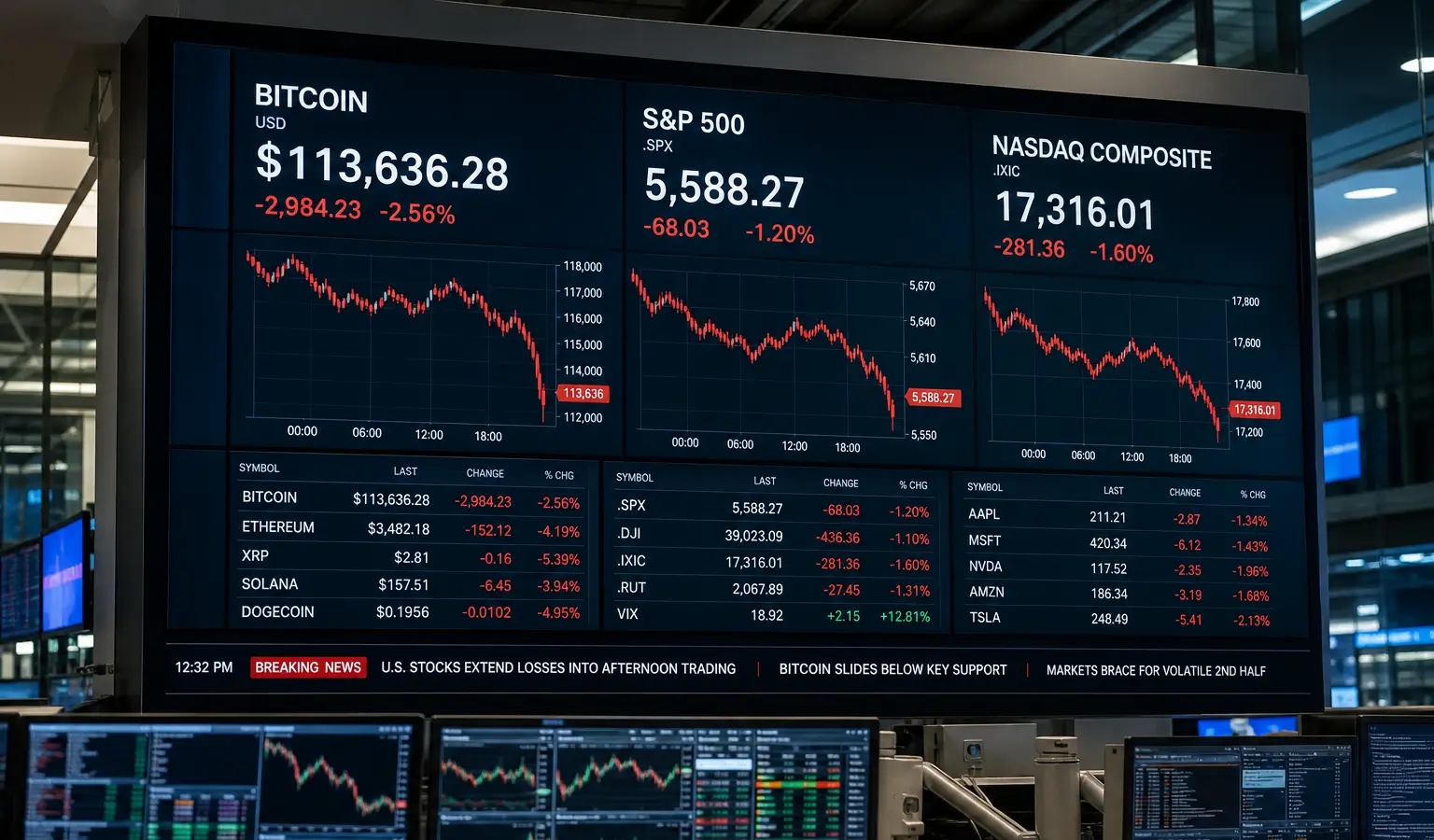
- Bitcoin was trading around $58,300 on Tuesday after falling 46% this year, leaving it highly exposed to macroeconomic swings.
- Analysts say Bitcoin may be building a bottom between $54,000 and $58,000, while spot Bitcoin ETFs and derivatives have changed the way the market trades.
The first half of the year was all about the AI trade, but market watchers say the second half may be more about which companies and assets actually capture the upside. That shift matters for both stocks and crypto, especially with Bitcoin lagging badly this year and the broader crypto market looking more reactive to macro headlines.
AI Splits the Market
Former Credit Suisse executive Mark Connors says AI is no longer lifting the tech sector across the board. Instead, he sees a growing divide between companies building AI infrastructure and businesses whose products or services are being pressured by large language models and AI agents.
He pointed to the recent slide in Accenture's stock as a sign that investors are reassessing consulting firms now that generative AI can take over more knowledge work. He also cited software names such as Autodesk and Intuit, saying they show how pressure on traditional software could continue.
Even so, Connors says macro uncertainty remains the main force driving financial markets. Kestrel data shows the correlation between stocks, bonds, commodities, and crypto has climbed over the past few months, suggesting investors are responding more to policy shifts than to company-specific fundamentals.
Bitcoin Remains Under Pressure
Bitcoin was trading around $58,300 (€51,200) on Tuesday after dropping 46% this year. That has renewed debate over whether the coin has finally broken from its old four-year cycle, especially after the launch of U.S. spot Bitcoin ETFs.
Chris Sullivan, co-founder and portfolio manager at digital asset hedge fund Hyperion Decimus, says those ETFs, along with hedging in derivatives markets, have changed how Bitcoin trades. In his view, that has weakened many of the asset's old links to broader macro indicators, even if he still sees the current decline as part of a familiar market pattern.
Sullivan is waiting for a clear bottoming setup before saying the bear market is over. He thinks Bitcoin could eventually bottom in the $54,000 (€47,400) to $58,000 (€50,900) range, where stronger on-chain fundamentals and weak sentiment could create a better risk-reward setup once the uncertainty clears.
The price action lines up with the broader strain in the market. The Bitcoin demand drought in the U.S. has now lasted eight weeks, which also shows that American demand for BTC has been under pressure for some time.
Why This Matters
For European crypto readers, the main takeaway is that Bitcoin is increasingly being traded as part of a wider macro and liquidity backdrop rather than as a standalone asset. That could also shape how investors think about spot Bitcoin ETFs, derivatives, and other products tied to the same market cycle.
The discussion also reflects a broader shift on Wall Street, where traditional firms are folding crypto more directly into their market outlooks. If that continues, Bitcoin's reaction to rate expectations, risk sentiment, and institutional flows could keep evolving.