Bitcoin Demand Drought in the U.S. Has Lasted Eight Weeks
The Coinbase Premium Index has been negative for eight straight weeks, while U.S. investors shift capital into semiconductor ETFs and BlackRock’s Bitcoin fund sees outflows.
Key Takeaways
- Bitcoin demand from the United States has been weak for eight weeks, while the Coinbase Premium Index has stayed below zero since May 6.
- Bitcoin has drifted toward $59.500 after the negative premium began when the price was still around $81.429.
- U.S. investors are rotating into semiconductor stocks, while Bitcoin and gold ETFs have shed about $12 billion combined since April.
Demand for Bitcoin in the United States has been soft for eight straight weeks, even as money continues to move into chip stocks. The Coinbase Premium Index has remained negative since May 6, marking its longest losing streak in more than a year, while Bitcoin has eased toward $59.500 (€52.200).
Coinbase Signal Remains Weak
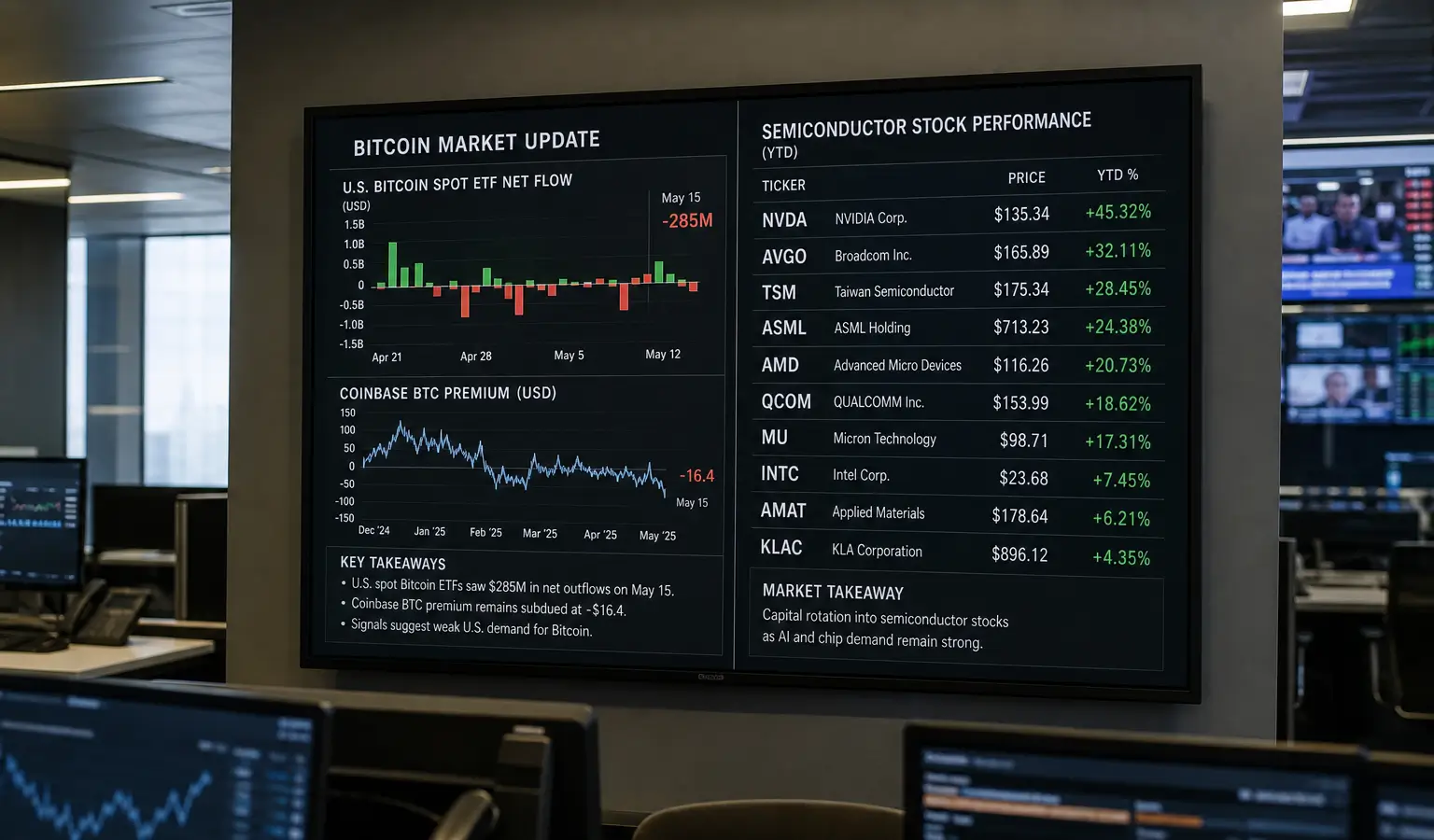
The Coinbase Premium Index tracks the price difference between Bitcoin on Coinbase and on other major exchanges. A negative reading means U.S. buyers are paying less for BTC than traders elsewhere, which is usually a sign that domestic demand is cooling.
That weakness has now persisted for weeks. The streak began when Bitcoin was still trading near $81.429 (€71.500) and has since stretched to roughly eight weeks. It is the longest run of its kind since early 2025 and suggests U.S. buyers are not the main force lifting the market right now.
Capital Is Flowing Into Chips
The slowdown in Bitcoin demand fits into a broader shift in U.S. markets. Investors are not sitting on the sidelines; they are putting money into semiconductors instead. According to market data, semiconductor stocks have outperformed the S&P 500 by about 85 percentage points this year, the biggest first-half lead ever recorded.
That rotation is also showing up in fund flows. Since April, U.S. gold and Bitcoin ETFs have lost about $12 billion (€10.5 billion) combined, while chip ETFs have attracted around $20 billion (€17.6 billion). BlackRock’s iShares Bitcoin Trust, the largest Bitcoin fund tracker, also recorded the biggest monthly outflow among spot ETFs in June since its launch.
Bitcoin is still hovering near the psychologically important $60.000 (€52.700) level, with analysts warning of more downside risk if that support gives way.
Why This Matters
For European crypto readers, the main takeaway is how dependent Bitcoin still is on U.S. demand. The Coinbase Premium Index is often used as a quick read on that sentiment, and a long stretch below zero can point to market conditions that are temporarily working against BTC. Still, it is not a one-way signal: in the past, a negative premium has sometimes come before a rebound, so it remains worth watching closely.
The current setup also makes the gap with other risk assets easier to see. Bitcoin is still lagging the tech sector this year, even though the Nasdaq and BTC usually move in a fairly tight range together. That divergence shows this rotation is about more than crypto alone; it is also about where U.S. capital wants to go right now.