Bitcoin BIP-110 Gets Little Support Ahead of August Deadline
The soft fork would limit OP_RETURN and other data paths, but miner support is still at zero. The fight over Ordinals and Bitcoin Core shows how difficult protocol changes are without consensus.
Key Takeaways
- BIP-110 uses a soft fork to temporarily restrict more non-financial data in Bitcoin transactions.
- Miner support is still at zero, and node adoption remains low.
- Critics say BIP-110 could set a risky precedent for changing consensus rules and valid transactions.
Bitcoin is heading into another governance showdown as BIP-110 approaches its August deadline, with miner support still sitting at zero. The proposed soft fork would temporarily limit more non-financial data in Bitcoin transactions, but pushback across the community remains strong and broad support still looks distant.
What BIP-110 Wants to Change
BIP-110, formally known as the Reduced Data Temporary Soft Fork, focuses on what Bitcoin block space should be used for. The proposal would restore OP_RETURN to its older, smaller limit, block most arbitrary data chunks above 256 bytes, and limit certain script formats that are mainly used to store data.
That would hit use cases such as Ordinals, inscriptions, and some token schemes, which depend on those paths to place images, text, or token metadata onchain. Supporters argue the change would keep Bitcoin closer to a payments network and ease the burden on nodes.
Critics, however, see a much bigger issue. Michael Saylor said BIP-110 turns a spam dispute into a consensus change that could invalidate transactions that are still valid and paying fees today. Adam Back echoed that view, saying Bitcoin simply says no to this approach.
Support Is Still Far Behind
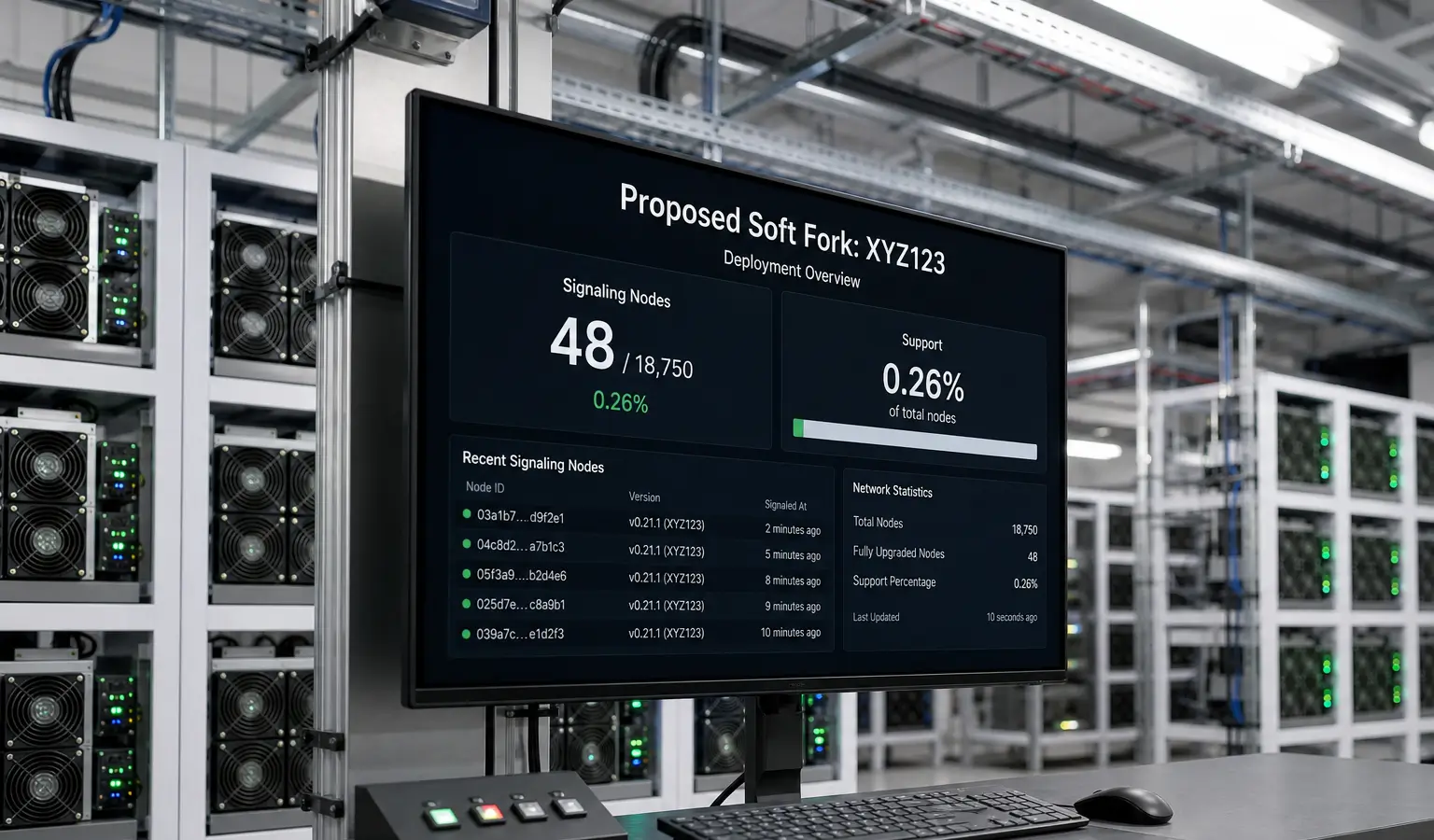
The current numbers leave little doubt about where support stands. According to the signaling monitor, miner support has never climbed above roughly 1 percent and is now at zero, with no backing from a major mining pool. Node adoption is also weak and comes almost entirely from Bitcoin Knots, an alternative to the more widely used Bitcoin Core software.
Even so, the process is still moving. The current signaling window runs from block 957.600 to 959.615, with a voluntary lock-in deadline at block 961.542 in the next period. If BIP-110 is activated in software, nodes could start rejecting blocks that do not signal support, with activation potentially arriving around September.
Why This Matters
For European crypto readers, the debate matters because it highlights the tension between Bitcoin as money and Bitcoin as a data layer. These governance fights can also affect developers, node operators, and teams building on Bitcoin infrastructure. The outcome could also show how difficult it is to push through major protocol changes without broad agreement.
The discussion is also not happening in isolation: in a more recent fight over BIP-110 and Ordinals, the clash between data use and Bitcoin's role as a monetary network was already the central issue.