Bitcoin Holds Near $66,300 as Yen Slides
The weak yen and the ongoing chip rally are supporting risk sentiment, while Bitcoin is still mostly moving with macro factors and does not have its own catalyst yet.
Key Takeaways
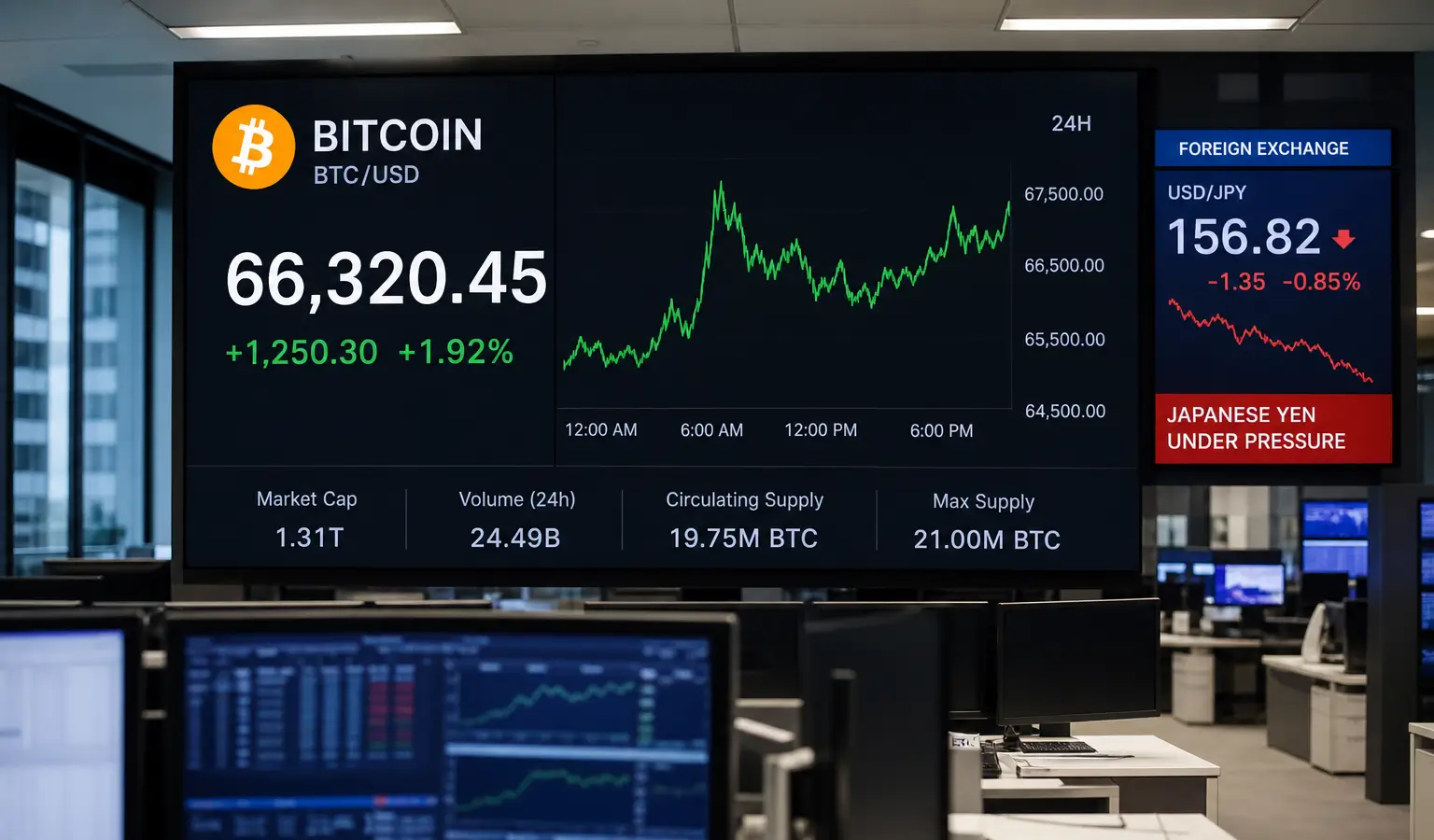
- Bitcoin held around $66,300 on Wednesday, consolidating at its highest level in two weeks.
- The Japanese yen fell to its weakest level in four decades, while semiconductor stocks and broader Asian markets kept climbing.
- Bitcoin is still reacting strongly to global macro factors, but its correlation with semiconductor stocks has eased in 2026.
Bitcoin was trading near $66,300 (€58,100) on Wednesday, holding steady at a two-week high as semiconductor stocks extended their rally and the Japanese yen sank to its weakest level in four decades. For crypto traders, it was a familiar setup: supportive macro conditions, but still no obvious crypto-specific trigger.
Chip Rally Keeps Crypto Supported
The largest crypto asset gained almost 1% on the day and 3% over the past week. Roughly $31 billion (€27.2 billion) changed hands, while Bitcoin traded between about $65,400 (€57,300) and $66,900 (€58,600) over the last 24 hours. Ether was sitting near $1,935 (€1,690), XRP climbed 2% to $1.14 (€1.00), and TRON also moved higher. HYPE from Hyperliquid underperformed, falling 4% to $60 (€53) and dropping 10% across seven sessions.
The move lines up with a broader market that is still following the chip trade. MSCI's Asia Pacific index added 1% after logging its best day in a month on Tuesday. In South Korea, the Kospi surged 5% as signs grew that the unwind in leveraged positions, which had earlier pushed the index nearly 30% below its peak, was starting to ease.
Yen Under Pressure
The yen broke below 163 per dollar for the first time since 1986. Finance Minister Satsuki Katayama said officials are still prepared to take "bold steps" if necessary, but that warning has not stopped the currency from sliding so far. A stronger dollar, higher U.S. Treasury yields, and rising oil prices tied to the conflict with Iran are all adding to the pressure.
For Bitcoin, that matters because a weaker yen and broader currency stress tend to bring the fiat debasement debate back into focus. Still, the relationship is not as simple as it is often portrayed. Bitcoin's correlation with semiconductor stocks has actually eased in 2026, which suggests the asset is not just moving in lockstep with the chip sector. That supports the idea that Bitcoin is still mostly trading as a macro asset, as seen in the recent test of $68,000, where ETF inflows helped, but overall trading remained thin.
What This Means for Europe
For European crypto investors, this move is another reminder that Bitcoin still reacts sharply to global macro forces, from rate expectations to currency stress. That could matter in a market where regulation, network activity, and adoption trends are also becoming more important alongside the usual risk-on mood in equities. In other words, this latest move says more about the mix of forces shaping crypto than about any single driver on its own.