Bitcoin Power Law Gets Peer Review After New Study
The study in Nonlinear Science gives the model more academic credibility, while the current bear market is testing whether Bitcoin’s price really moves along a power law.
Key Takeaways
- The Bitcoin Power Law has now been peer-reviewed in the journal Nonlinear Science, adding academic support to the idea that Bitcoin’s price follows a long-term pattern.
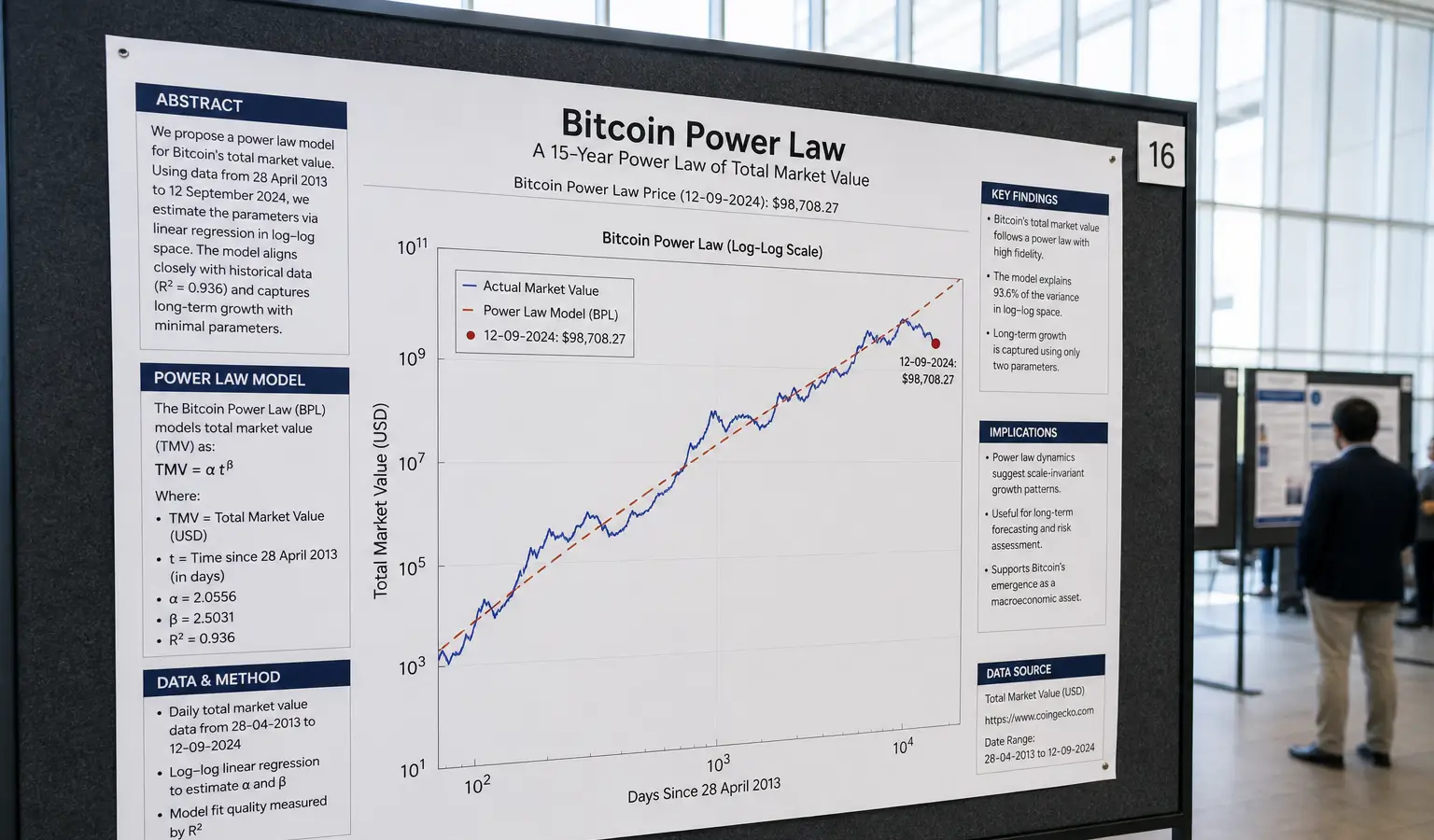
- The study looked at 5,696 daily prices and says a single stable curve explains about 96 percent of the long-term price variation.
- The current bear market is putting the model to the test, and the authors say it can also identify clear breakpoints and deviations.
The Bitcoin Power Law has now made it through peer review after a new study in the journal Nonlinear Science argued that the long-term price of Bitcoin follows a predictable mathematical pattern. For people who support the model, that is a meaningful milestone, especially with the current bear market now testing whether the theory can survive outside a bull run.
From Reddit to Science
The model was first developed more than 10 years ago by physicist Giovanni Santostasi, who posted the idea on Reddit in 2014. He noticed at the time that Bitcoin’s price, when plotted on a logarithmic scale, lined up with a straight line more closely than expected. He later expanded the idea in an essay, while critics brushed it off as curve fitting, much like the criticism often aimed at the well-known rainbow chart.
The new paper, by Santostasi and Stephen Perrenod, is meant to narrow that gap. The authors argue that Bitcoin is not just a random price series, but a network whose growth can be described over time with a power law. Earlier academic work, including a 2018 analysis by Timothy Peterson and a 2019 Royal Society study, had already connected Bitcoin to network value, but those studies still treated the growth rate as a parameter fitted to the data.
What the Study Claims
The researchers examined 5,696 daily Bitcoin prices from July 2010 through February 2026. Over that stretch, they say a single stable curve accounts for about 96 percent of the long-term price variation. They also say the projected growth rate would come within 1.6 percent of the measured value.
The model’s basic idea is straightforward: new users arrive in waves, and the network’s value increases as each new participant connects with everyone already there. According to the authors, that dynamic has tracked Bitcoin’s price surprisingly well for 15 years. They also note that speculation still matters, but mostly as noise around the trend rather than the main force behind it.
The paper also highlights clear breakpoints, including a sharp drop below the trend, a slowdown in adoption, or a weaker connection between price and network data. That keeps the theory testable, even if the market behaves differently from earlier cycles.
Why This Matters Now
For European crypto watchers, the bigger takeaway is that Bitcoin is once again being measured against other valuation models, including Stock-to-Flow, which are under strain in this market cycle. Peer review gives the Power Law model more academic weight, but it does not change the fact that the current downturn sits outside the study’s dataset. That is exactly why this bear market is turning into a real-world test for a model that has mostly lived in community charts and online debates for years.
The argument over valuation models is also unfolding against a broader market backdrop. In an analysis of the second half of the year, for example, the focus is on continued volatility, weak Bitcoin demand, and a possible bear-market bottom in the $54,000 (€47,400) to $58,000 (€51,000) range.