Cardano Launches Token Standard for Freezing and Recovery
CIP-0113 lets issuers control token transfers, freezing, and recovery. The standard is aimed at stablecoins, funds, and bonds under stricter compliance requirements.
Key Takeaways
- The Cardano Foundation launched CIP-0113, a token standard for stablecoins, funds, and bonds with built-in transfer rules.
- The standard lets issuers decide who can receive assets and, according to the Foundation, can also make freezing or recovery possible.
- CIP-0113 is live after security audits; ADA fell 4.5% in 24 hours, while Cardano focuses on regulated tokenization in Europe.
The Cardano Foundation has launched a new token standard that lets issuers of stablecoins, funds, and bonds decide who can receive their assets. The standard, CIP-0113, is live on the network after independent security audits were completed. Cardano’s ADA fell 4.5% over the past 24 hours, along with a broader drop in the crypto market.
Rules Built Into the Token Itself
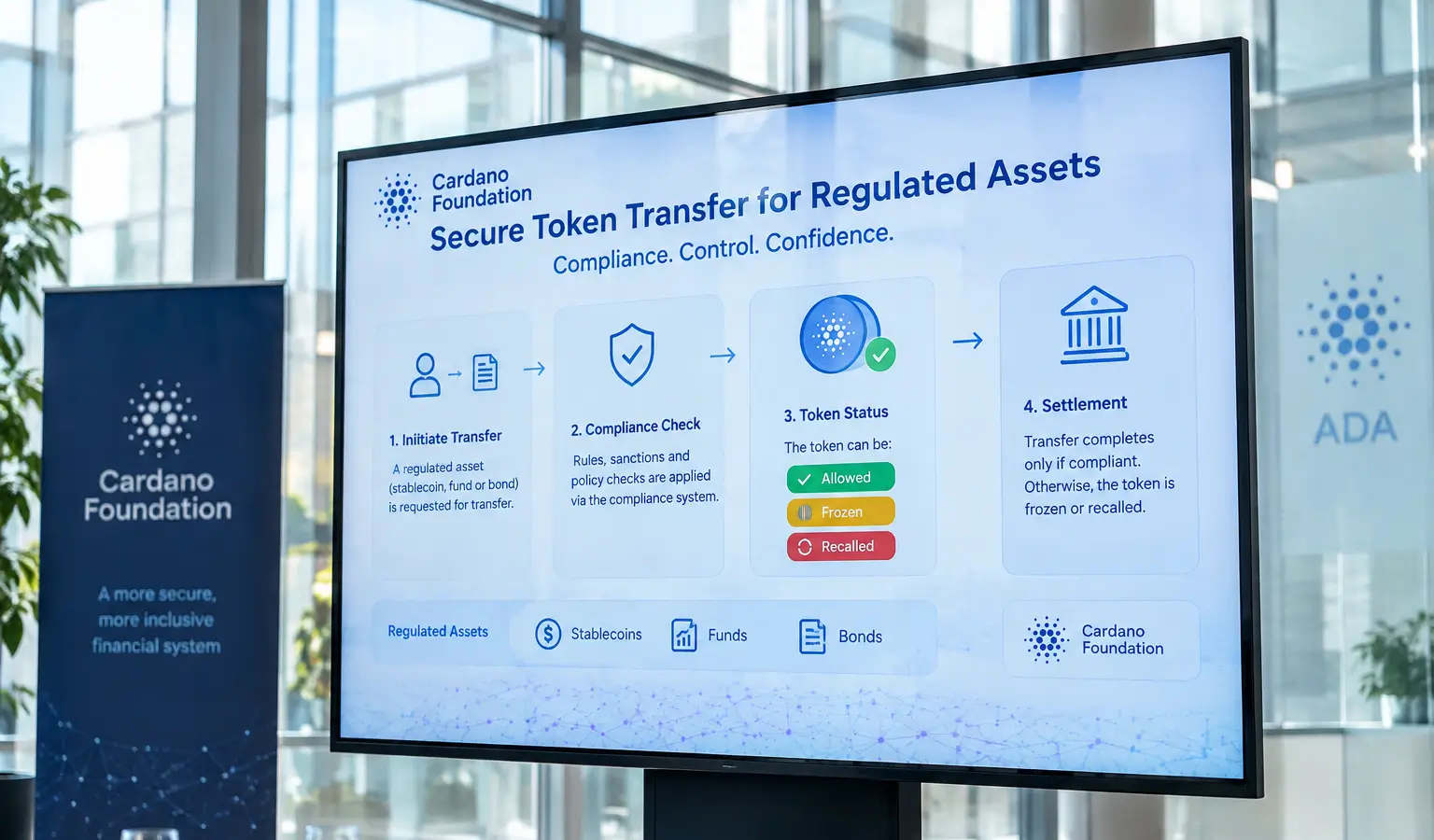
The core of the new standard is that the rules are no longer only outside the token, but built into it. That means the network first checks whether a transfer meets the conditions before the transaction goes through.
That is especially relevant for regulated products. A fund that may only be sold to verified investors can reject a transfer to an unverified party. A stablecoin issuer can prevent tokens from ending up at a sanctioned address. According to the Foundation, those restrictions apply every time the tokens move, even between different wallets or services.
More Control for Issuers
The standard is meant for parties that have to comply with identity checks, sanctions rules, and other transfer restrictions. In some cases, issuers or authorized parties can even freeze or recover tokens if a regulator or court requires it.
Cardano uses a shared smart contract for this that determines how the tokens can be moved. That happened without a hard fork, because the features were already available on Cardano. The Foundation also said issuers can choose existing rule sets or write their own rules and later adjust them if laws change.
The Foundation mentioned wallets Eternl and GeroWallet, blockchain explorer CardanoScan, and developer tool BloxBean as parties supporting the launch.
Why This Matters for Europe
For European crypto followers, this is especially relevant because regulated tokenization is increasingly about built-in compliance. In Europe, ERC-3643 on Ethereum and other EVM chains is already a well-known standard for permissioned tokens with identity checks and transfer rules. With CIP-0113, Cardano is taking a similar step, showing that multiple networks are moving in the same direction when it comes to tokenized funds and other regulated assets.
The Foundation also reported recognition under the certification framework of the Capital Markets and Technology Association, a Swiss industry group whose standards are used for tokenized shares. That puts Cardano more clearly in the regulated tokenization market, where control over transfers is often just as important as the token itself.