Cardano Whales Buy ADA as Network Activity Slows
Large ADA holders are building positions while Cardano’s transaction and smart contract activity cools off. Market attention is now shifting to the Leios and Rossem upgrades, along with the ongoing governance vote.
Key Takeaways
- Cardano whales added to their ADA positions in late June, even as the token traded near $0.15 and remained down on both a weekly and monthly basis.
- Daily transactions, smart contract activity, and fees all slipped to their weakest levels in weeks, suggesting softer network usage.
- Two planned upgrades, Ouroboros Leios and Rossem, are designed to boost capacity and lower smart contract costs, but both are still ahead.
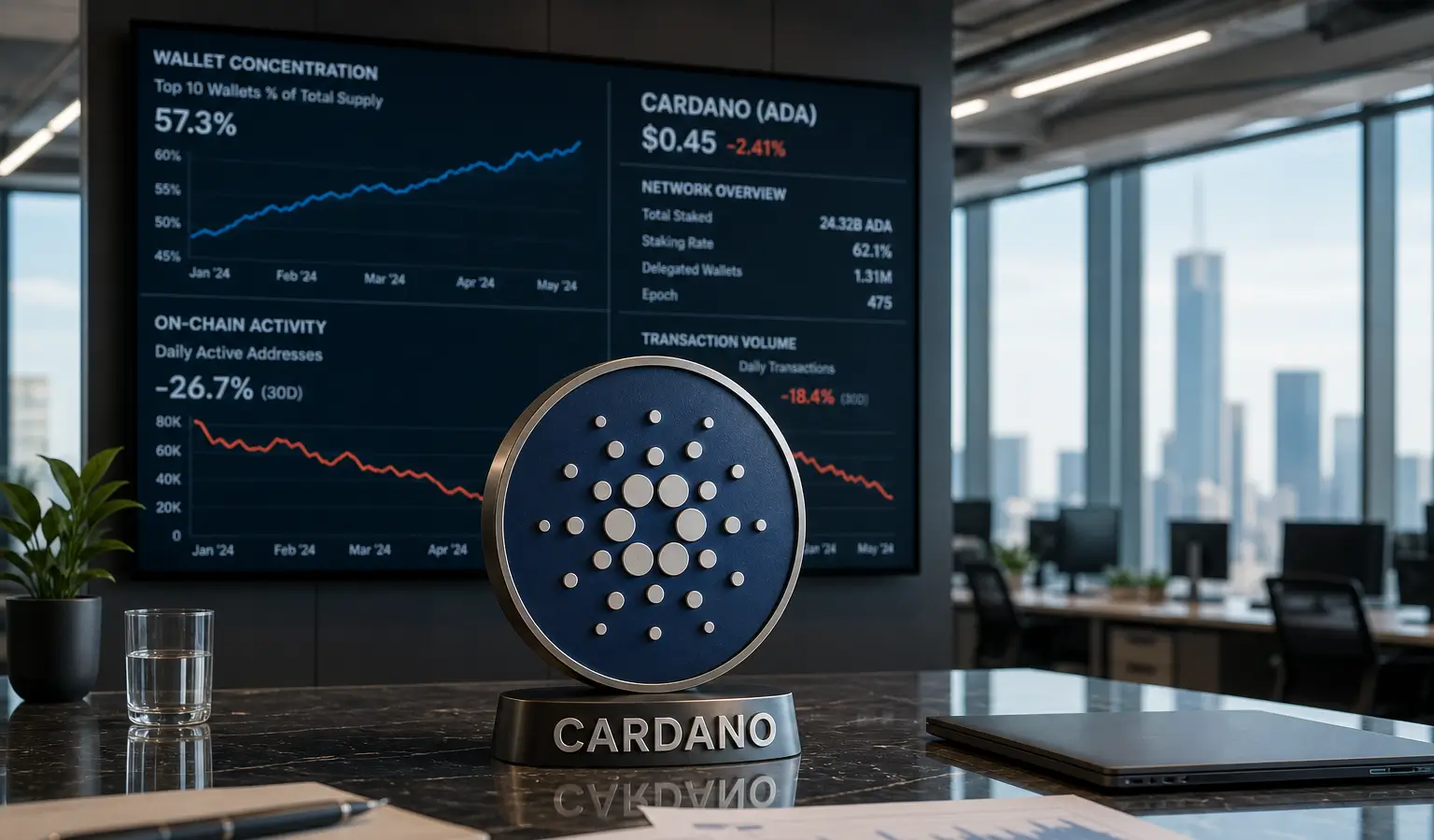
Cardano-whales added more ADA in late June, even as activity on the blockchain slowed. Large wallets increased their share of supply, but transactions, smart contract activity, and fees all fell to their lowest levels in weeks. The disconnect comes as Cardano moves through a major upgrade cycle and ADA trades near multi-year lows.
Whales Build Up ADA
ADA was changing hands around $0.15 (€0.13) on June 29, down about 8% for the week and roughly 38% over the past 30 days. That leaves the token ranked No. 21 by market value, with an estimated market cap of about $5.4 billion (€4.7 billion).
Santiment data shows that wallets holding 10 million to 100 million ADA lifted their share of supply from 37.66% on June 25 to 38.13%. Other onchain data points to larger moves from big holders as well: outputs above 1 million ADA peaked on June 21 and again on June 24, when the number of distinct large wallets reached a 45-day high. Those flows could also reflect internal transfers or exchange activity, so they mainly show positioning rather than clear buying pressure.
Cardano Usage Slows Down
The broader network picture was weaker. Daily transactions fell to about 17,400 on June 28, putting them close to a 45-day low. Smart contract transactions dropped to around 4,250 that day, while the share of transactions interacting with a smart contract slipped to about 24%.
Fees also declined, falling to around 5,100 ADA from roughly 23,000 ADA at the June peak. For the market, that matters because it shows whale accumulation is not being matched by stronger user activity. The gap between large-wallet positioning and everyday network use is still wide.
Upgrade Plans Keep Attention on Cardano
The interest from large holders lines up with two planned upgrades. Ouroboros Leios is designed to process transactions in parallel instead of in a single batch, with the aim of scaling throughput from about 10 transactions per second toward 1,000. A test version, Musashi Dojo, opened to developers on June 23, while the mainnet launch is currently targeted for around November 2026.
The second upgrade is van Rossem, also known as Protocol Version 11. It changes the fee structure for smart contracts to make them cheaper, while also aiming to improve Plutus performance, ledger consistency, and node security without pushing Cardano into a new era. The governance vote began on June 13 and runs until July 18, with ratification requiring support from at least 85% of stake pools based on active stake.
For European crypto readers, the bigger takeaway is that Cardano shows how price, network usage, and governance can move in different directions. If the upgrades later this year or in 2026 deliver more capacity and lower costs, ADA could see a fresh round of debate. For now, though, the market is likely to keep focusing on the gap between the roadmap and actual usage.