German Banks Open Crypto Trading to Millions of Customers
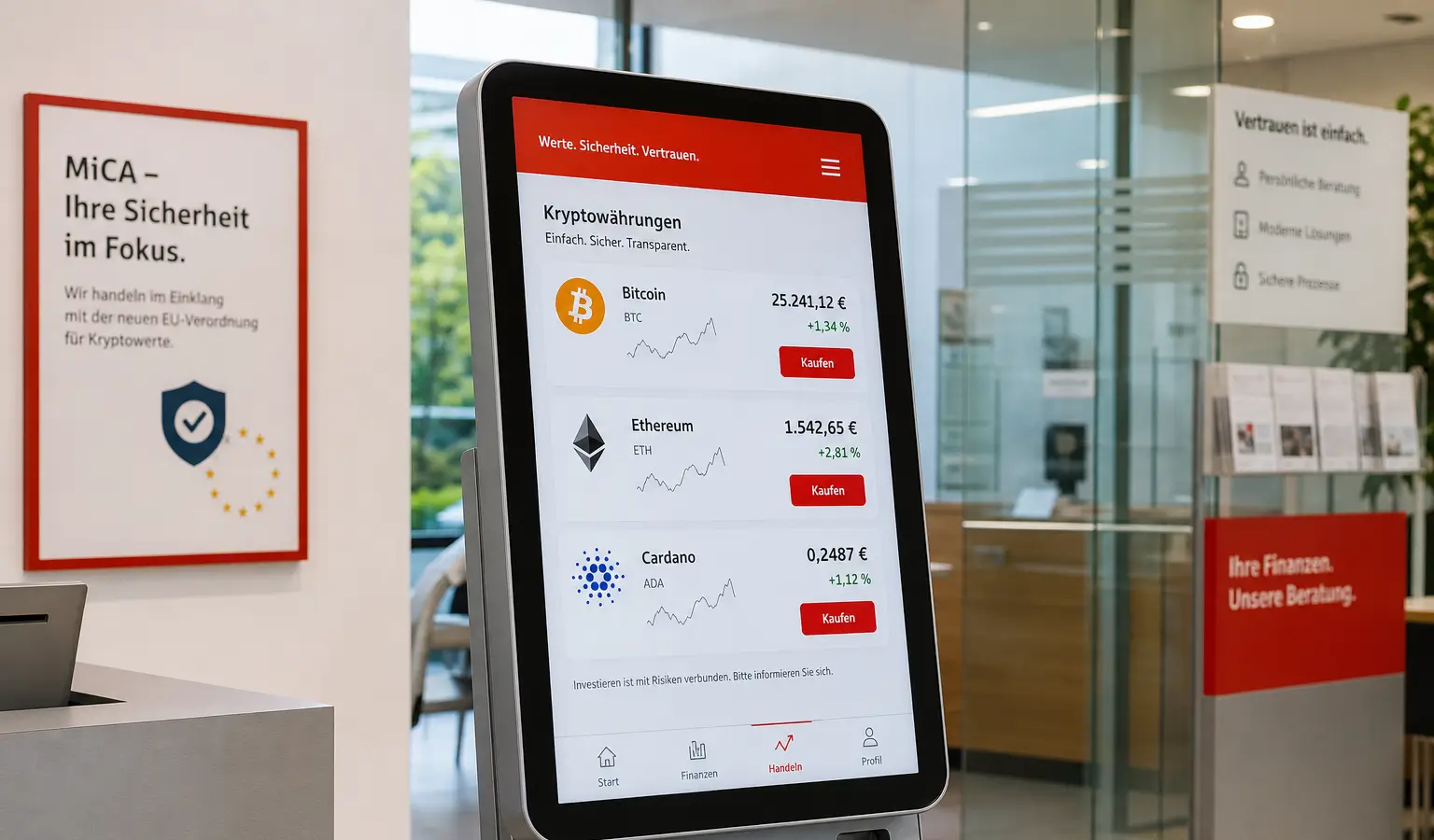
Sparkassen and cooperative banks will soon offer Bitcoin, Ethereum, and other coins in their own apps. MiCA and BaFin are now giving the German sector more legal room to do that.
Key Takeaways
- German savings banks and cooperative banks are bringing crypto trading to retail customers through their own apps.
- MiCA is giving banks more legal clarity to offer crypto under supervision, while DZ Bank and DekaBank are rolling out products.
- The industry sees trust as a major advantage, but it is also warning about speculation and the risk of total loss.
German savings banks and cooperative banks are now moving to offer crypto trading directly to retail customers. That puts Bitcoin inside the apps of institutions that together account for about 80 million customer relationships in a country of 84 million people.
Banks Are Changing Course
DSGV data shows that the Sparkassen serve around 50 million customers, while the cooperative banks have another 30 million, according to BVR figures. The bigger story, though, is how much the industry’s stance has changed: just four years ago, both banking groups still dismissed crypto as far too risky.
According to Bloomberg, the banks are now building these services in-house rather than steering customers to outside crypto exchanges. DZ Bank has already added its meinKrypto platform to the VR Banking App, where users can trade Bitcoin, Ethereum, Litecoin, and Cardano, among others. The move reflects a broader trend: crypto is increasingly being folded into existing banking apps instead of sitting outside the traditional financial system.
MiCA Opens the Door
The regulatory backdrop has shifted as well. MiCA, the European rulebook for crypto assets and service providers, has given banks a clearer path to offer crypto under supervision. DZ Bank said BaFin approved meinKrypto under that framework at the end of December 2025, with Boerse Stuttgart Digital handling custody.
DekaBank is also developing a similar product for roughly 340 savings banks, with a phased rollout planned for later this year. Each of the nearly 650 cooperative banks and each Sparkasse can decide on its own whether to participate. DZ Bank product specialist Markus Bärenfänger expects hundreds of banks to join.
Why This Matters in Europe
For European crypto readers, this is about more than a single German product launch. It shows how MiCA is making it easier for traditional banks to offer crypto as a regulated investment product. A recent Genoverband survey also found that more than 71 percent of German cooperative banks were already interested in crypto services for retail customers, underscoring how quickly sentiment in the sector is changing.
Trust Versus Risk
For banks, the main selling point is trust. A Boerse Stuttgart Digital survey found that Germans trust their primary bank twice as much as specialized crypto platforms, at 38 percent versus 19 percent. Even so, only about a quarter of the population has invested in crypto, which lines up with broader adoption trends across Europe.
That trust, however, does not make the move any less controversial. Professor Co-Pierre Georg of the Frankfurt School of Finance & Management says traditional bank customers may not fully grasp the risks. The savings banks’ own lobbying group also describes crypto as a highly speculative investment with a risk of total loss, and says the service is only appropriate for self-directed investors.
The timing makes the debate even more pointed. Bitcoin is trading around $62,483 (€54,600) after falling about 50 percent from its October 2025 record of $126,080 (€110,100). For German banks, the issue is not just whether crypto can bring in new revenue, but whether a bank brand and crypto can still coexist during the next major downturn.