Clarity Act Moves to September as Banks Keep Building
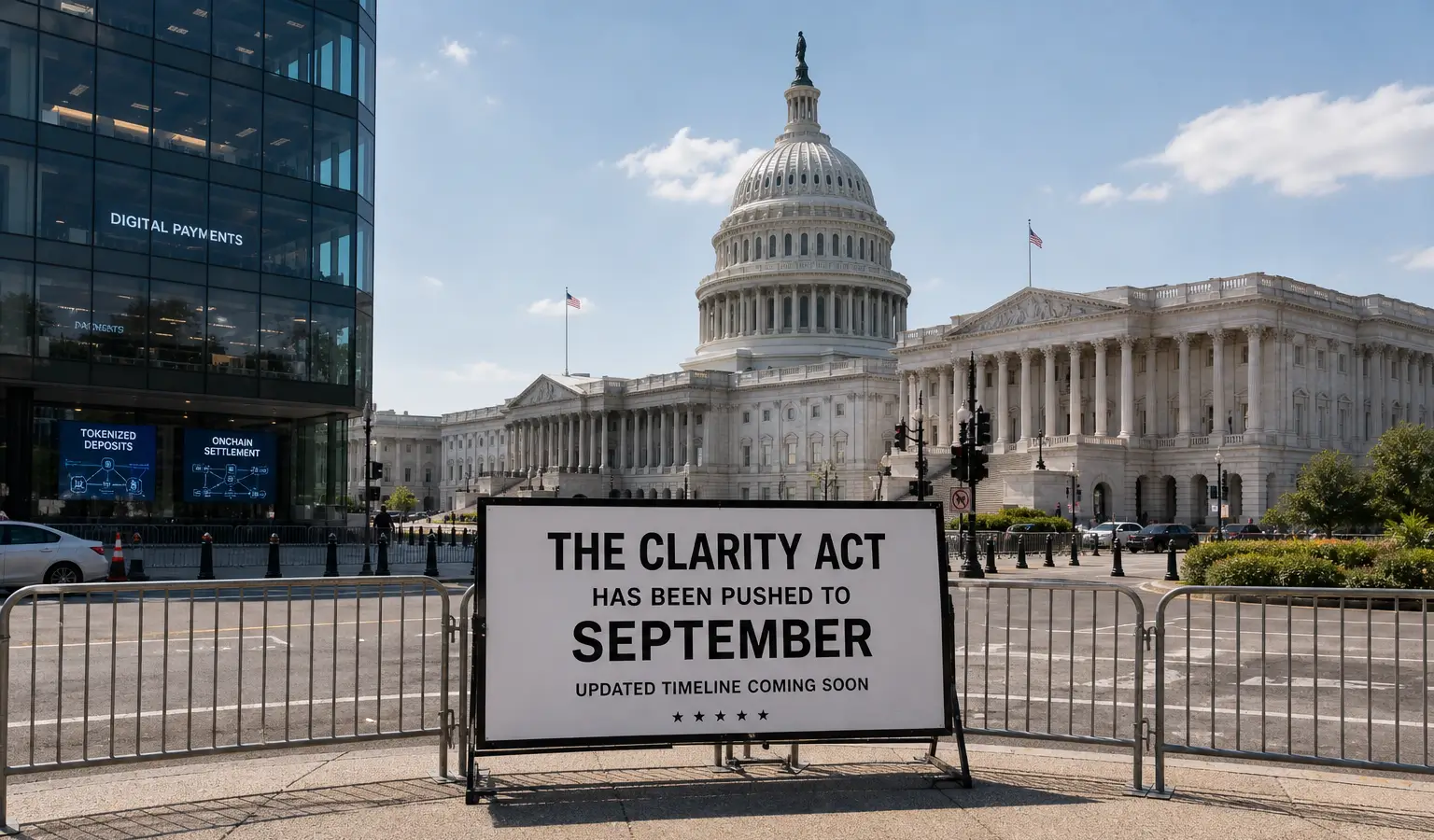
The Senate is pushing the market structure bill to September, while JPMorgan, Citi, and other banks are already rolling out tokenized deposits and onchain settlement.
Key Takeaways
- The U.S. Senate pushed the Clarity Act to September, leaving the rules for digital asset markets unclear for now.
- Banks are meanwhile continuing with tokenized deposits, onchain settlement, and new payment infrastructure, including at JPMorgan, Citi, and The Clearing House.
- The main question is interoperability between bank networks, while the Clarity Act may mainly reduce legal uncertainty without directly solving that connection.
The U.S. Senate has pushed the Clarity Act to September. After months of talks, the market structure proposal went into the August recess without a final vote, leaving the rules for digital asset markets unclear for at least a few more weeks. Banks are not waiting for that. They are issuing tokenized deposits, testing onchain settlement, and building new rails for commercial bank money.
Banks Are Already Building
JPMorgan has been processing institutional payments through Kinexys for years and reported more than $3 trillion (€2.6 trillion) in cumulative transaction value. The company now also offers JPMD, a deposit token for institutional clients. Citi uses Token Services for cross-border treasury in four markets. In June, seventeen major financial institutions, including JPMorgan, Bank of America, Citi, and Wells Fargo, announced that The Clearing House tokenized deposits will be cleared and settled onchain, with a planned launch in 2027.
The move is not limited to the biggest banks. In March, Huntington, First Horizon, M&T Bank, KeyCorp, and Old National became design partners on Cari Network, a bank-governed network for tokenized deposits led by former Comptroller of the Currency Gene Ludwig. Over the past four months, more than 30 institutions have joined and another 40 are in active discussions, together representing institutions with more than $10 trillion (€8.6 trillion) in combined assets.
Why Interoperability Matters
The core of the debate is not whether banks put deposits onchain, but whether those systems can talk to each other. A tokenized deposit remains a claim on one specific bank. A token dollar from JPMorgan and a token dollar from a regional bank are therefore different obligations on different balance sheets.
That is why interoperability does not come from a simple messaging standard or a token bridge. In practice, clearing has to do the job. That means the token from one bank is redeemed, the receiving bank issues its own token, and the balance between the institutions is settled in central bank money. That is also why privacy, neutrality, and verifiability are needed at the same time. Banks do not want counterparties or payment data on a public ledger, and they do not want their network to run on a competitor's infrastructure.
What Washington Can Do
The Clarity Act does not directly regulate tokenized deposits, and it does not automatically make bank networks interoperable either. But the law can remove some of the uncertainty around the edges of these projects. Under the broader design of the bill, there should be a clearer framework for digital assets in the U.S., with a sharper line between oversight by the SEC and the CFTC.
That matters for banks building their own systems alongside regulated stablecoins. Industry groups have also pointed to open questions, such as how tokenized deposits should be treated consistently across borders and what the rules are for transfers outside their own network. As long as those questions stay open, connecting to another bank network will remain a tougher choice for many institutions.
For European crypto readers, this shows how fast the market is shifting from isolated experiments to real infrastructure. If major banks keep rolling out their own token networks, the question becomes less and less about whether onchain money technically works, and more about under what rules different networks are allowed to connect. That makes U.S. legislation relevant beyond the U.S. too, especially for players that see stablecoins, settlement, and bank money coming together in the same market.