CME Adds Bitcoin Cash and Uniswap Futures
The exchange is still waiting for CFTC approval. For institutions, the expansion through standard and micro contracts offers regulated access to UNI and BCH.
Key Takeaways
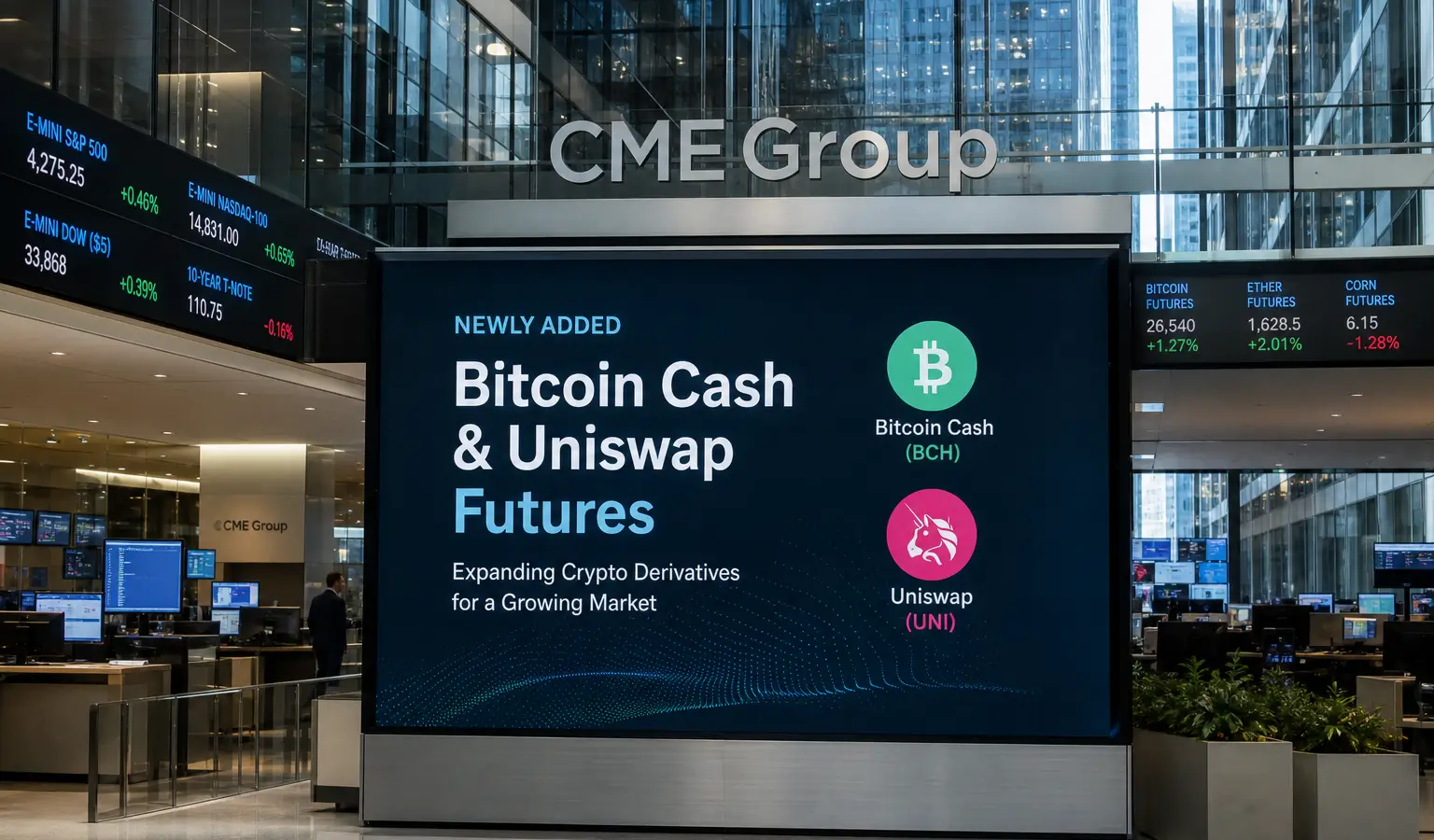
- CME Group will add futures for Bitcoin Cash and Uniswap on October 19, if the regulator approves.
- The announcement immediately pushed prices higher: Uniswap rose about 5% and Bitcoin Cash nearly 10%.
- CME offers standard and micro contracts, allowing institutions to build or hedge regulated crypto exposure.
CME Group will add futures for Bitcoin Cash and Uniswap to its crypto derivatives lineup on October 19, if the regulator approves. The announcement immediately moved both tokens: Uniswap rose about 5% and Bitcoin Cash nearly 10%.
New Access for Institutions
The world's largest derivatives exchange confirmed the contracts on Tuesday. For both tokens, there will be a standard contract and a smaller micro version, so traders can work with less exposure per contract.
A futures contract makes it possible to speculate on or hedge against the price of a token without owning the token itself. CME falls under the oversight of the U.S. Commodity Futures Trading Commission, the CFTC. For many banks, hedge funds, and asset managers, a regulated market like this is often the only way to take a position in a coin, because they are not allowed or do not want to trade on offshore crypto exchanges.
The standard contracts cover 10,000 UNI or 250 BCH. The micro contracts are worth 1,000 UNI or 25 BCH. At current prices, one standard UNI contract represents about $90,000 (€78,300) in exposure, while one standard BCH contract represents around $69,000 (€60,100).
CME Keeps Expanding
CME already has a large crypto business. In the first half of 2026, the company traded an average of 279,800 crypto contracts per day, worth $8.3 billion (€7.2 billion) in notional value, according to the announcement. In February, the exchange added futures for Cardano, Chainlink, and Stellar, and in May CME switched to 24/7 crypto trading.
That broader expansion fits a clear pattern: institutional players are getting more and more regulated access to crypto. In the third quarter of 2025, volume in CME's crypto futures and options topped $900 billion (€783 billion), with average open interest of $31.3 billion (€27.2 billion). That shows demand from professional traders has been strong for some time.
What This Means for the Market
For European crypto followers, the key point is that a listing on CME often means more than just extra trading in the U.S. It can shift price discovery to a regulated market and make it easier for bigger players to build or reduce exposure. At the same time, futures trading also makes it easier to short, so a listing is not a one-way story.
The first reaction showed that the market picked up the news right away, but the longer-term picture depends on how the new contracts are used. The main question is whether real open interest will build after October 19, or whether the jump will mostly stay a short-lived news reaction.