Crypto Falls on Iran Tensions and Weak Inflation Data
Tether froze USDT on Tron addresses linked to Iran, while Brent stayed around $81. Weaker U.S. producer prices offered the crypto market little support.
Key Takeaways
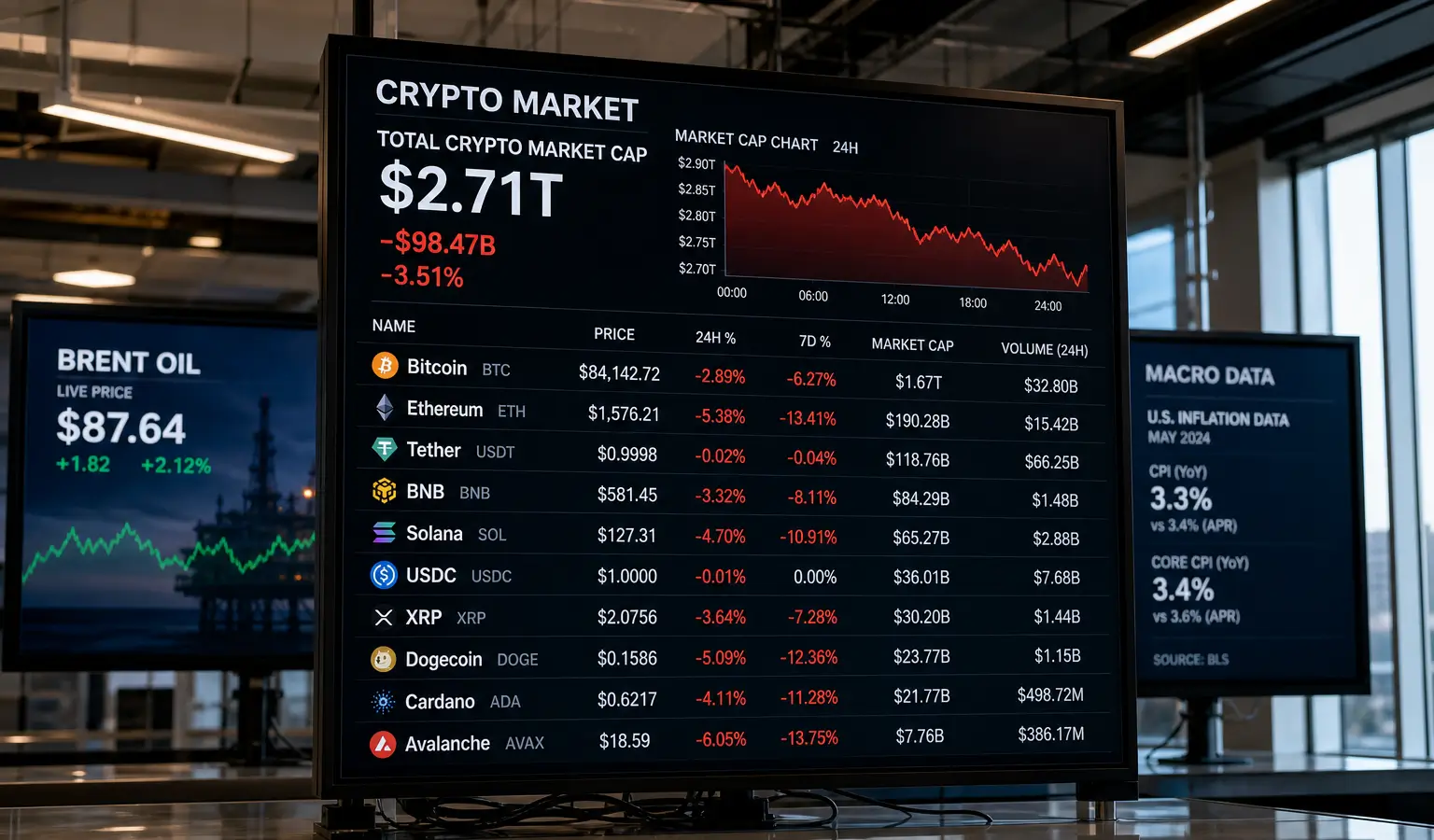
- The crypto market fell about 0.48% on July 16 and finished at roughly $2.20 trillion in total value.
- Tensions between the U.S. and Iran hurt risk appetite, while Tether froze about $131 million in USDT.
- Weaker U.S. producer prices did little to lift the market as traders stayed focused on geopolitical risk.
Crypto traded lower on July 16, with the total market cap holding near $2.20 trillion (€1.9 trillion) after a decline of about 0.48%. Softer inflation data failed to trigger fresh buying, as sentiment was still being driven more by rising tension between the U.S. and Iran.
Iran Is Pressuring Risk Sentiment
The story is no longer just about oil. It is now spilling directly into crypto markets as well. On July 14, Tether froze about $131 million (€115 million) in USDT across four Tron wallets that authorities said were connected to Iran's central bank. That action follows a broader enforcement campaign, with the U.S. already freezing hundreds of millions in USDT on Tron addresses tied to Iran.
For traders, the immediate effect is a weaker appetite for risk. Fresh tension around the Strait of Hormuz is keeping Brent close to $81 (€71), while the market, according to the text, needs to get back above $2.23 trillion (€2 trillion) before it can push toward $2.29 trillion (€2 trillion). If $2.16 trillion (€1.9 trillion) fails to hold convincingly, then $2.12 trillion (€1.9 trillion) and $2.08 trillion (€1.8 trillion) are also key levels to watch.
Inflation Data Offered Little Support
U.S. producer prices cooled noticeably in June, rising 5.5% from a year earlier versus 6.2% expected. On a monthly basis, prices fell 0.3%, marking the first drop since August 2025. Even so, the report did not bring much new demand into crypto.
That reaction makes sense given the current setup. The market had already digested a softer CPI reading, so this second inflation surprise had less room to move prices. At the same time, traders kept their attention on geopolitical risk and on whether the recent easing in inflation is enough to bring back a broader risk-on mood.
What This Means for Europe
For European crypto investors, the takeaway is that stablecoins, energy prices, and U.S. macro data are all shaping sentiment at the same time. Sanctions enforcement through USDT, combined with higher oil prices, can also influence how traders think about liquidity and risk well beyond the U.S. These are not just American headlines. They are signals for the wider crypto market too.
The pressure on USDT also ties into the broader debate over stablecoin regulation and usage. In Europe, Tether's MiCA decision has already led to changes at providers, including in the European distribution of USDT.