DeFi Leaves $150 Million in Fees on the Table Because of Idle Liquidity
Dune found a lot of capital sitting outside the optimal range on Uniswap, PancakeSwap, and Aerodrome. According to 1inch, that costs DeFi about $150 million a year in fees.
Key Takeaways
- Dune analyzed concentrated liquidity on major DEXs for 1inch and found $1.6 billion in liquidity that was not earning efficiently.
- Of the $1.84 billion in tracked liquidity, 85% sat outside the most efficient range; on average, $542 million per week was completely out of range.
- Dune estimates these out-of-range providers are missing out on about $150 million a year in fees, although the research also points to the risks and costs of active management.
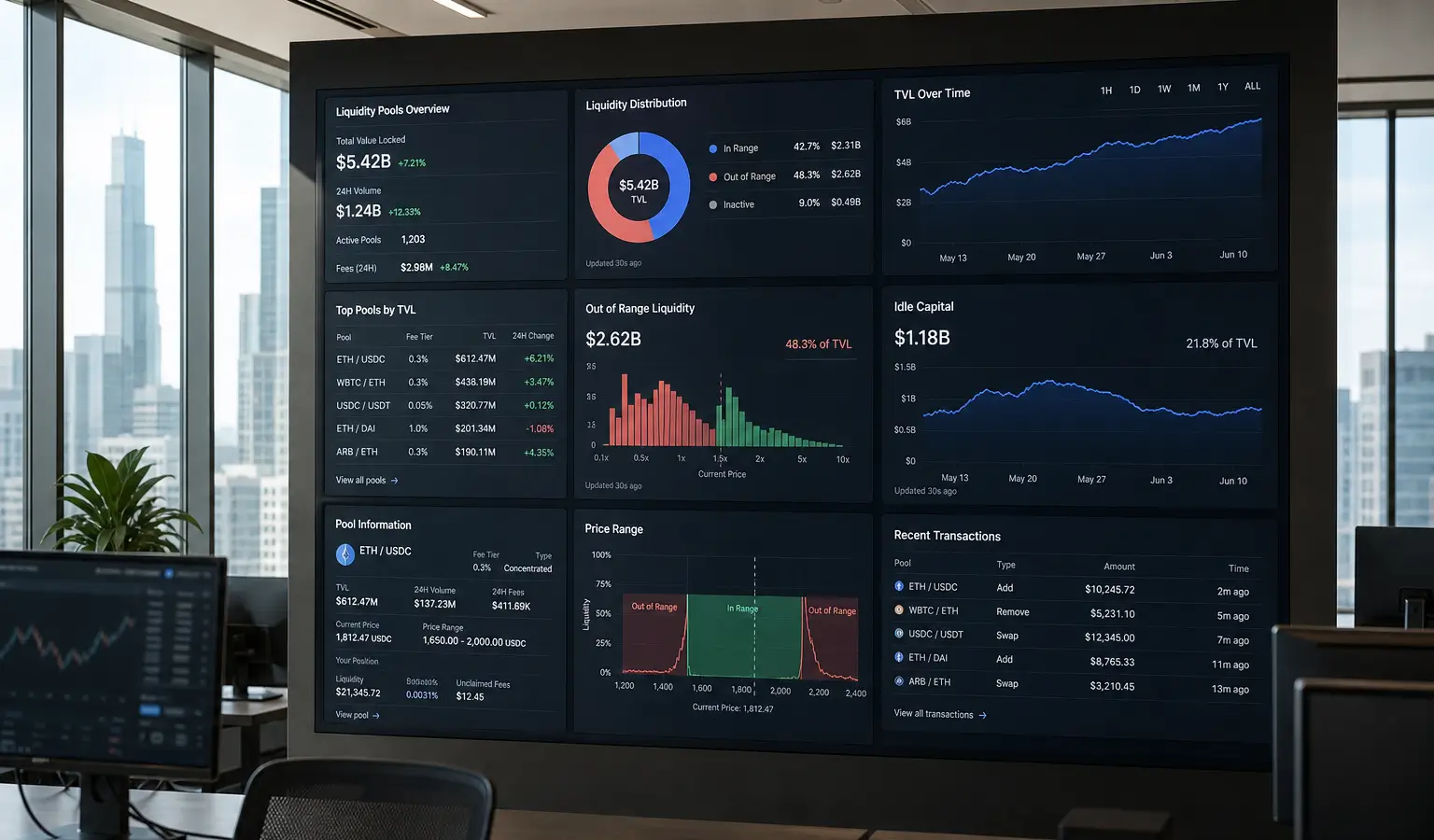
Research from Dune, commissioned by 1inch, suggests that a large chunk of the liquidity on major decentralized exchanges was barely earning anything in the first half of 2026. The analysis found that roughly $1.6 billion (€1.4 billion) in liquidity was not being used efficiently, even though that capital is supposed to help power swaps and generate fees.
A Large Share Stayed Out of Range
The report examined concentrated liquidity pools on Uniswap, PancakeSwap, and Aerodrome, covering Uniswap v3 and v4, PancakeSwap v3, and Aerodrome Slipstream across seven chains. In total, Dune tracked $1.84 billion (€1.6 billion) in liquidity, and 85% of it sat outside the most efficient range. On average, about $542 million (€474 million) per week was fully out of range, equal to 29.5% of the total.
That does not mean the capital left DeFi. It remained in the ecosystem, but it was positioned too far from the current price to be useful to traders. Dune said the out-of-range share during the period studied typically ranged between 25% and 35%, with a high of nearly 41% in early February.
Why This Matters for DeFi
Concentrated liquidity pools are built to make capital work harder by allowing providers to place tokens within a specific price band. Once the market moves outside that band, the position stops earning until it is rebalanced or price action moves back into range. As more capital flows into the market, 1inch says that dynamic can leave more liquidity sitting idle and reduce the fees providers could otherwise collect.
The data also shows that the problem was not evenly distributed. Smaller positions below $1,000 (€875) were out of range more often than positions above $1 million (€0.9 million), but those larger positions still accounted for nearly half of all idle capital. Wallet-managed positions were also much more likely to fall behind than contract-managed ones, pointing to manual oversight as a key issue.
Fees, Risk, and Context
Based on a blended in-range fee APR of about 35%, Dune estimates that these out-of-range providers are missing out on roughly $150 million (€131 million) a year in fees. Still, the report makes clear that this is not the same as guaranteed lost revenue, since keeping positions active can also mean transaction costs, execution risk, and exposure to unfavorable price swings.
The timing is notable as retail platforms bring more users onchain and financial firms keep pushing tokenized funds and blockchain-based settlement. It also fits into a wider move toward more efficient capital use in DeFi markets, like Uniswap and Spark, where liquidity is being pooled for stablecoin swaps. 1inch shared the research ahead of the planned launch of Aqua, a new liquidity protocol, while Dune said it built the methodology independently and reached its conclusions on its own.