Ethereum Foundation Sets December 2029 Quantum Deadline
The Foundation is using Hegotá and five hard forks to make execution, consensus, and data quantum-resistant before 2029. About 65% of ETH addresses are already considered vulnerable.
Key Takeaways
- The Ethereum Foundation is setting December 2029 as the hard deadline for quantum-resistant base layers of Ethereum.
- Hegotá will be the first major test in a path of five hard forks toward full post-quantum security.
- About 65% of all ETH is already in addresses that are vulnerable to quantum attacks, according to Project Eleven.
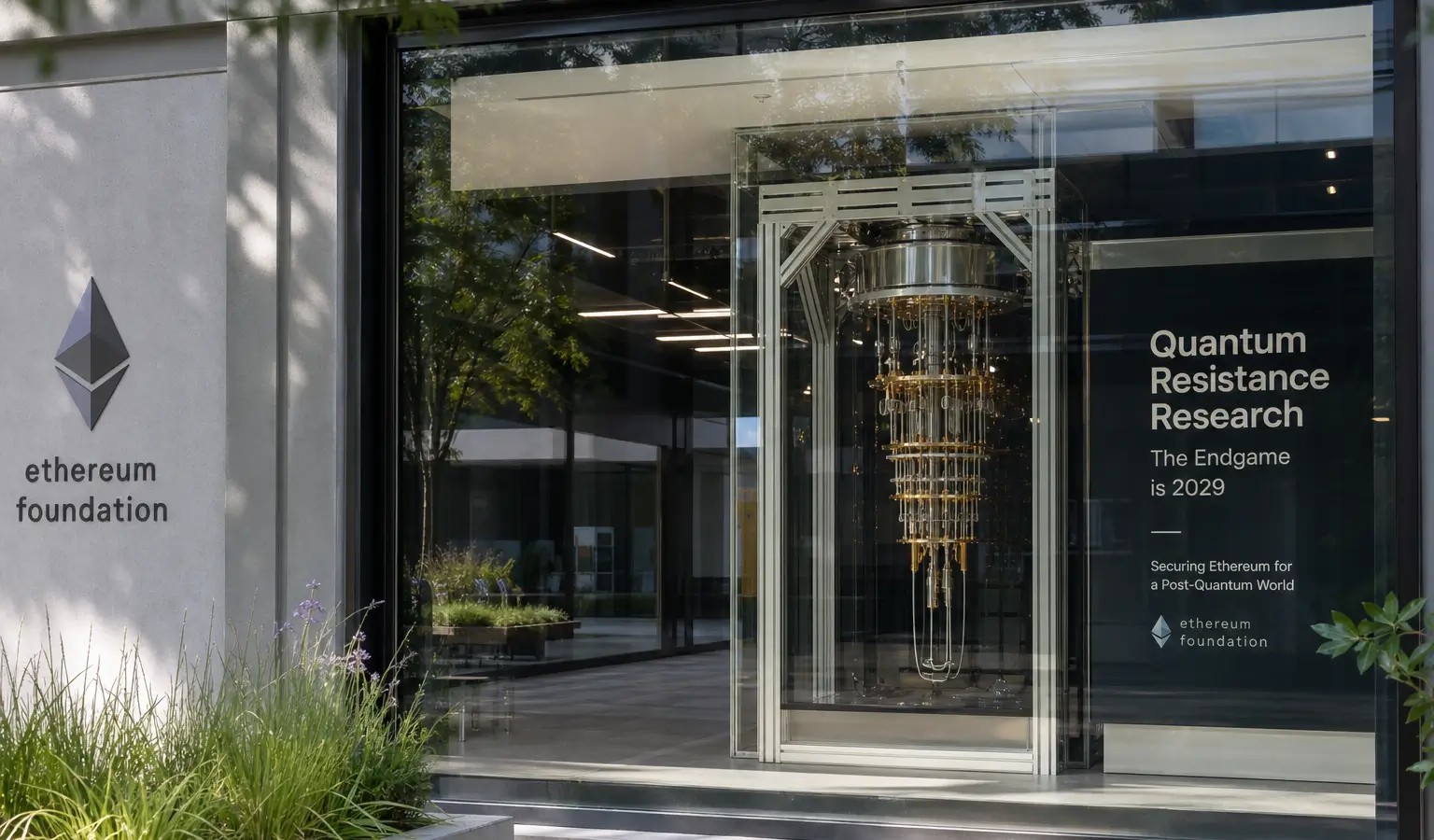
The Ethereum Foundation has set December 2029 as the hard deadline for making Ethereum resistant to quantum computers. This is not a vague research goal, but a date by which the network’s base layer must be quantum-resistant across execution, consensus, and data.
Hegotá as the First Test
The Foundation is tying that timeline to Hegotá, the hard fork after Glamsterdam. According to the Protocol cluster, Hegotá is the first major test of whether the later post-quantum upgrades can be delivered on time. The path to full quantum resistance includes five hard forks, and hitting December 2029 requires an average of 7.2 months per fork.
The cluster itself calls that pace aggressive. The Foundation also says it is using Q-day in 2030 as a deliberately strict assumption. In January 2027, there will be a new review with outside experts, when the progress of quantum computers will again be measured against the plan.
Why This Matters Now
The urgency is not just theoretical. In principle, quantum computers could weaken the elliptic-curve cryptography Ethereum uses to protect funds and the network’s integrity. The Foundation also points out that about 65% of all ETH is already in addresses that are vulnerable to quantum attacks, according to Project Eleven.
That is why the roadmap’s execution is getting so much attention. Frame Transactions is supposed to become the main step on the execution side, because it would let new signature schemes be introduced without needing a separate hard fork for every change. Frame Transactions is already included in Hegotá, showing how the quantum roadmap and other protocol changes are coming together in the same upgrade cycle. EIP-8298, EIP-8151, and EIP-8365 should then help separate accounts and validator data from vulnerable cryptography.
What Investors Get Out of It
For European crypto investors, this is mainly relevant because it shows how seriously Ethereum takes its long-term security. The Foundation has also set up a separate post-quantum research group and a central information hub with the roadmap, repositories, specifications, papers, EIPs, and an FAQ. That makes it clear this is not a one-off announcement, but a multi-year effort meant to strengthen the technical foundation of ETH.