Loopring Shuts Down DEX After LRC Fails to Gain Traction
The relayer went offline immediately, and users will receive their remaining assets back. The shutdown underscores how intense competition has become in Ethereum Layer 2 and zkEVM.
Key Takeaways
- Loopring has shut down its decentralized exchange and taken the relayer offline immediately after Sunday’s announcement.
- The crypto company says limited adoption, early technical constraints in its zkRollup design, and outside pressure all played a role in the decision.
- Users will receive their remaining assets back at no extra cost, and LRC fell 4.24% over the past 24 hours after the news.
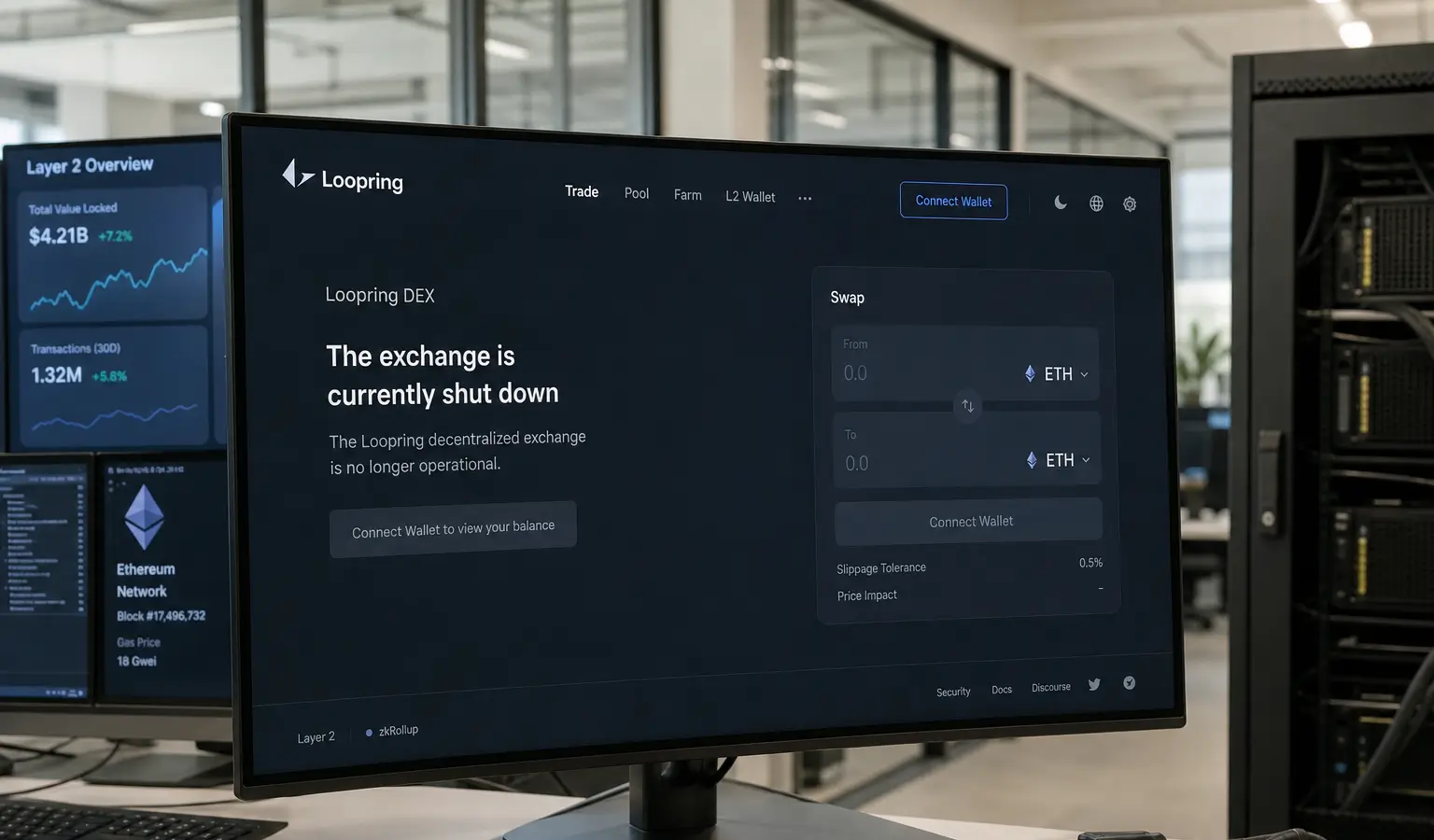
Loopring has closed its decentralized exchange (DEX), and the relayer was taken offline right away after the announcement on Sunday. The company said that despite being an early mover as the first zkRollup on Ethereum, the project never managed to build enough momentum to become a broadly used product.
Why Loopring Is Shutting Down
Loopring said the issue went beyond weak adoption. The original architecture also came with technical limits, since the first zkRollup did not include a virtual machine, according to the team. That meant it lacked composability and real payment use cases, a drawback that became more obvious as the Layer 2 market moved quickly and newer zkEVM projects arrived with full Ethereum smart contract compatibility.
The team also pointed to weak business development and outside pressure, including delistings of the native token LRC on major crypto exchanges. LRC fell 4.24% in the past 24 hours to $0.012 (€0.011) after the announcement, according to price data from The Block.
Refunds Without Extra Costs
Loopring said users will get their remaining assets back directly, with the company covering all transaction fees. Because of that, users will not need to submit Merkle proofs, which the team said should make the process simpler and more equitable.
Over the next few days, Loopring plans to publish a full breakdown of final Layer 2 balances, including spot holdings and AMM positions. After that, there will be a two-week review window, and then the team intends to upgrade the Loopring DEX smart contract so that only team-controlled, whitelisted addresses can move assets out of Layer 2.
A Bigger Signal for Layer 2
For European crypto readers, the shutdown is another sign of how competitive Ethereum Layer 2 has become. Projects that got an early lead in zk technology now have to compete with systems that fit existing smart contracts more cleanly and give developers an easier path to build. In that sense, Loopring is a clear example of how quickly a technical advantage can disappear when adoption does not keep up.