MNX Launches Futures on OpenAI and Anthropic
MNX uses fixed expirations and no funding fees for contracts on OpenAI, Anthropic, and other private AI companies. The exchange runs on MegaETH and is targeting a market that still has no public listing.
Key Takeaways
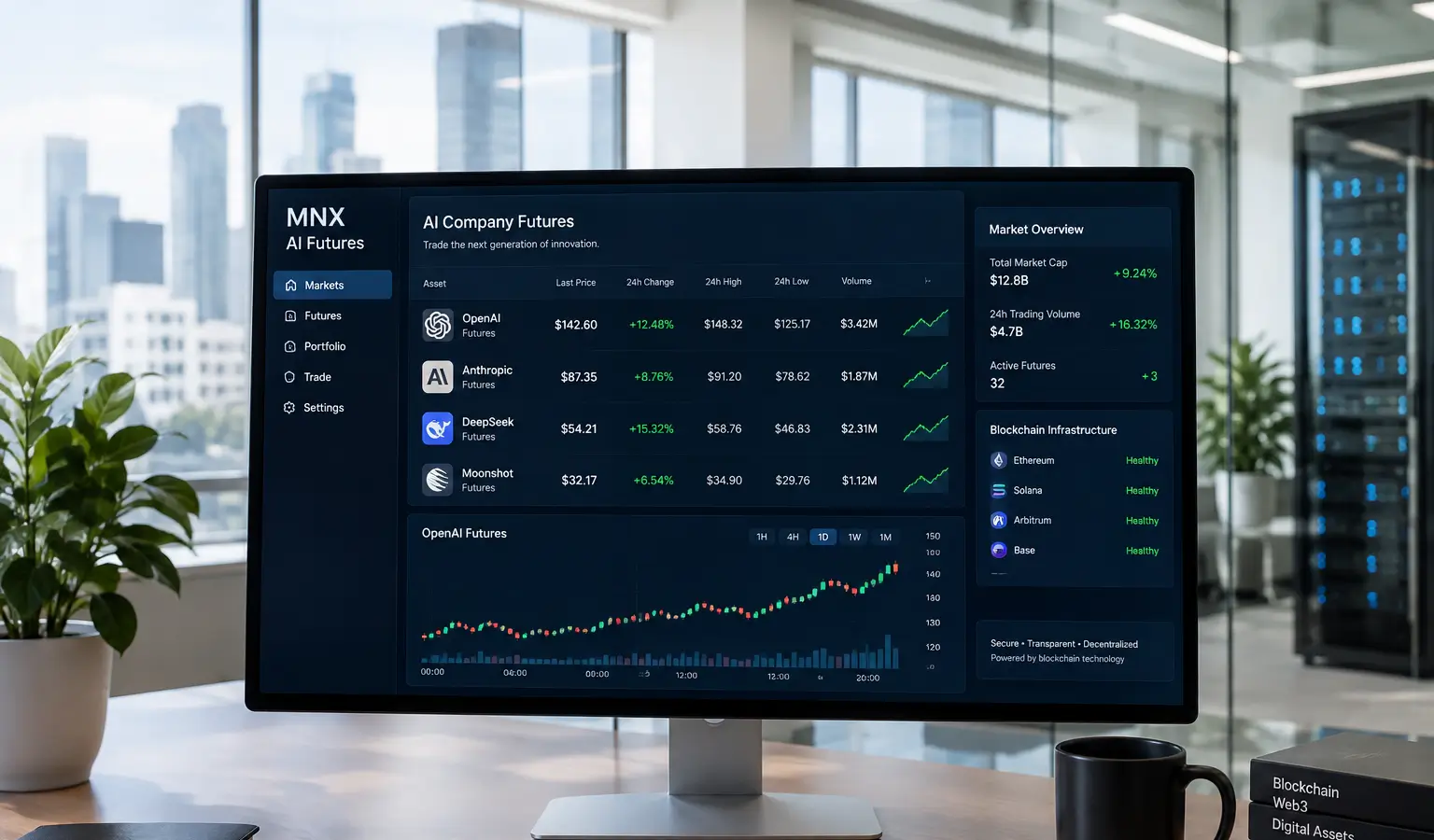
- MNX has gone live with futures on the valuations of private AI companies like OpenAI, Anthropic, DeepSeek, and Moonshot.
- The exchange runs on MegaETH, uses fixed expirations through the end of 2027, and does not charge recurring funding fees.
- MNX sets prices through trading activity and public valuations, while the platform is not available to U.S. customers for now.
MNX has gone live with futures on the valuations of private AI companies like OpenAI, Anthropic, DeepSeek, and Moonshot. The new crypto exchange, built on the MegaETH blockchain, wants to make it possible to trade companies whose shares are not yet publicly tradable. According to the team, MNX is tapping into a market that, in their view, still does not line up well with the huge flows of money into AI.
Trading Private AI Valuations
MNX was developed by Manifold Markets and went live on Tuesday. The exchange offers contracts with an expiration date at the end of 2027, while larger crypto exchanges like OKX and Bitget have already offered similar products for some time. The main difference is in the structure: Bitget uses perpetual futures with no expiration date, while MNX uses fixed expirations and does not charge recurring funding fees.
According to co-founder Stephen Gruggett, those contracts are better suited for private companies like OpenAI and Anthropic, whose shares only change hands occasionally and are hard to price. He said that a perp based on an illiquid, outdated price, in his view, works poorly, is easy to manipulate, and can have an unpredictable funding rate.
How MNX Sets the Price
Prices on MNX are determined by trading activity on the platform itself, not by an external price feed. If a company is still private at the end of the contract, MNX uses publicly available valuations from funding rounds, investment funds, or secondary markets. As a last resort, the exchange can set the settlement price itself, although it does so according to a published review process.
That means traders can end up with a settlement price that differs from what investors would pay in a real private transaction. Traders can also use up to three times their available funds, which can make both gains and losses much bigger.
Why This Matters for Crypto
For European crypto followers, MNX shows how far the line between crypto infrastructure and traditional financial products has already shifted. The combination of a blockchain-built exchange, futures, and private AI companies fits into a broader trend where financial products are being adapted to the rapid growth of the AI economy. That is also visible in the huge flows of capital into AI, even as the companies involved still do not have public listings. Tokenized stocks also show that investors are increasingly looking to AI and chips as the underlying market instead of purely crypto-related assets.
MNX raised $6.4 million (€5.7 million) in June in a round led by Village Global. The platform is not available to U.S. customers for now, although Gruggett says it wants to apply for the required licenses. The exchange also wants to later offer markets around broader AI topics, such as revenue, employment, housing, the AI supply chain, and computing power.