Morgan Stanley Sees Banking Hours Fading as Tokenization Grows
Morgan Stanley links tokenization to 24/7 markets and real-time settlement, while E*TRADE already offers spot trading in Bitcoin, Ether, and Solana.
Key Takeaways
- Morgan Stanley says tokenization, 24/7 markets, and real-time settlement are making the traditional banking day less and less relevant.
- The bank is also expanding its own digital offering with spot trading and crypto ETFs for different clients.
- According to Morgan Stanley, tokenization could speed up payments, make collateral more efficient, and open up new investment opportunities.
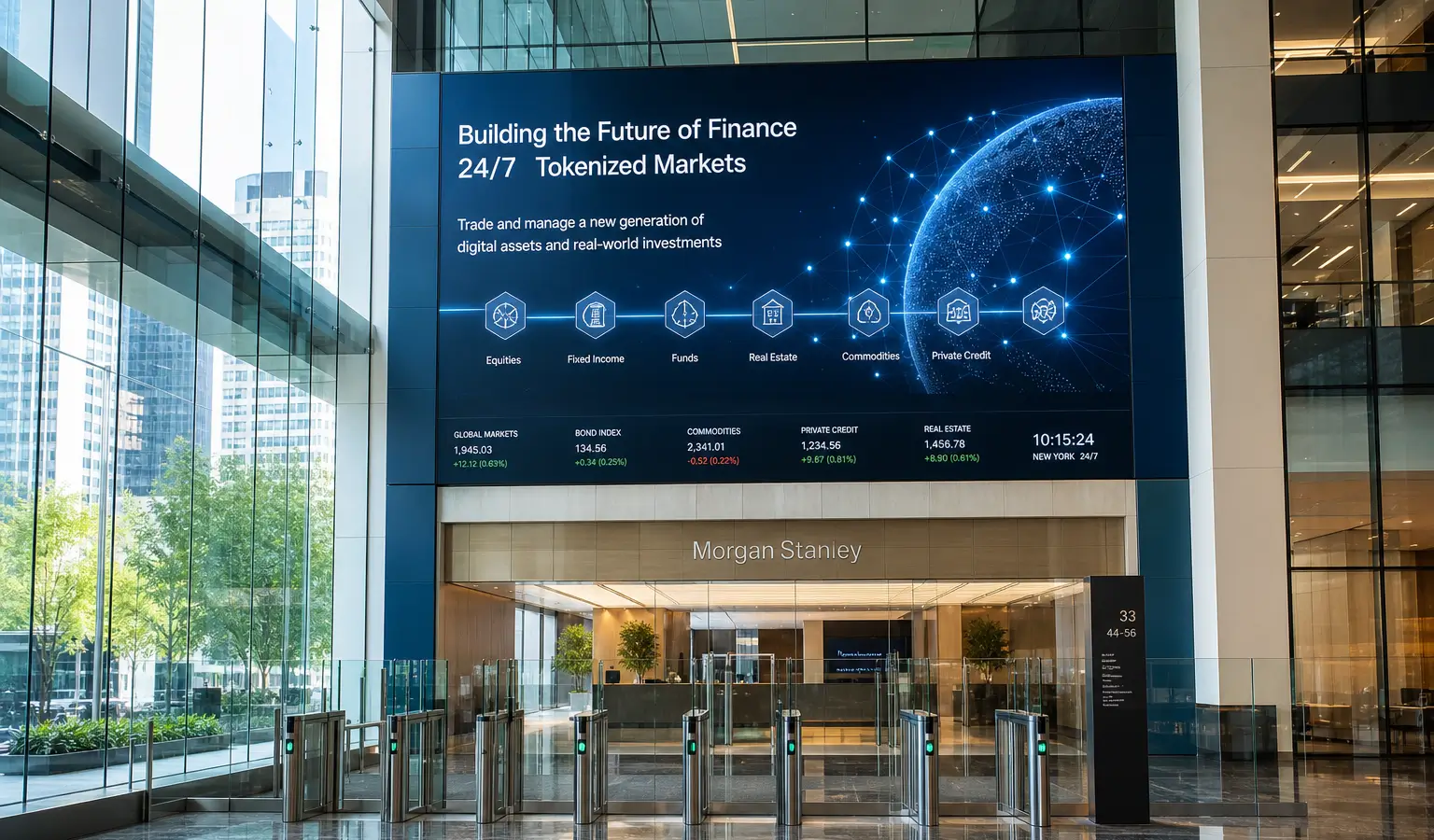
Morgan Stanley executives say the old banking schedule is losing its grip as tokenization, nonstop markets, and real-time settlement continue to reshape finance. In the bank’s view, the conversation is no longer just about crypto. It is increasingly about the infrastructure that lets money and investment products move and trade around the clock.
Banking Hours Are Losing Ground
Betsy Graseck, Morgan Stanley’s global head of banks and diversified finance research, said during a digital assets panel that tokenization is much bigger than cryptocurrencies alone. She described it as a broader effort to rebuild financial infrastructure for an economy that never really shuts down.
She was direct about where she thinks things are headed: banker hours are on the way out, and batch processing is becoming outdated. That lines up with a wider shift across the market, as banks, exchanges, and custodians build systems designed to handle assets 24 hours a day, seven days a week.
Crypto already proved that nonstop markets can work in practice. Now that same model is being pushed further into traditional finance, including payments, settlement, and custody.
Morgan Stanley Expands Its Offering
Those comments come as Morgan Stanley continues to broaden its own digital product lineup. Through E*TRADE, the bank now offers spot trading in Bitcoin, Ether, and Solana, and wealth management clients have also gained wider access to cryptocurrency ETFs. On the wealth management side, Morgan Stanley rolled out its first spot Bitcoin ETF earlier this year, then added spot Ether and Solana ETFs this week.
Graseck said institutional investors are looking beyond Bitcoin and crypto more broadly. In her view, tokenization can help money move faster, improve how collateral is used, and create new investment opportunities. She also cautioned that firms that fail to update their systems could get left behind as more activity shifts onto digital asset rails.
Why This Matters
For European crypto and market watchers, the bigger point is that tokenization is increasingly being viewed as a link between traditional finance and blockchain infrastructure. If more assets can trade 24/7, that will require more than new trading rules. It also means major upgrades to technology, real-time oversight, and cybersecurity at financial firms.
Morgan Stanley Wealth Management strategist Denny Galindo also said tokenized money market funds and stocks have grown quickly this year. He said products like these could be many investors’ first exposure to blockchain, even before they ever buy crypto. Ali Wallace, global head of capital markets and ETF strategy at Morgan Stanley Investment Management, also pointed to rising demand for multi-currency digital asset ETFs as the next stage in product development.
Other major firms are already moving in that direction. DTCC Puts Tokenized Securities to the Test in Live Wall Street Trial recently showed that existing securities can already be handled in a blockchain setting and move through settlement infrastructure.