Ripple Gets a Role in the U.K.'s Tokenized Markets Plan
The Treasury report names Ripple, BlackRock, and Santander as building blocks for onchain wholesale markets. The U.K. wants to move tokenized repo, bonds, and funds from sandbox to live fast.
Key Takeaways
- Ripple has secured a visible place in the U.K.'s push to move wholesale markets onchain.
- The report describes a hybrid setup that combines permissionless liquidity with permissioned institutional networks layered on top.
- The U.K. wants to go from testing to rollout within twelve months, as tokenization starts to look more like core market infrastructure.
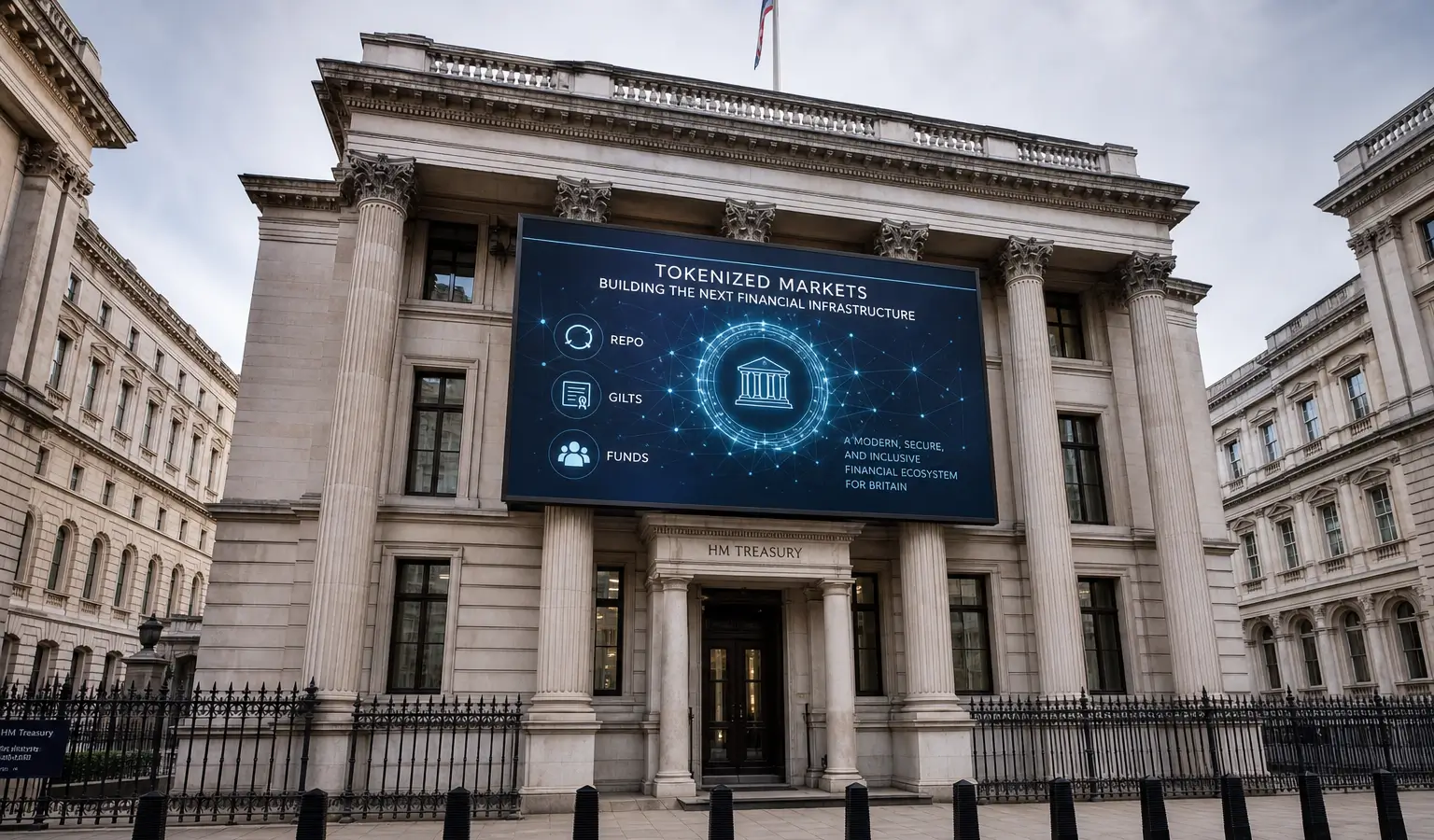
Ripple now has a clear role in the U.K.'s plan to move wholesale markets onchain. In a Treasury-backed report, the crypto company is treated less like an outside player and more like one of the names helping shape the country's push to bring tokenized repo, fixed income, and funds out of the sandbox and into live markets.
The report was written by Chris Woolard, the Treasury's wholesale digital markets champion. He argues that the U.K. needs to shift from experimentation to execution within twelve months, or risk seeing standards and liquidity move abroad before the domestic market is ready.
Hybrid Model for Liquidity
Woolard lays out a structure in which permissionless networks supply shared liquidity, while permissioned institutional networks sit on top of them. As an example, the report points to BlackRock's tokenized money market fund BUIDL, with Ethereum serving as the base layer and a compliance wrapper provided by Securitize.
The report also flags a technical issue tied to permissionless chains. In some cases, a confirmed transaction could be rolled back through a chain reorganization, which could create problems for settlement finality, something traditional market infrastructure is not usually built to handle.
Ripple and Traditional Finance
The U.K.'s approach reflects a wider trend of traditional finance firms and crypto-native companies working more closely together. Ripple is named in the report as part of a task force designed to speed up the process, and the company previously spent $1.25 billion (€1.1 billion) on prime broker Hidden Road, now Ripple Prime.
Santander U.K. is also cited as an example of white-labeling, where the bank keeps the customer relationship while Ripple's blockchain handles the transfer of funds. The report says that setup shows how the line between traditional financial services and blockchain infrastructure is becoming harder to define.
Why This Matters
For European crypto readers, the main point is that the U.K. is no longer treating tokenization as a small pilot. Instead, it is starting to frame it as part of the market's core infrastructure. In May, the FCA and the Bank of England already asked for joint input on tokenized securities, including bonds, gilts, and fund units, which shows the regulatory scope is widening.
The next phase is also taking shape on the legal side. The U.K.'s FSMA rules for this new framework take effect next year, with applications opening on September 30 and a planned launch in October 2027. That puts the country in a race to make institutional tokenization work before other major markets, especially as stablecoin rules in both the U.K. and the U.S. move toward 2027.