SoFi Puts $25 Billion in Card Payments on the Blockchain
SoFi is processing its card settlement through SoFiUSD and Mastercard, a move that brings stablecoins closer to everyday payments. The bank wants to keep the blockchain behind the scenes for merchants.
Key Takeaways
- SoFi is settling its entire $25 billion card program through SoFiUSD on a public blockchain.
- Customers pay as usual, while merchants receive settlement directly into a SoFi Bank account.
- Mastercard is expanding stablecoin settlement, while SoFi is talking with major U.S. merchants without any announced contracts.
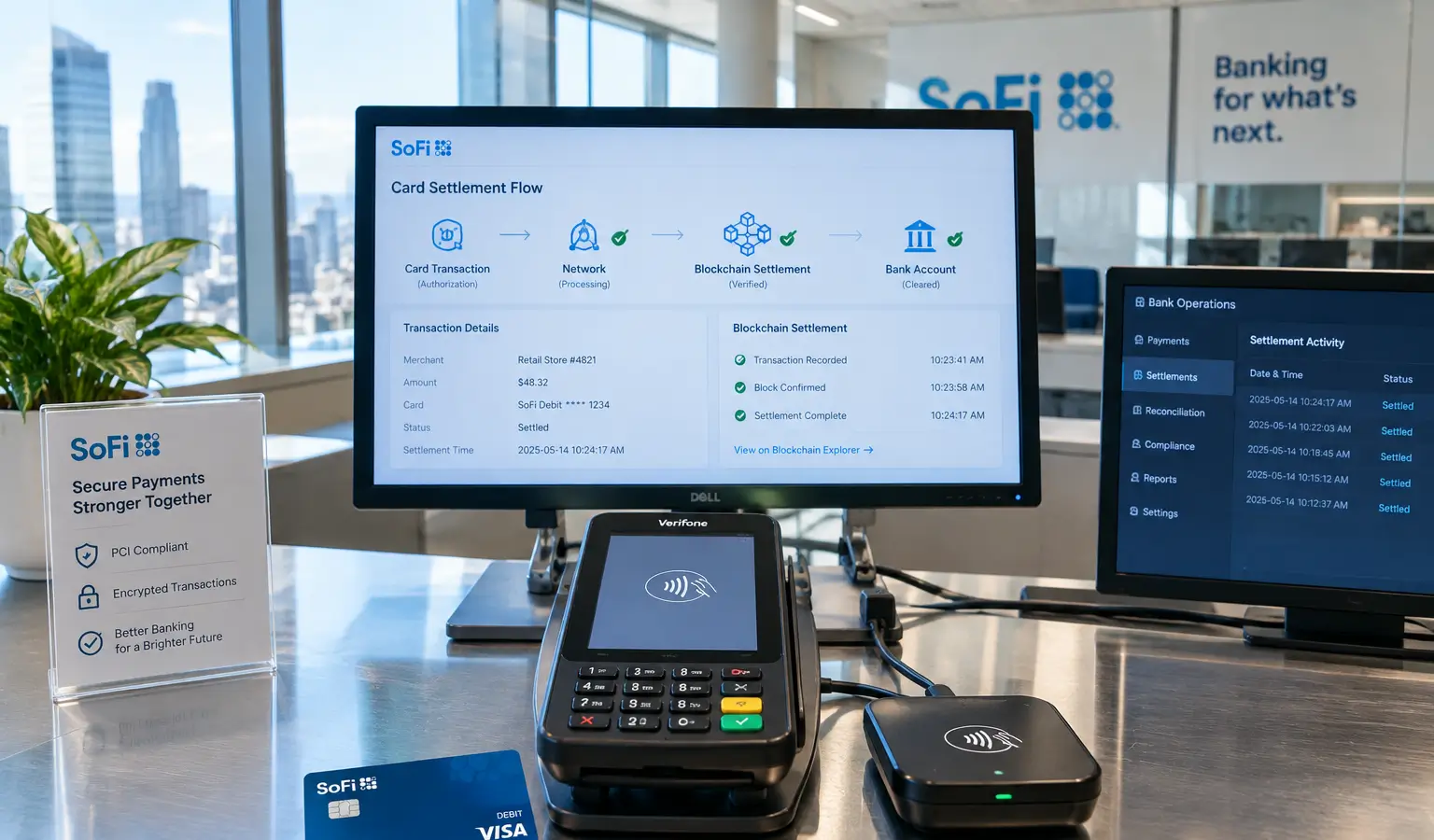
SoFi Technologies is settling its entire $25 billion (€21.9 billion) card program through SoFiUSD. For customers, nothing changes at checkout, but behind the scenes the settlement runs through a public blockchain and Mastercard's network. That puts the American bank one step closer to bringing stablecoins into everyday card payments.
Settlement Through SoFiUSD
A customer simply taps or swipes a SoFi card at a Mastercard merchant. The authorization is then converted into SoFiUSD and processed through the blockchain, while the merchant receives settlement directly into a SoFi Bank account. According to SoFi, that revenue can be converted to cash at any time without fees.
Merchants do not need to hold stablecoins or build new systems for this. That matters because extra training, changes to point-of-sale systems, updates to accounting software, and concerns about price volatility have often been barriers to crypto use in retail so far.
SoFiUSD is issued by SoFi Bank, N.A., a nationally chartered bank regulated by the OCC. The stablecoin is redeemable 1:1 for U.S. dollars and is mainly backed by cash, according to the source. That makes it easier for regulators and finance teams to evaluate this kind of setup.
Mastercard Is Embracing Stablecoins
The move fits into a broader shift at Mastercard. In June 2026, the company already expanded its settlement options for stablecoins, including Circle's USDC and SoFiUSD. Earlier this year, Mastercard also announced the acquisition of BVNK, a London-based stablecoin infrastructure company, for up to $1.8 billion (€1.6 billion).
Other banks are testing similar routes too. One bank, for example, ran a live pilot with its own dollar-backed stablecoin on the Stellar blockchain, showing that blockchain settlement is increasingly being built into existing banking services. For SoFi, this is therefore not just an internal experiment, but part of a broader shift in payment infrastructure.
What This Means for the Market
The rollout is big enough to take seriously, because it involves a $25 billion (€21.9 billion) card book and not a small test. SoFi CEO Anthony Noto said on July 29 that the company had already started settling its trading arm in SoFiUSD and that the debit and credit card program with Mastercard would follow after that.
For European crypto followers, the main takeaway is that stablecoins are no longer being used only as trading tools. They are also moving into the back end of payments, where banks and payment networks are trying to make blockchain invisible to the user. Whether that gets widely adopted beyond SoFi still remains to be seen; SoFi says it is talking with major U.S. merchants, but no contracts have been announced yet.