Vitalik Buterin Tests Local AI on Laptop With AMD Chip
Buterin sees local AI as a practical option for sensitive tasks around wallets and code, helped by AMD’s Strix Halo with lots of shared memory.
Key Takeaways
- Vitalik Buterin tested Alibaba’s Qwen3.8-Flash-Next on his laptop with AMD Strix Halo and found local AI already useful for everyday tasks.
- The Strix Halo chip makes more memory available to AI models, letting heavier models run on a single laptop without a cloud server.
- Buterin highlights the privacy benefits of local AI, especially for sensitive information like wallet addresses, private code, and names.
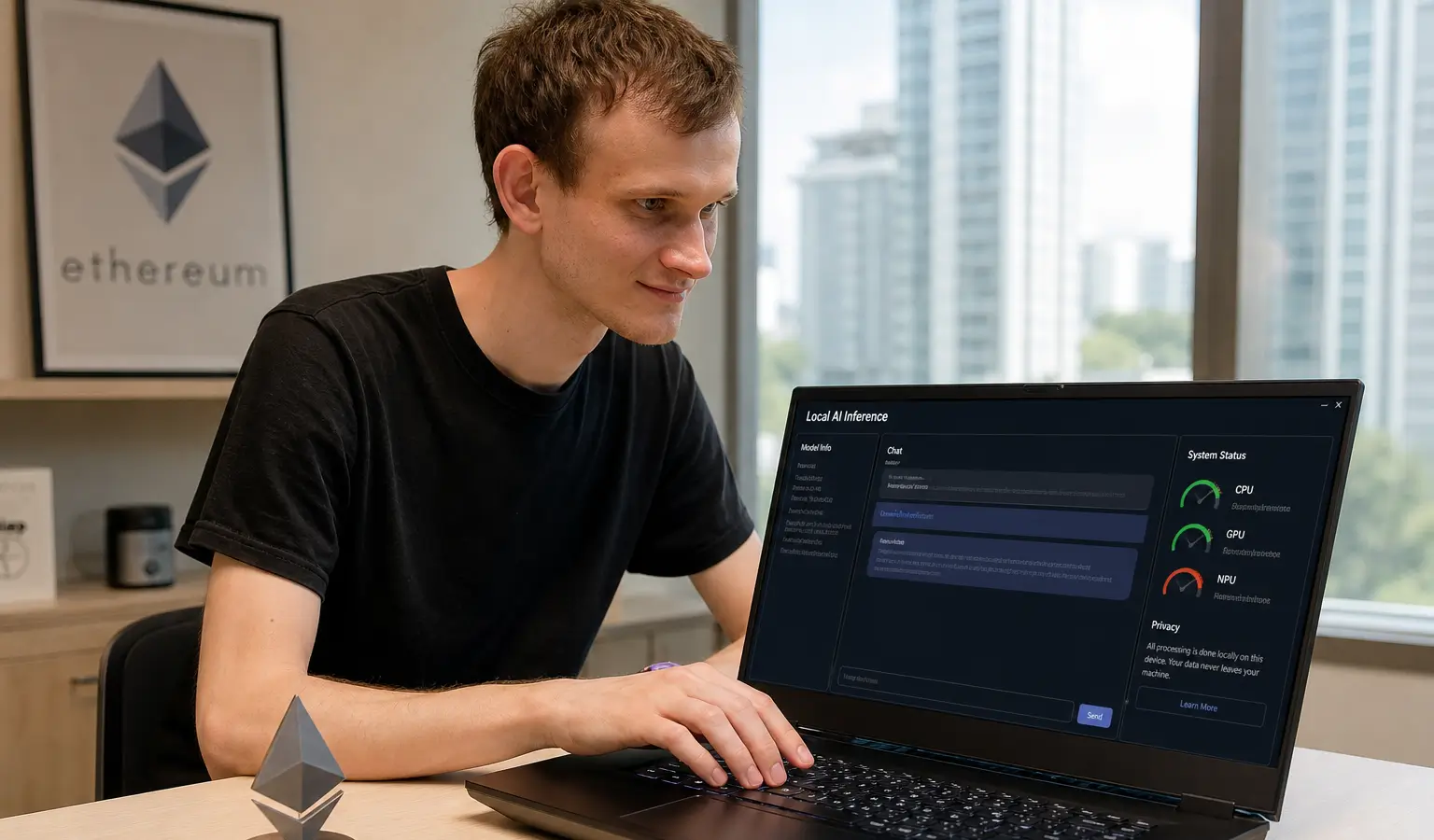
Ethereum cofounder Vitalik Buterin says local AI can now handle a big share of everyday tasks. He ran Alibaba’s Qwen3.8-Flash-Next on his own laptop and shared speed results that, in his view, show these kinds of models are becoming more useful without a cloud server.
Local AI Becomes More Practical
Buterin’s test ran on a laptop with AMD’s Strix Halo chip. The chip combines the processor and graphics computing power on one piece of silicon and lets both parts use one shared memory pool. That matters because an AI model has to fit in memory before it can run at all.
According to the test description, that is exactly where many regular laptops still fall short. A separate graphics card often has 8 to 24 gigabytes of memory, while Strix Halo machines can offer up to 128 gigabytes that both parts of the chip can use. That means a model that once needed server hardware can now run on a single laptop.
The growing demand for computing power shows why systems like this are becoming more interesting: companies are still looking for ways to fund and expand AI infrastructure at scale. Buterin’s test, by contrast, shows that some of that computing load may be able to move closer to the user.
The speed seemed good enough for normal work, according to Buterin. Short prompts came back quickly, while very long documents were noticeably slower. That makes it clear that local AI has come a long way, but still does not work equally smoothly everywhere.
Privacy Plays a Bigger Role
Buterin sees a privacy advantage alongside speed. A local model processes the request on the device itself, so a provider does not need to receive the prompt. For users sharing sensitive information, that can make a big difference.
He also outlines a hybrid approach. A local model can first pull sensitive details out of a request, such as names, wallet addresses, or private code, and then pass only the remaining question to a larger hosted model. That would limit how much data leaves the device, although it does not offer an absolute guarantee that nothing sensitive gets out.
That focus on privacy fits a broader trend in AI. Local models are gaining ground because they process data entirely on the user’s own device, without sending it to external servers. At the same time, companies like Nvidia and Palantir show that privacy and data management are becoming more important in the use of advanced AI models.
Why This Matters for Crypto
For crypto users, this matters because many everyday tasks around wallets, code, and personal data are sensitive. A local AI setup can be appealing in those cases because less information has to leave the device. Buterin also connects this to his earlier concerns about surveillance and data collection, a theme that has long been part of the crypto world.
The bigger question is not just how smart AI gets, but where that computing power runs. If more standard tasks can be handled locally, some of the control shifts from cloud platforms to the user themselves.