XRP Ledger Votes on Privacy for $530 Million in Assets
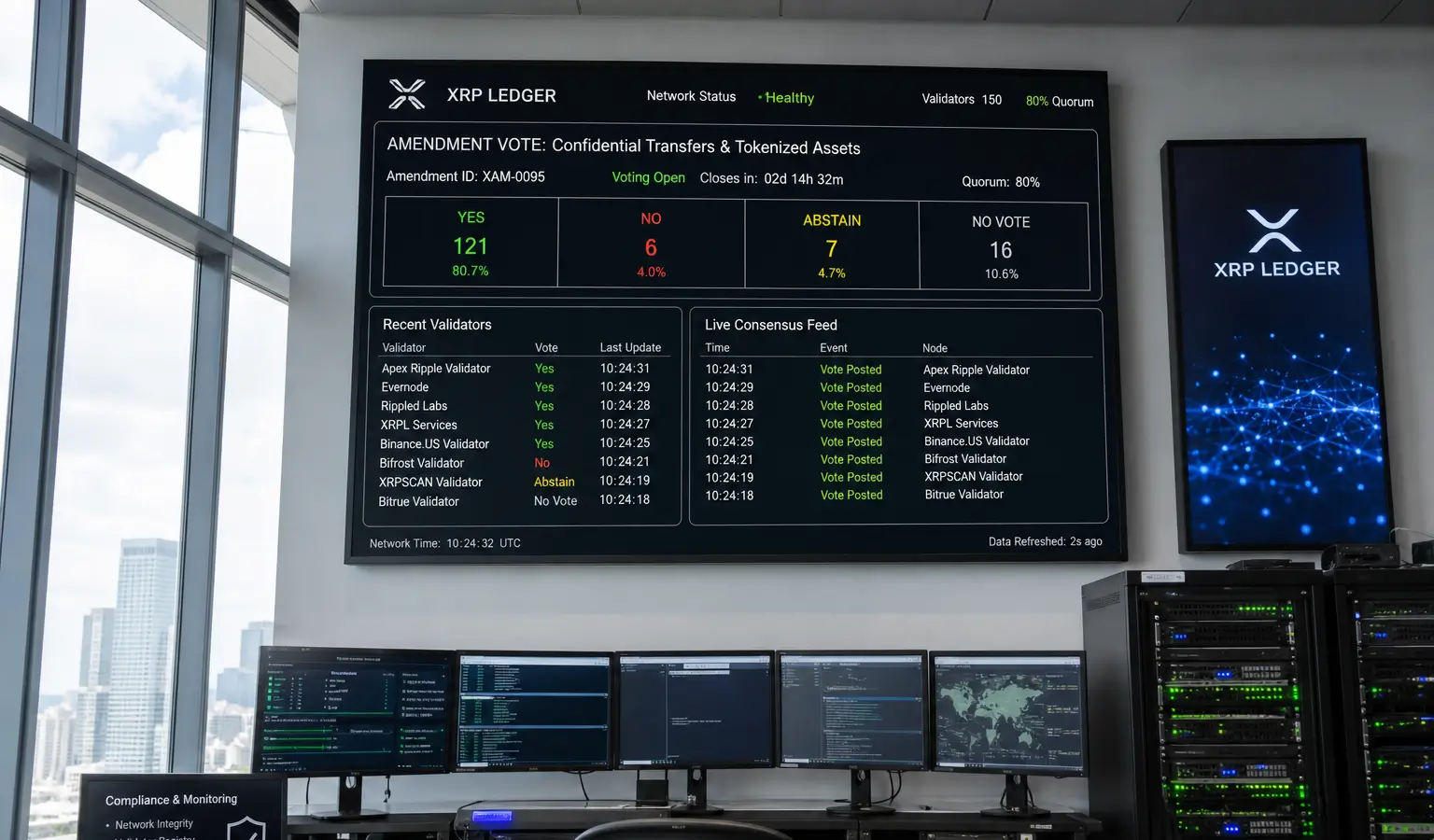
Confidential Transfers is designed to encrypt balances and transfers for MPTs, while XRPL already hosts more than $530 million in tokenized assets. If approved, the change could make the ledger more attractive to banks and asset managers.
Key Takeaways
- Confidential Transfers is now up for a vote on the XRP Ledger, with the goal of giving institutional users more privacy when moving tokens.
- The upgrade encrypts balances and payment amounts, while accounts and token type stay visible and transactions remain verifiable.
- XRPL version 3.3.0 also brings five other upgrades and needs 80% validator support for two straight weeks before any amendment can go live.
On the XRP Ledger, a privacy-focused update is now being voted on for institutional users on a network that already holds more than $530 million (€459 million) in tokenized real-world assets. The idea is to give institutions more room to operate discreetly when moving tokens, while still keeping the ledger transparent enough to track activity.
Confidential Transfers Up for a Vote
XRPL version 3.3.0 includes six proposed amendments, but Confidential Transfers is the one drawing the most attention. The feature is built for Multi-Purpose Tokens, the format that Ripple is promoting for funds, bonds, and other financial assets. It encrypts balances and payment amounts, while accounts and the token type remain visible.
In other words, an institution could move tokens without exposing the size of each position or transfer to the public. At the same time, the network would still be able to confirm that each transaction is valid through cryptographic proofs that verify the math without revealing the underlying figures. That approach fits a broader shift in crypto, where public blockchains are increasingly expected to balance privacy with compliance if they want to stay useful for larger players.
More Than Just Privacy
The release also adds five other proposals that are mostly aimed at making the network run more smoothly. Batch can group up to eight transactions, Sponsor allows one account to cover another account’s fees and reserve requirements, and Permission Delegation gives a third party limited transaction rights without handing over full control. Dynamic MPT also makes it possible to change certain token features after issuance.
According to XRP Ledger Operations, version 3.3.0 also reduces memory usage by at least 10% to 15% and helps nodes sync with the network faster. That is especially relevant for a ledger that is seeing more use in tokenized finance, particularly as players like Aviva Investors, Ondo, VERT Capital, Archax, and Societe Generale have already issued assets on XRPL. That broader institutional push is also reinforced by the partnership with Aviva Investors around tokenized fund structures on XRPL.
Why This Matters for Europe
For European crypto readers, the update stands out because privacy and oversight often need to work together in regulated tokenized finance. If Confidential Transfers is eventually activated, it could make XRPL more appealing to banks, asset managers, and other institutions that want to use a public blockchain without putting every balance or transfer on display.
The feature is not live yet. XRPL amendments need at least 80% support from trusted validators, and that support must hold for two straight weeks before they take effect. For now, it remains to be seen whether institutional users will actually adopt the new privacy layer once it becomes available.