Zcash Holders Back Faster Blocks and Halving
Nearly 2.4 million ZEC voted for shorter block times and keeping the halving schedule. The NU7 governance vote ran through the private Ironwood pool and zk-SNARKs.
Key Takeaways
- Zcash holders voted almost unanimously for faster blocks and keeping the halving schedule in the NU7 governance vote.
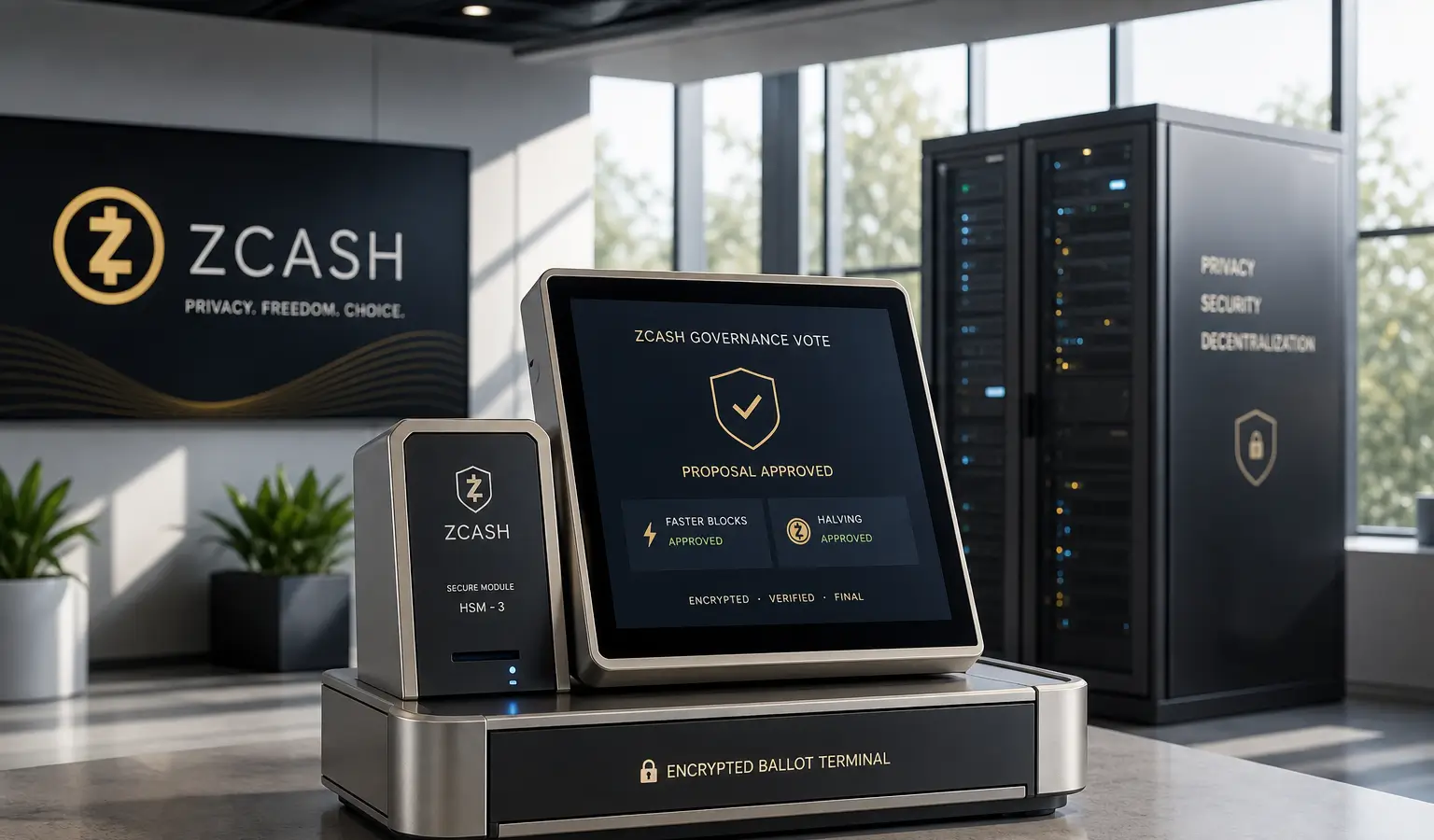
- Nearly 2.4 million ZEC took part; 99.9% supported 25-second block times and 98.9% wanted to keep the current halving schedule.
- The vote used privacy tech, since only ZEC in Ironwood was allowed to vote and the votes were counted in encrypted form.
Zcash holders voted almost unanimously in a governance vote to approve faster transactions and keep the bitcoin-style halving schedule. Nearly 2.4 million ZEC took part in the vote on NU7, Zcash’s next major network upgrade, equal to about two-thirds of the 3.6 million ZEC that was allowed to vote at the time of the snapshot.
Voting With a Hidden Balance
The result stands out because the voting process itself leans heavily on privacy. Only ZEC in Ironwood, Zcash’s newest private transaction pool, was allowed to participate. That meant holders could have their economic weight counted without making their balance or identity public.
That fits with how Zcash has worked for a while. The network’s privacy is powered by zk-SNARKs, a technique that lets the blockchain verify that a transaction is valid without revealing the sender, receiver, or amount. In this vote, the ballots were encrypted and split into 16 pieces before being counted.
Faster Blocks and Halving
Of the ZEC that took part, 99.9% supported the proposal to cut the time between blocks from 75 seconds to 25 seconds. In practice, shorter block times mean payments can be confirmed faster. Also, 98.9% voted to keep Zcash’s current halving schedule, where miners receive less newly issued ZEC at fixed intervals.
Organizers set a minimum turnout of 1 million ZEC to call the result representative. The vote also showed that most holders want NU7 rolled out as soon as possible: 99.3% chose to drop parts that were not ready by September 30, instead of waiting until everything was finished.
What This Means for Zcash
For European crypto followers, the big takeaway is that Zcash is not just talking about privacy here, it is using it in its own decision-making too. That makes the network’s governance different from many other tokens, where votes are often publicly visible. At the same time, the chosen upgrade still has to be built, tested, and eventually added to the software before the network actually changes.
The vote does give developers a clearer mandate after months of debate over the scope of NU7. Earlier this year, a sentiment poll still showed much lower participation, with clear tension between coin holders and the Community Advisory Panel. The new setup, introduced this summer, was meant to offer more privacy for shielded balances and give a broader picture of the community. Earlier steps to make private transactions faster, such as faster private transactions, also show that scalability and privacy are increasingly being tackled together at Zcash.