Bitcoin Falls Below $63,000 Amid Global Sell-Off in Risk Assets
The pressure on Bitcoin comes after a broad sell-off in risk assets. That puts the key support level around $63,000 back in focus.
Key Takeaways
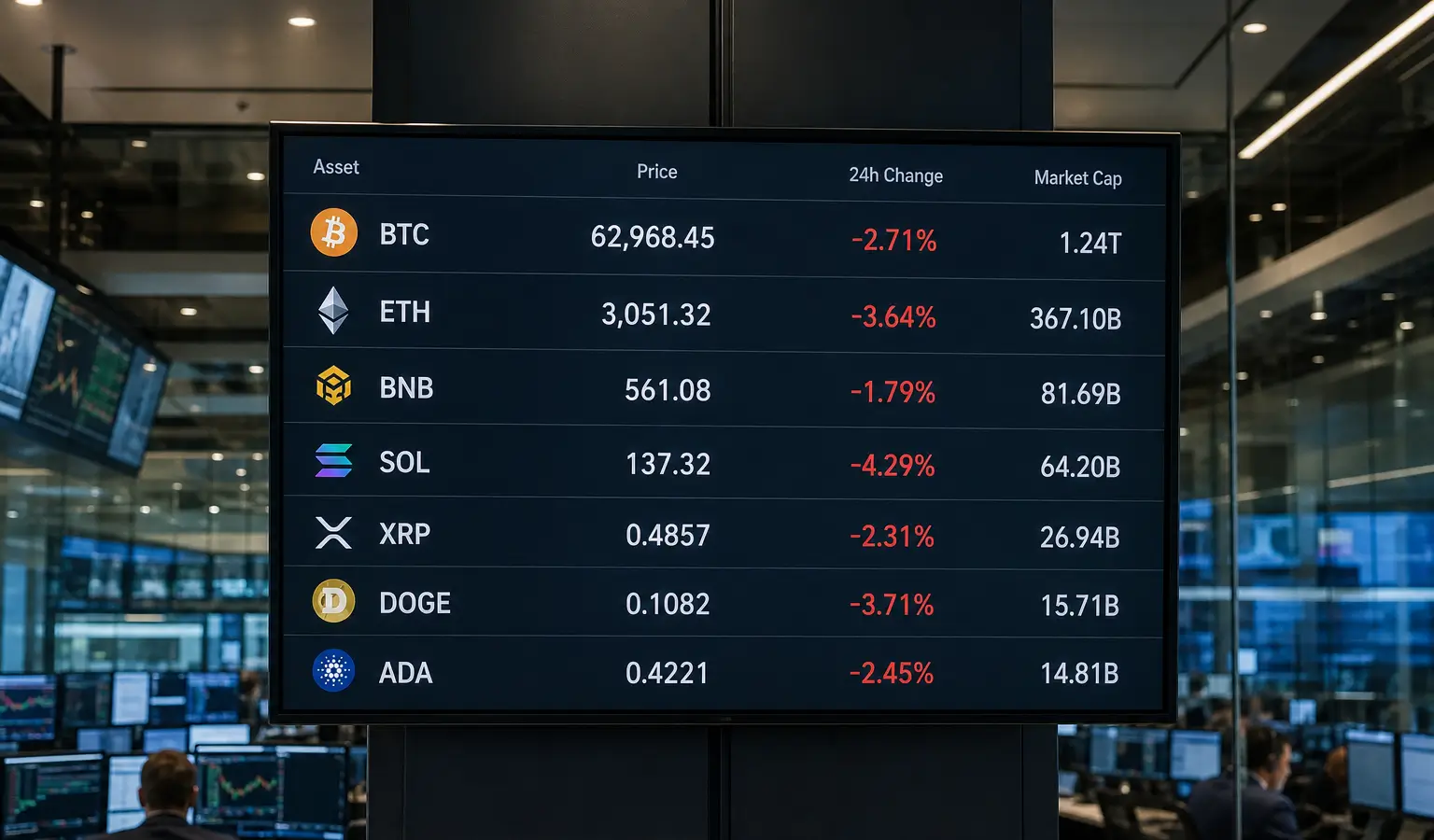
- Bitcoin fell below $63,000 on Friday and traded around $62,700 after global selling pressure hit risk assets.
- Ethereum, XRP, Solana, and BNB also lost ground, while technical analysts see $63,000 as a crucial level.
- Market watchers point to stronger institutional demand through spot Bitcoin ETFs and less speculative interest in altcoins.
Bitcoin slipped below $63,000 (€55,000) on Friday after risk assets came under pressure worldwide, wiping out most of the gains made earlier in the week after the U.S.-Iran peace deal. The biggest crypto coin was trading around $62,700 (€54,700), down 1.9% in 24 hours and 1.3% over the week, putting it near the lower end of the range it had held for almost two weeks.
Broad Selling Pressure Across the Crypto Market
The sell-off was widespread: Ethereum fell 2.3% to $1,695 (€1,480), XRP dropped 3.2% to $1.13 (€1), Solana and BNB each fell more than 2.7%, while Tron held steady. Hyperliquid's HYPE was the exception, falling 3.7% and failing to hold onto its 13.2% weekly gain. For technical analysts, the area around $63,000 (€55,000) is crucial; a break below the $59,000 (€51,500) to $60,000 (€52,400) range reached earlier this month could point to a deeper correction phase, with a possible target around $45,000 (€39,300).
Impact of Global Market Conditions and Oil Prices
The pressure on Bitcoin and other risk assets comes alongside a broader pullback in global stock markets, which were less liquid because of holiday periods and closed markets in the U.S., China, Hong Kong, and Taiwan. Asian stocks fell 0.6% after a five-day record rally. At the same time, Brent crude dropped about 9% this week, partly because shipping traffic through the Strait of Hormuz returned to normal after the signed U.S.-Iran agreement, ending a historic supply shock.
Attention is now shifting to talks over Iran's nuclear program, with a 60-day deadline now in place to work out the details of the deal.
Changing Market Behavior and the Future of Altcoins
Market watchers say this cycle is playing out differently from past bull runs. The approval of spot Bitcoin ETFs in early 2024 has led to more institutional demand, changing how Bitcoin and the broader crypto market behave. According to Michael Egorov, founder of Curve Finance, the speculative interest that used to flow into altcoins has shifted toward lower-value memecoins since those ETFs launched.
He warns developers not to count on an altseason in the next few years and says they should focus on tokenomics that tie a token's value to real project revenue instead of hype. That lines up with recent market moves, where Bitcoin is getting the edge over smaller altcoins, whose performance and interest are lagging, as shown by the weak demand for dogecoin ETFs.
What This Means for European Crypto Investors
For European investors, this trend could point to a more institutional crypto market, where Bitcoin is increasingly seen as a core and relatively stable asset. The impact of global geopolitical events like the U.S.-Iran deal, along with the connection to traditional markets and commodity prices, shows why it helps to keep a broad view when judging crypto investments in this changing market cycle. That could matter when weighing risks and opportunities in a European context.